News

US Secretary of State Marco Rubio asks China to prevent Iran from closing Strait of Hormuz
The Strait of Hormuz is only 33km wide at its narrowest point, making it vulnerable to disruption.
June 23, 2025, 06:50 PM
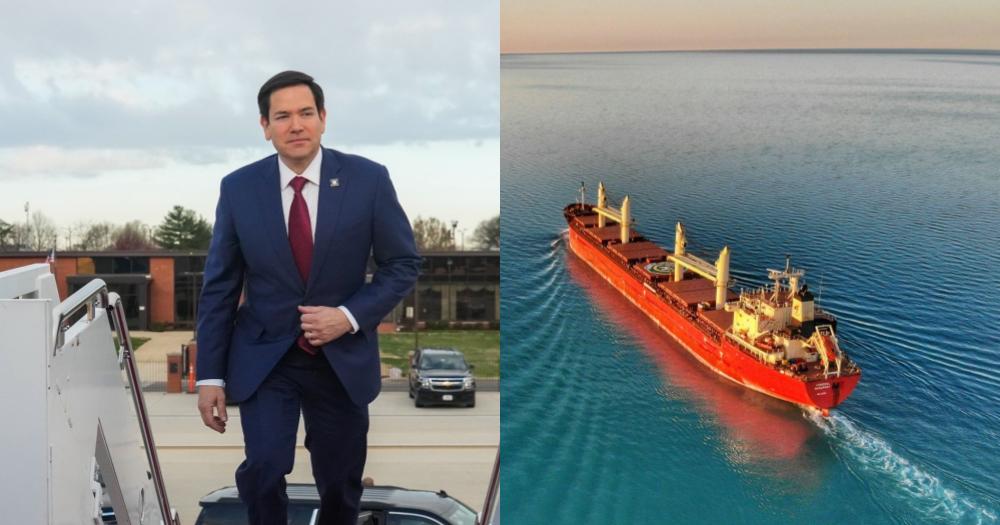

 United States Secretary of State Marco Rubio said in an interview that he wants China to dissuade Iran from closing the Strait of Hormuz, stating that such a closure would harm the economies of other countries more than it would the U.S.
Iran’s parliament has reportedly given its endorsement to close the Strait of Hormuz, putting the vital shipping lane at the heart of potential retaliatory measures after the United States attacked its nuclear facilities on Jun. 21.
Strait talk
Politico reports that Iran’s legislature had “reached a consensus to close the Strait”.
However, the decision on whether or not to close the vital shipping lane lies with Iran’s Supreme National Security Council and ultimately with its supreme leader, Ayatollah Ali Khamenei.
Rubio was being interviewed by Fox News on Jun. 22, in the wake of news of the potential closure breaking.
Reuters quotes him as saying, “I encourage the Chinese government in Beijing to call them about that because they heavily depend on the Strait of Hormuz for their oil”.
Rubio said it would be “a terrible mistake” if Iran were to close the Strait.
Calling it “economic suicide”, Rubio said that the U.S. retained “options to deal with that (the closure of the strait), but other countries should be looking at that as well”.
“It would hurt other countries’ economies a lot worse than ours.”
Economic impact
The Strait of Hormuz is a particularly sensitive waterway linking the Persian Gulf with the Gulf of Oman and the Indian Ocean beyond it.
It is bordered by Iran on its north and the United Arab Emirates and Oman to the South, and Bloomberg estimates that about a quarter of the world’s seaborne oil passes through it.
The Persian Gulf is home to many of the world’s largest oil producers, including Saudi Arabia, Iran, Kuwait, and the UAE, as well as Qatar and Bahrain.
Much of the oil they produce is carried by tanker through the Persian Gulf, then the Strait of Hormuz, out to the world.
The Strait’s geographic characteristics make it a particularly treacherous geopolitical hotspot.
The Strait narrows to just over 33 kilometres at its narrowest point, requiring tankers navigating the Strait to confine themselves to two lanes, one entering and one leaving the Strait, separated by a third lane, each about 3.2 km wide.
This leaves traffic potentially vulnerable to land-based weaponry, and the Strait’s narrow depth also leaves it vulnerable to sea mines.
Although the Strait has never been closed to maritime traffic before, Iran has threatened to do so on several occasions, and traffic passing through it has been at risk of attack.
Perhaps the most serious disruption to shipping in the Strait occurred between 1981 and 1988, during the “Tanker War”, itself part of the broader Iraq-Iran war, which saw 451 oil tankers attacked.
Global fuel prices
Rubio’s comments refer to the fact that the United States does not depend on the Gulf States for its oil supply, relying instead on domestic and North American sources.
But hovering the background is the fact that domestic oil prices in U.S. are determined by global prices.
Not to mention that several crucial U.S. allies, such as Saudi Arabia and the UAE, would be heavily affected by a closure of the Strait.
The U.S. and Europe heavily sanction Iran’s oil economy, partly due to opposition to its nuclear program, which they say is to develop a nuclear weapon, but Iran officially claims is for peaceful purposes.
Diversification
China does not comply with these sanctions and is the largest purchaser of Iran's oil.
As a result, it is believed that closing the Strait will antagonise China, but this implies that Iran will not make an exception for China-bound vessels.
It should be noted that when Iranian-backed Houthi rebels in Yemen recently disrupted shipping passing through the Gulf of Aden towards the Suez Canal, they granted safe passage to China's vessels.
However, an opinion piece published by ThinkChina states that China’s vulnerability to a closure of the Strait is “overstated,” as the country has diversified its energy sources.
That is to say that while much of the Middle East’s oil is sold to China, China has increasingly turned to other sources for its energy and fossil fuels needs.
These alternate sources include Russia and Central Asia via overland pipelines, but also include shipping fossil fuels from countries such as Brazil and Australia.
China has so far urged an end to the conflicts in the Middle East but has limited its involvement.
Iran, meanwhile, has threatened retribution for U.S. attacks on its nuclear sites but has yet to specify what form that retaliation will take.
Related stories
Top image via U.S. Department of State/Facebook & Chris Pagan/Unsplash