Features

Why are there Chinese clan associations in S’pore?
Chinese clan associations gave early migrants a sense of belonging and promoted education, but have evolved over the years to be bastions of Chinese culture in Singapore.
June 10, 2025, 07:00 PM


The year is 1880 and you have just arrived in Singapore after leaving China three weeks ago on a junk.
The voyage made you sea sick.
You arrive on shore broke and disoriented, and you do not know anyone.
What should you do?
Looking for a community
Like many before you, you turn to an existing community that provides familiarity and some semblance of support.
People who might be obligated to take you in as a newbie.
Fulfilling that role were clan associations, which provided support for livelihood matters, helped people resolve disputes, built hospitals and schools, and even set up communal burial grounds.
They were established soon after Stamford Raffles founded Singapore.
Their importance grew over time.
The colonial British government tolerated the existence of clan associations as they provided representation for the various communities.
From 1890 onwards, the British required all clan associations to register as legal organisations under the Societies Ordinance, establishing them as non-profit entities prohibited from engaging in illegal or political activities.
What are clan associations anyway?
Bloodline-based associations
Clan associations in Singapore came about broadly in two ways.
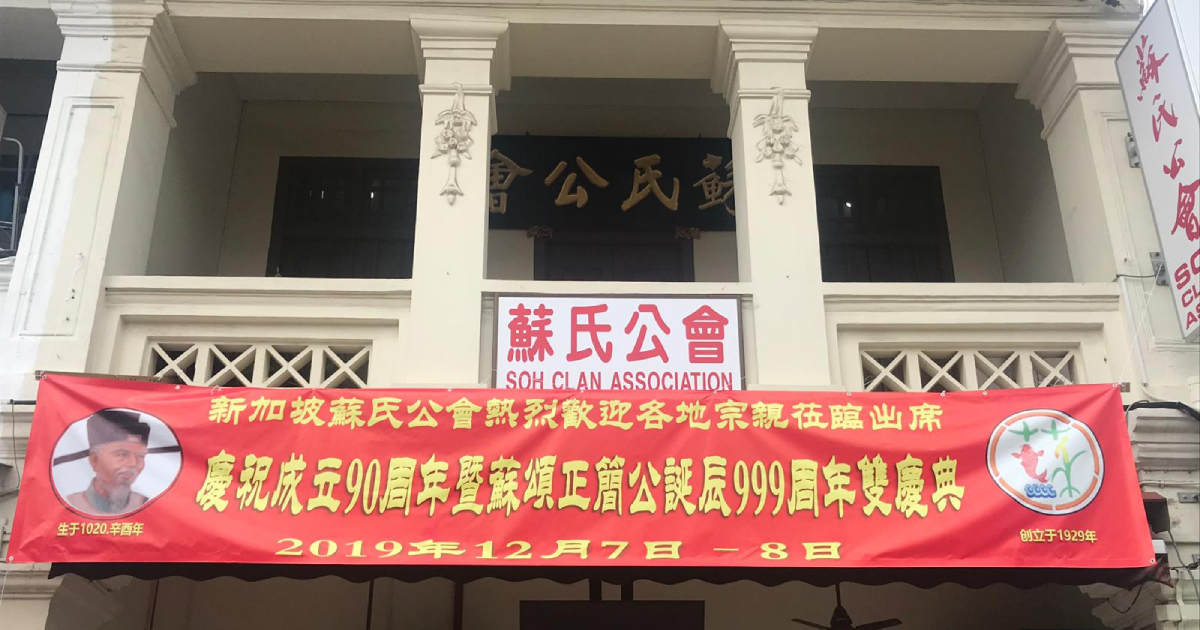
Bloodline-based clan associations were joined by Chinese migrants who shared the same surname or closely related surnames.
These organisations tend to be smaller in scale with limited membership, focusing primarily on fostering connections among members of the same extended family lineage.
Cho Kah Koon, established in 1819, officially known as Sing Chow Chiu Kwok Thong Cho Kah Koon, holds the distinction of being the earliest example of such a clan association in Singapore.
Its founder, Chow Ah Chey (1782–1830), was from Taishan and had arrived on the island with the Raffles expedition.
Locality-based associations
Locality-based clan associations were set up and joined by migrants who hailed from the same or nearby geographical regions, such as provinces or villages in China.
Chow Ah Chey and his peers from Taishan subsequently went on to establish Ning Yeung Wui Kuan in 1822, the first locality-based clan association seen in Singapore, as well as outside of China.
That same year, the Hakka community founded Ying Fo Fui Kun and Wui Chiu Fui Kun.
In Singapore, people from neighbouring regions in the Guangdong prefecture often started clan associations together.
Sizes of clan associations
The scale of these associations varied.
Smaller associations often indicate their village-specific origins via their names, such as the Koh Leng Association, Song Heng Association, and Geok Shee Association.
Large locality-based organisations include the prominent Hokkien Huay Kuan, Ngee Ann Kongsi, Teochew Poit Ip Huay Kuan, Kiung Chow Hwee Kuan (now known as Hainan Hwee Kuan), and Kwangtung Hui Kuan.
Clan associations grew over time
The proliferation of clan associations in Singapore grew over time in the early years.
Between the early 19th century and Singapore's independence in 1965, more than 200 bloodline-based clan associations were established.
During the same period, 133 locality-based clan associations were formed.
Contributions of various clan associations
The Chinese migrants who first came to Singapore were from different parts of southern China.
They were divided into five major dialect groups known generally as bang.
The Min bang (Hokkiens) comprised immigrants from Fujian.
The Guang bang (Cantonese) were immigrants from Guangdong.
The Ke bang (Hakkas) were made up of Hakka immigrants.
The Chao bang (Teochews) immigrants came from Chaozhou.
Lastly, the Qiong bang (Hainanese) consisted of immigrants from Hainan.
These migrants who arrived in Singapore with very little then went on to contribute to society.
The Hokkien, Cantonese, Hakka, Teochew, Hainanese, Henghua, and Foochow all went on to establish clan associations, many of which are still around today, which includes the Singapore Hokkien Huay Kuan set up in 1840.
These associations primarily focus on the welfare and mutual support of people who originated from the same area.
Many of these associations also built schools to promote education and are actively working on preserving their culture and dialect in recent years.
Contributions to education
The forward-looking contributions of clan associations benefitted society and its people.
The various dialect groups, for example, demonstrated exceptional commitment to education through their clan associations.
Cantonese clan associations, such as Ning Yeung Wui Kuan, Tung On Wui Kun, Kong Chow Wui Koon, offered free education through establishing education arms in the early 20th century.
Ban See Soon Kongsi, the earliest locality-based organisation of Singapore's Teochew community, which can be traced back to 1826, was set up to worship the sea goddess Mazu and support education.
This organisation's dual purpose of religious worship and educational support showed clan associations seamlessly integrated practical community needs with cultural preservation.
The Hakka community, despite being smaller than other dialect groups, was one of the first dialect groups to set up modern schools.Ying Fo Fui Kun founded Yin Sin School in 1905, while Char Yong Association followed with Khee Fatt School in 1906.
The Hainan Hwee Kuan established Yock Eng School in 1910.
They were modern educational institutions at the time, which was a shift away from private tutoring.
Adapting to contemporary era
In the last few decades though, clan association membership has dwindled following the modernisation of Singapore.
In response, the Singapore Federation of Chinese Clan Associations (SFCCA), the apex authority for all Chinese clan associations, was established on Jan. 27, 1986, to reinvent clan associations.
As of 2025, the SFCCA boasted 250 member organisations, of which 20 are associate members.
These associate members are Chinese community organisations, which include cultural and arts organisations, alumni associations, and other Chinese community groups.
Their focus was on reinventing themselves, while preserving and promoting Chinese culture and language, such as through the holding of dialect classes, and supporting educational initiatives. .
The annual River Hongbao event, which has mainstream appeal, is overseen by the SFCCA.
There are also classes pertaining to Chinese culture, such as for qigong, which is a Chinese practice involving coordinated body posture and movement, breathing, and meditation, as well as modern poetry writing.
As clan associations grow older, its members have aged and membership has shrunk.
Lianhe Zaobao reported on Jul. 20, 2020 that clan associations were predominantly seniors in their 60s and 70s, though some associations had successfully attracted younger members.
Seven organisations had fewer than 50 members, highlighting the need to maintain relevance and in attracting younger members to join.
Another way to groom a younger leadership for renewal and succession purposes is to intensify cultural and educational activities by organising large-scale activities, The Straits Times reported on Feb. 10, 2025.
Existing clan associations under the leadership of the SFCCA now also oversee social welfare, such as scholarships or funds for the needy, ancestral worship services, setting up Chinese cultural centres, where classes and seminars are held to promote Chinese culture, as well as attracting younger generations through youth activity groups.
They are now multifaceted organisations that serve various community functions, marking a shift away from their origins owing to economic development in Singapore and demographic, as well as societal and cultural changes.
This change in priorities shows how far clan associations have come.
While it was about survival in the past, it is now catered to the changing demographic needs of society.
Keen to learn more interesting nuggets about Singapore Chinese history and culture? Check out Culturepaedia, a bilingual repository featuring articles by scholars and experts from academia and the wider community.
It will offer you an introduction to Singapore Chinese culture, and show you how it has evolved over the years.
Top photo via Soh Clan Association