When is Singapore’s next general election?
Now you know.
But you don’t need to be a fortune-teller to know what happens once the election is called, as it is all neatly laid out in our election laws and there is a nice amount of precedents to show how it pans out in practice.
Starting gun fired
The parliamentary election process starts when the President, acting on the advice of the Prime Minister, dissolves the Parliament and issues a Writ of Election.
The Writ specifies the date when candidates can submit their nomination papers in the various Nomination Centres.
A nominating place
The 2020 general election is a useful example, with then PM Lee Hsien Loong sharing the image of the Writ signed by then President Halimah Yacob.
The Writ was accompanied by a media release from ELD naming the Returning Officer, a senior public official, who will oversee the impartial and smooth conduct of the election.
(The name you’re thinking of is 2011’s RO, Yam Ah Mee, whom netizens have honoured with his own Know Your Meme page)
This media release also specified other details, such as when is Polling Day, Nomination Day, and other steps aspiring candidates need to take to run in the election.
It also appointed nine locations as Nomination Centres, each catering to a few electoral divisions.
An example is the school hall building of the Methodist Girls’ School being named the nomination centre for the Bukit Panjang and Holland-Bukit Timah electoral divisions.
Nomination Day - must have six friends to run
Nomination Day is… almost what the name implies.
Candidates, or in the case of Group Representation Constituencies, groups of candidates, put themselves forward for the electoral contest.
They’re required to show up, with a proposer, seconder, and at least four assentors.
Prospective candidates are required to submit their nomination papers and other certificates in person, and in duplicate, between 11am and 12 noon.
These documents will later be put on display, for other candidates and their “friends” (the technical term is subscribers) to inspect and raise any objection they may have with the nomination to election officials.
This qualifications
I recall, but could not find footage of, a senior politician inspecting such documents and finding what appeared to be an oddity.
With a wily smile, he notified an election official, but it appeared to be more a matter of clarification, rather than any actual attempt to disqualify an opponent.
Although it should be noted that if an uncorrectable discrepancy is found with the documents, a candidate could be disqualified, potentially leading to a walkover.
Candidates have to meet some requirements such as being a Singapore citizen, being at least 21 years-old, as well as being a current elector, resident in Singapore, and not disqualified (such as by being an undischarged bankrupt).
I also learnt in the process of writing this that a candidate must have enough proficiency in one of Singapore’s official languages (spoken, written, and reading) to actively participate in Parliament.
While this makes sense, I always assumed it was simply understood, and not a formal requirement.
This process ends with the candidates being announced publicly at the end of the Nomination proceedings, usually to supporters who will turn up at the Nomination Centre, and candidates giving brief speeches to thank their supporters, which kickstarts the election campaigning proper.
If there is only one candidate or group of candidates for an electoral division, the Group Assistant Returning Officer (GARO) in charge of the Nomination Centre concerned will declare a walkover. If not, the election will adjourn until Polling Day.
That’s when voters will cast their votes to decide on their Members of Parliament!
Campaign for my real friends
If the issuing of the Writ is the starting gun for the election, Nomination Day is the starting gun for its campaigning phase.
Polling Day must take place between 10 and 56 days after Nomination Day.
If one takes away Cooling-Off Day (more on that later), that leaves between 9 and 55 days of campaigning, although in recent elections, nine days is more typical.
Campaigning is a strictly regulated affair, with rules on how and where it can be conducted, and even how much can be spent per elector in each electoral division.
(It’s currently S$5 a voter, so if you only get one flyer, that’s probably why)
Candidates’ declared election expenditure will be made available to the public after the election for members of the public to inspect.
Candidates can campaign in a number of ways, the most highly visible being rallies.
Throughout Singapore’s electoral history, there were a few “legendary” rallies, whether it be the lunchtime rallies in the Central Business District, or at sports stadiums throughout Singapore’s heartlands, seared into our memories as hallmarks of the campaign period.
Perambulation
Candidates may also conduct walkabouts and house to house visits.
Another hallmark of Singaporean political campaigns is the “perambulating vehicle”, usually a lorry with banners and flags attached, and sometimes a candidate speaking over a loudspeaker.
For those of us used to following news of overseas elections, it should be noted that the publication of election surveys and exit polls before and while polling is taking place is illegal in Singapore.
Cooling-Off day
The day before Polling Day marks the end of the campaigning period.
Cooling-Off day, as it is known in Singapore, is our own version of an “electoral silence” law.
Countries around the world have versions of this, France also bans campaigning the day before polling day, in Indonesia it’s three days.
It mandates that from midnight of the day before Polling Day, no more campaigning may take place, so that means no more rallies, house visits, flyer distribution, or online posts.
This does not mean that physical banners that were installed before Cooling-Off day have to be taken down, it just means that no new ones can be put up.
It also allows for news reports relating to election matters by authorised news agencies.
Cooling-Off day does not mean that you can’t discuss the election with friends in private settings, but is meant to “give voters some time to reflect rationally on issues raised during the election.”
Get in, we’re going to go vote
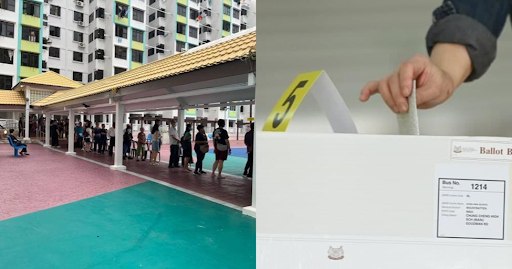
Polling Day is when you actually go cast your vote.
Grab your poll card and your IC and head to your assigned polling station between 8am and 8pm.
(Hint: If you want to spend less time in the queue, plan to come in the late afternoon, it’s the ‘off-peak’ period for voting.)
While you’re there, you may notice a whole bunch of people. Some are clearly identified as election officials, who will help check your ID and direct you through the voting process.
But also present are polling agents who are appointed by the candidates or their election agents to observe the voting process.
This allows candidates, both independent and affiliated to political parties, to ensure that elections are held fairly, as well as making sure that the process is not tampered with, especially before the ballot boxes are sealed.
(Yes, the reason why the election official shouts your name out is so that the polling agent can verify you are an actual voter who is supposed to cast a vote here at the polling station. No funny business going on here.)
Ballot bus
At the end of the voting process, polling boxes are sealed to ensure the ballots are not tampered with.
This is witnessed by the candidates’ polling agents, who can also add their own seals so that they are sure the ballot boxes are not tampered with before they are opened for the votes to be counted.
They also witness the transport of the polling boxes to counting centres, which are usually transported by bus.
(Why buses? This is because buses have the capacity to carry the ballot boxes, the election staff, observers, and police guard altogether.)
Agents of C.O.U.N.T.
The ballots are (you guessed it) counted at the Counting Centres.
When at the counting centre, that’s where another element of the voting process is introduced: the counting agents.
Counting agents are appointed by candidates to observe the counting of votes, to ensure that the count takes place in accordance with the law.
Their involvement begins by making sure the ballot boxes arrive at the counting centre without having been tampered with.
They also watch the officials carry out the count and give views on ballot papers which are going to be rejected by the Assistant Returning Officer.
They then also ensure that the depository boxes containing the ballot papers are sealed, after counting is complete.
There are numerous online accounts of individuals’ experiences acting as a counting agent, and the situations they encountered. Some of these experiences are generally excellent cautionary tales about marking your ballot carefully and purposefully.
The presence of the counting agents ensures that the counting process is not just done correctly, but is seen by the public to be done correctly, and are vital parts of the electoral process.
Sample sized
The last quirk of election day is the sample count.
The sample count was first made publicly available in 2015 and involves election officials counting a bundle of 100 votes at random from each polling station.
It provides a snapshot of the likely outcome of the vote but does not alter the vote in any way, and will be overridden by the final result.
But the sample count has proven to be quite accurate.
For example, in GE2015, the largest sample count variation from the final result in a single ward was 2.6 percentage points.
It’s interesting, but not definitive.
That’s all folks
By the end of the night, and sometimes till the early morning, the votes should all have been counted.
Assuming the overseas votes have no impact on the outcome, the Returning Officer will announce the results, then congrats, you have your new Members of Parliament!
There’s still a lot of work left to do, from the securing and eventual disposal of the ballot papers, but that’s for a different explainer.
This Elections Department-supported article has made the writer want a perambulating vehicle with a flag.