News

S'pore has 'no choice' but to remain open, inclusive & maintain 'omni-directional' balance in foreign policy: Vivian Balakrishnan
"Singapore has always had to make ourselves useful and relevant to the world."
January 24, 2025, 06:42 PM
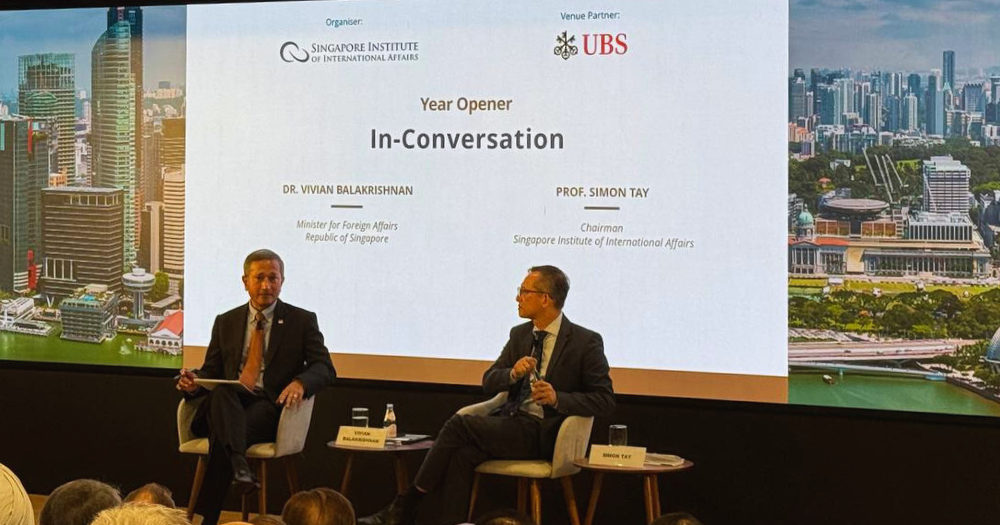


Singapore needs to remain open and inclusive while maintaining a productive and constructive engagement with all powers, said Singapore's Minister for Foreign Affairs Vivian Balakrishnan.
Vivian was speaking at the Year Opener event with the Singapore Institute of International Affairs (SIIA) on Friday, Jan. 24, 2025.
The Minister for Foreign Affairs began his speech by highlighting that 2025 is a "significant year", as this is the year Singapore is turning 60.
"I think this is an opportune time for us to ask three sets of fundamental questions," Vivian said.
How far have Singapore come in 60 years?
The first set of questions focused on Singapore. "How far [have Singapore] come in 60 years?"
In 1972, Singapore's first Foreign Minister S Rajaratnam outlined the vision for Singapore to become a global city.
"Singapore was so small, no hinterland, no natural resources, he (S Rajaratnam) made the case that Singapore had to become a world-embracing city," Vivian said.
The concept of "going and leaping beyond our immediate limitations, boundaries, and neighbourhood" was ahead of its time, but one that had "served" Singapore "very well".
Competitive advantage
"Singapore embarked on hyper-connected globalisation before it became conventional wisdom, before it became a standard formula for rising cities and countries throughout Asia," said Vivian.
With the competitive advantage of strategic location and conducive environment, Singapore was able to thrive and progress.
Singapore's GDP, according to Vivian, had multiplied from US$1 billion in 1965 to over US$500 billion last year.
Trade is Singapore's life-blood, not just an ideological point or a negotiating one.
Singapore also successfully built a "cohesive identity" forged by "a very diverse set of multiracial, multilingual, multireligious society", he said, making the point that GDP growth is not the only indicator of a country's success, but also the strength of its social fabric.
Meanwhile, Singapore's healthcare, education, housing, savings, and retirement schemes remain some of the world's best.
What does the current state of the world portend for Singapore?
For his second question, Vivian focused on the current state of the world and the impact it has on Singapore.
Singapore is located at a strategic location where the Straits of Malacca connect with the Pacific Ocean and the Indian Ocean.
But even this strategic location might be affected by the development of the world, such as an Arctic route opening up if climate change accelerates.
"Singapore has always had to make ourselves useful and relevant to the world."
Vivian stressed the importance of upholding the international law and sanctity of contracts, as doing so "gives us that competitive advantage to take full opportunities that come from our strategic location".
Multipolarity
However, Vivian pointed out that the prerequisites for Singapore's past success, including "liberal world order, global supply chains, growth of multinationals, peace in the region, and a stable global balance of power "are now severely eroded".
Unipolarity, for instance, is now being replaced by multipolarity.
At the same time, we are also increasingly witnessing an erosion in trust in domestic political systems and international institutions.
"We are living in a world in which at the domestic level, there are deep anxieties about globalisation, multilateralism, and free trade," said Vivian.
How should Singapore respond?
So how should Singapore respond to this changing landscape?
Singapore needs to "remain open [and] inclusive" while taking on an "omnidirectional balance" in the area of foreign policy, with productive and constructive engagement with all powers, said Vivian.
Citing Senior Minister Lee Hsien Loong's speech in 2015 at an S Rajaratnam lecture, Vivian stressed the need to balance between "realism and idealism".
Realism as we have to "take the world as it is" and not as we "hope it will be", but idealism because we must "refuse to surrender to our fates as a small state" and insist we still have "agency" and will "defend ourselves and advance our interests".
"Unity, success, the ability and willingness to defend and to stand on our own two feet remain absolutely essential, perhaps even more essential going forward," said Vivian.
Singapore must not be "bought or bullied"
"Singapore must not allow itself to get into a position where we can be bought or bullied," said Vivian, adding that we should not depend on overseas development or expect foreign troops to fight on our behalf.
"That's why we have National Service. That's why we spend 3.4 per cent of our GDP on defence."
And closer to home, this is why Asean remains a key pillar for economic opportunity and peace in the region.
Domestically, with the change in leadership, Vivian cautioned that "there will be a test" every time there is a transition.
"You must expect the new leadership team to be probed, to be pushed, to be assessed."
"Singapore will stand on our own two feet"
"Singapore will stand on our own two feet. We will defend what is ours. We will take a long-term enlightened view. We will make common cause with partners and supporters and potential and hopefully an expanding pool of partners," Vivian said.
"If we fail to do this, the alternative is a more chaotic, unsafe world on a global stage and a divided and polarised domestic body politic."
Top image via Mothership