
News

'They know what to do': President Tharman says China will avoid extreme economic downturn & deflationary spiral
"Growth might be somewhat slower than hoped, but I don't see a situation that leads us to a deflationary spiral."
January 24, 2025, 07:33 PM
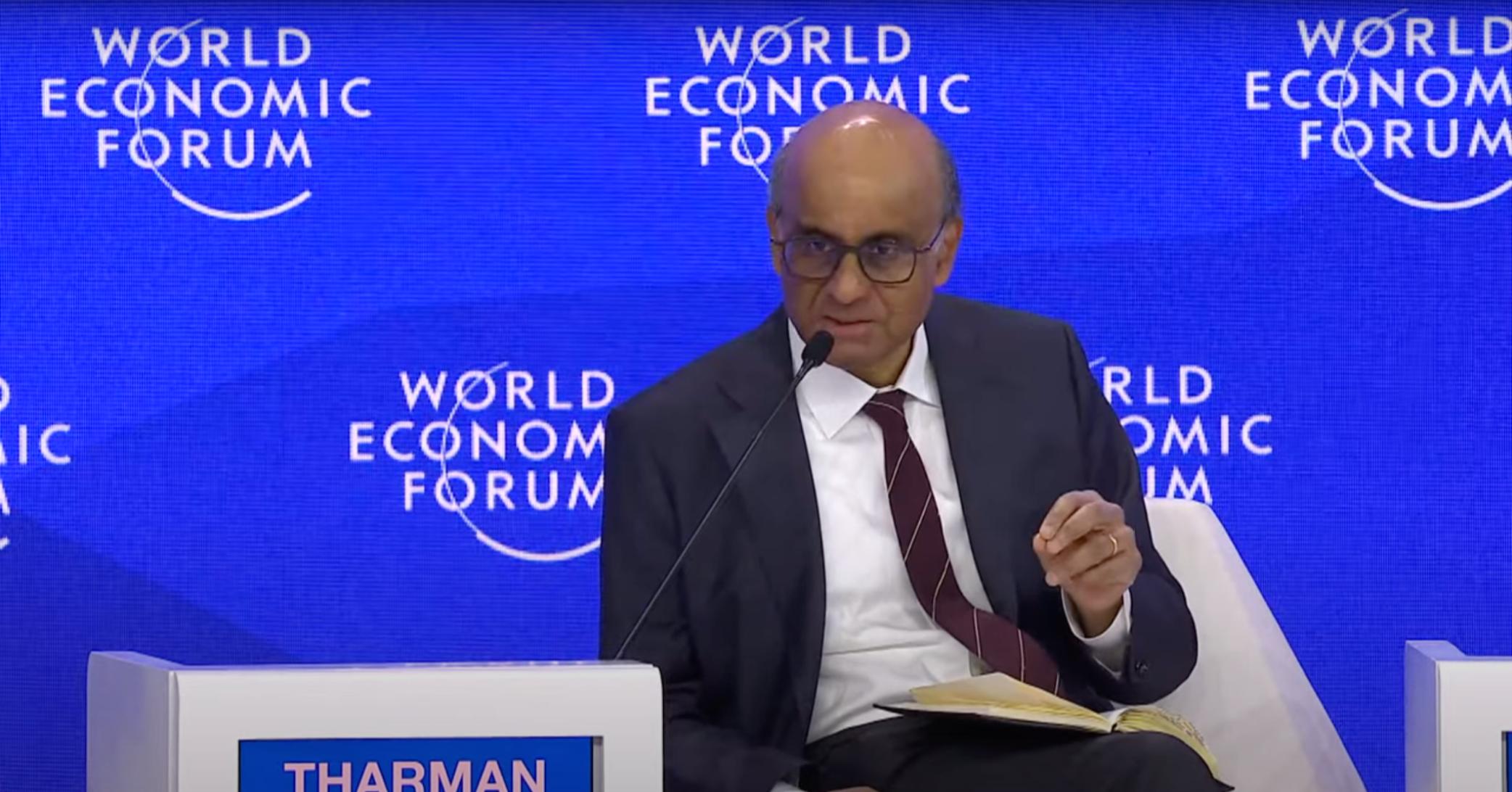


China is expected to avoid an extreme economic downturn, get past its property slump, and strengthen consumer spending, said President Tharman Shanmugaratnam.
President Tharman was speaking at the World Economic Forum (WEF) in Davos, Switzerland on Jan. 24, 2025, at a panel, "The Global Economic Outlook".
China will avoid an extreme economic downturn: President Tharman
During the panel, Sara Eisen, an anchor at CNBC, asked President Tharman how he assess the current Chinese economy and the spillover effects it might have globally, given that the country is witnessing a deflation.
In response, President Tharman said he thinks China will avoid an extreme economic downturn.
"They know what to do," he said. "They're measuring the pace of the measures they're taking to strengthen consumer spending, [and] to get past the property market overhang."
President Tharman said that China would have to achieve this "extremely complex task" in an economy that is not fully market-based."
"But I think they'll get there," President Tharman predicted.
"Growth might be somewhat slower than hoped, but I don't see a situation that leads us to a deflationary spiral."
Inflation
Commenting on the broader economic outlook, President Tharman said that the central banks and fiscal authorities have "made mistakes" in the last 15 years that set the world "on a somewhat higher plane of inflation for the medium term".
But Tharman remains optimistic about the situation, as the world had "the fundamental advantage" for several years now— the entry of China and some parts of the developing world in the global labour market and global trading system, as well as countries' willingness to absorb their products.
"It's been a tremendous deflationary force, counter-inflationary force," he said.
Ageing population
"We also have now an unprecedented situation of ageing in the entire developed world," said President Tharman, adding that the impact can be observed in the West, Japan, China, and the U.S.
But despite the ageing population in these countries, there are growing populations in other parts of the world.
"You've got Africa that's coming up. You've got India that's still growing rapidly."
This, in turn, creates the fundamental advantage for consumers all over the world to have an international trading system that allows for emerging countries with growing populations, work forces, and lower wages to be a part of the global economy.
But the question is, how do we now replicate it in the next phase, when we have the added disadvantage of ageing in the Western world and severe labour shortages that already exist in Europe.
"How do we have, if you like, a global industrial policy, so that we can benefit globally from higher productivity but also a lower cost of goods for consumers around the world?" President Tharman asked.
"I think that has to be an important challenge."
Top image via World Economic Forum/YouTube