News


Govt won't intervene & cap prices despite high cost of living: PM Wong on S'pore not being a cheap place to live
Instead, the government will offer households targeted support.
October 09, 2026, 03:24 PM
Photo from Prime Minister's Office Singapore


Singapore must ensure that it continues to have good government, said Prime Minister Lawrence Wong on Oct. 8.
To do so, ministers' salaries must remain "competitive" to attract good talent, he added.
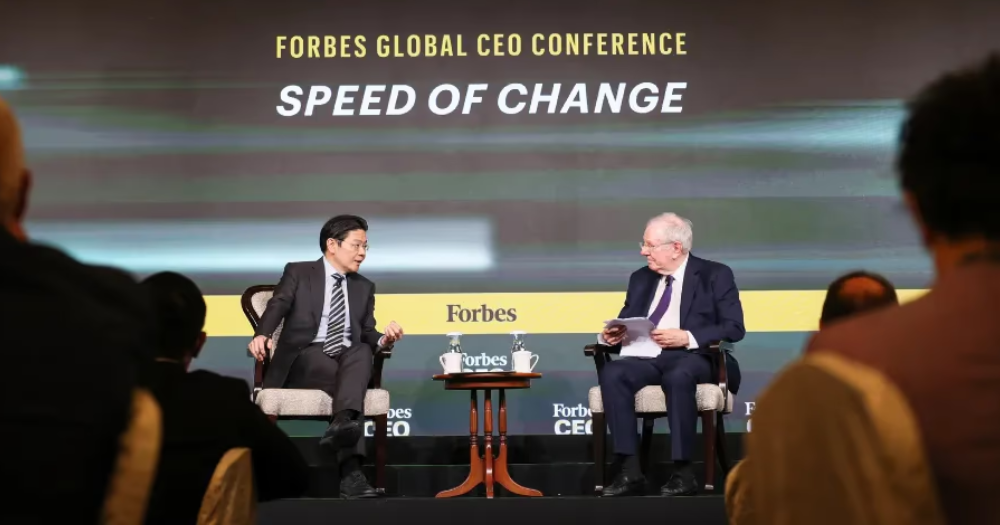
PM Wong made these comments at the 24th Forbes Global CEO Conference, an invitation-only conference that gathers hundreds of leading executives and industry leaders from across the world.
He participated in a dialogue with Steve Forbes, the chairman and editor-in-chief of Forbes.
In the dialogue, PM Wong discussed and commented on a diverse range of subjects, including geopolitics, AI, and economic policy.
Ministers' salary framework must be "competitive"
In response to Forbes' question on ministerial salaries, PM Wong asked:
"Well, our starting point is: Is government important? Is good government important? And I believe most of us will say 'Yes. Good government is important.' Then, if good government is important, what do you need to do to get good government?"
He continued that to create a "good government", the government must attract "the best" of every cohort by identifying individuals with good character and values, and appeal to their "sense of purpose".
However, a "practical issue" of getting such individuals to join politics is that they are often successful in their own careers, he explained, citing examples of these people being doctors, lawyers or businessmen.
And as high salary earners, "they would have made their own financial commitments for themselves, their spouses, and their children".
Singapore thus tries to have a "competitive" salary framework for ministers — this will not match their private sector pay, but is "broadly competitive".
PM Wong stated that the aim is to reduce the "burden and the financial loss and the hurdle of entering politics".
Under this principle, Singapore has been able to attract and retain good talent in the government over the past 60 years.
He pointed out that as Prime Minister, his mission is not only to complete his term, but to ensure that he is able to attract the next generation of leaders that he can pass the baton to.
His comments follow an announcement in September that political appointment holders will get a one-off adjustment of up to 9 per cent from Oct. 15, sparking debate in Parliament.
Expensive city?
In another instance, Forbes remarked to PM Wong on the country's cost of living, stating that "Singapore is not a cheap place to live."
"Not at all," he admitted.
However, PM Wong raised that cost and incomes go hand in hand and are "two sides of the same coin", pointing out that one "cannot ask for high incomes and low prices because the services that you consume, what you pay, forms a salary for the people who provide those services".
As such, the "critical" statistics are rather real incomes, accounting for inflation, as well as income inequality.
Singapore has been ensuring that real incomes continue to rise across all segments of society — "not just at the top level... but especially at the lower end — while aiming for income inequalities to go down, he added.
He also stressed that high prices are "legitimate price signals", rejecting the idea that the government should intervene to cap prices as it may generate unintended consequences.
He further explained that during the energy crisis, Singapore was buying oil at market price.
"So if prices are high, we accept that these are market prices."
In such situations, instead of intervening to cap the price, Singapore chose to provide targeted support to low- and middle-income households through utility rebates or cash support.
The AI-tech boom
In response to Forbes pointing out that Singapore makes 10 per cent of the world's semiconductors and about one-fifth of the equipment used to make them, PM Wong said that the semiconductor industry was a "big part of our economy".
While Singapore does not make the most advanced AI chips, firms such as GlobalFoundries and Micron make memory chips and specialty chips here, which AI increases the demand for.
The economy has grown at 5 per cent for the last three years, including 2026, he said, calling it "remarkable".
"[Given] where we are in terms of per capita GDP to be able to grow at 5 percent consecutively for three years with productivity at more than 3 percent — it is considerable."
When asked how long he thought the boom would last though, PM Wong admitted "No boom is forever."
He said that there would be a correction at some point in time yet to be determined.
As such, he stressed that Singapore's approach is to "make good use of this window of opportunity now, where there is external demand, capitalise on it, build new capabilities, and create better jobs for Singaporeans".
Protecting jobs
Forbes then raised the potential for AI to cause displacement and affect jobs.
PM Wong said that while it is "still early days", and it is unclear what impact AI will have on the job market, but that "clearly some jobs will disappear, and many jobs will have to change".
Therefore, Singapore is focused on protecting the worker rather than the job, he stressed, and one embracing unions as partners is one way to do so.
Claiming that Singapore's unions "have an enlightened approach", PM Wong said that they are aware "that it is better to enlarge the pie, rather than to fight for a bigger share of a smaller pie."
He stressed the importance of Singapore's "strong compact" between the government, employers, and unions, which allows for all three parties to work together to create win-win outcomes.
This makes it possible for Singapore to "make sure that the benefits of AI are shared widely," he said.