



Abroad


S'pore refuses to choose between US & China, won't be used by 1 against the other: Vivian Balakrishnan
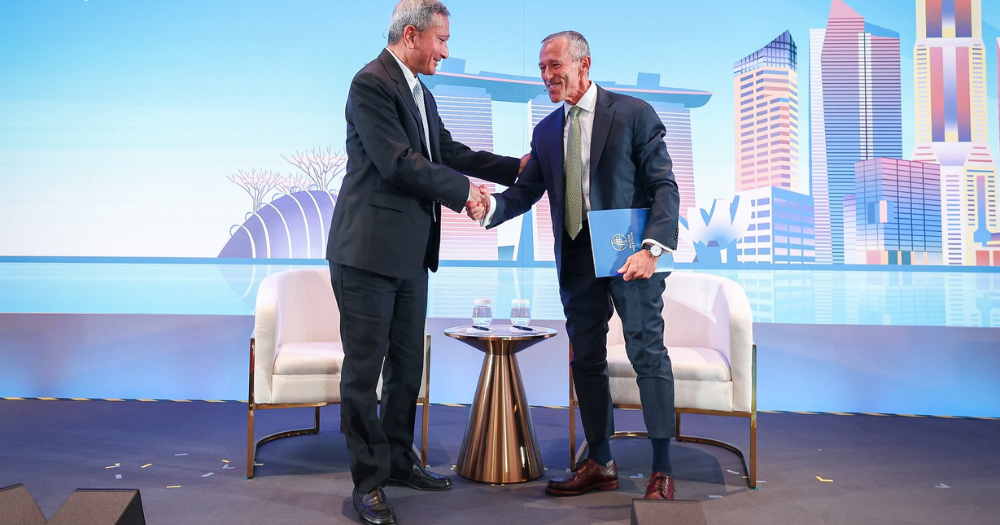
He spoke at the 13th Milken Institute Asia Summit on Oct. 7.
October 08, 2026, 08:36 PM
Photo from Milken Institute/Facebook


Singapore must "maintain trust" with China and the U.S. as a "useful partner", said Foreign Affairs Minister Vivian Balakrishnan on Oct. 7.
However, Singapore will continue to "refuse to choose" between the two powers, for as long as we are able. And not only that, Singapore must make clear that it won't be used by one party against the other, either as a proxy or a lever.
His comments were made at the Milken Institute Asia Summit in Singapore on Oct. 7, 2026, which took place at the Four Seasons Hotel.
Vivian participated in a dialogue moderated by Richard Ditizio, the chief executive officer of the Milken Institute, an American think tank based in California.
He commented on various geopolitical subjects, such as the rise of AI and the U.S.-China relationship, and how they related to Singapore.
Singapore must "refuse to choose" between China and U.S.
With respect to the "dynamic" between the U.S. and China, Vivian said it is a "peculiarly sensitive and existential point" for Singapore, with both the U.S. and China being important to us.
Vivian pointed out that more than half of foreign direct investment (FDI) made by the U.S. in Southeast Asia goes to Singapore.
"So, is America important to Singapore as a source of FDI, a source of technology, and as an ultimate market? Yes, absolutely," he said.
On the other hand, he noted that there is no "other political entity in the world where 74 per cent of the population have Chinese ancestry", with linguistic, cultural and historical ties between the two countries.
This does not however mean that we should necessarily agree with China, he said. Singapore remains a multiracial, multilingual city-state in the heart of Southeast Asia.
Relations with both powers are vital for Singapore, and it will handle these relationships very carefully.
In practice, this means refusing to choose between the two.
Vivian said that "as far as we can do so, we will refuse to choose, because the moment you choose, you have lost strategic options and strategic latitude."
What is more, if Singapore is forced to choose, "either one of you, you may not like the final answer." But Vivian went on.
"Even that is not enough. I then have to go on to say that, in any case, “I am not going to be used by the other guy against you, as a proxy or as a lever.” We have to religiously say, “I will refuse to choose, and whilst I will be useful to you, I will not be made use of.”
The key challenge comes back to trust. The challenge for us is to maintain trust with both the United States and China, not as a vassal state or a tributary state, but as a small but hopefully relevant and useful partner, who is not to be made use of."
He further stressed that Singapore ought to "maintain a clear, steady, principled, consistent position" towards both the U.S. and China, in order to quell worries that Singapore is "acting on behalf" of either side.
Tumultuous times
Commenting on the current tumultuous state of the world and the disruptions caused by technological advances, Vivian noted the need to adapt and change, but questioned where "societies can change to cope with these differences".
He mused that those who will emerge better or stronger depends on who better masters new technology. In addition, successfully restructuring not just the economy, but whether it can keep societies together and avoid fractures and polarisation.
The challenge is in balancing all these issues, he added: "Fear and despair can cause paralysis in all societies at the precise moment that our societies need to restructure as quickly as possible to deal with both the promise and the peril."
"We’ve got our hands full, absolutely."
With respect to Singapore, he believes that the government has been "upfront with [the] population, not just on the upsides and the downsides, but also on the trade-offs that we are going to have to make collectively as a society, and without fracturing."
He called this the "missing ingredient" of many other political systems.
"That’s why you get the corrosive erosion of trust. Then, with diminished political capital, you just cannot make the decisions that need to be made, even though you know what the right thing to do is.
You are unable to convince your people, and you end up being a deer in the headlights, and there is a revolution going on, on all fronts.
It is something that we are working on."
Tech revolution?
However, Vivian also stressed that technological advances – in fields such as AI and biotech – represent an opportunity.
"The fact is that there is a role and there are rich pickings for middle and small powers in the midst of all this," he stated.
However, he cautioned against the associated dangers that come with AI in particular, such as the loss of control of AI agents or the use of AI by malicious actors.
Reflecting on the potential for AI to cause harm, he noted that AI agents are trained on material from the Internet, which includes negative aspects. He added that one should not be surprised that AI agents brought up on a "diet" of human thought and writings will also behave like humans.
"Now that can either be very scary, or it should be moment of great contemplation."
But he concluded the dialogue on an optimistic note, saying that there is a lot of good one can do in the current age.