Abroad


What are French students protesting for & will it impact France's upcoming presidential elections?
Riots, grenades, and solidarity.
October 08, 2026, 05:23 PM
Image via AFP


A woman attacked with an aerosol flamethrower in the streets.
A teenager losing a hand to a grenade.
A local mayor stretches himself fully like a mother hen, trying to form a barrier between French riot police and protesting students behind him.
Tens of thousands have taken to the streets, not just in the capital, Paris, but in French cities all across the nation, from Lille in the north to Marseille in the south.
These protests are being initiated and led by school children aged 15-18, but at times with the support of their teachers, and even local mayors.
What are they protesting, why is the protest turning violent, and what political implications does this have?
Long days and crumbling schools
French students have turned out in the tens of thousands to protest the state of their schools, both physical and academic.
These students are mainly between the ages of 15 and 18, part of France's lycée system.
Le Monde reports leaking, crumbling school buildings that reach 40°C in the summer and are unheated during the winter, requiring children to wear coats while in class; and The Guardian also shares complaints about “rat-infested buildings.”
There are also concerns about academic workload, with students complaining that the curriculum restricts time for other pursuits, and that the university admissions process, critical for determining future outcomes, is plagued by opacity.
This is coupled with concerns about the school system's teacher shortages, with students reliant on temporary teachers for long periods when their original teachers quit or take leaves of absence abruptly.
Perhaps the most stinging critique is that these problems disproportionately affect public schools in poor areas, with an education analyst with the OECD telling The Guardian that there was a “marked gap” between students from advantaged and disadvantaged schools.
The BBC notes that teacher absenteeism is not markedly higher than the OECD average, and that according to an OECD report, France spends more than the EU average per student for upper secondary schools, the students protesting now, but acknowledges that France’s school day is both long and convoluted.
The Guardian notes that while France’s class size average is not much higher than the OECD average, 29 to 26, it varies significantly between rural and urban areas, where in the latter, class sizes can reach as high as 36.
Children of the revolution
Le Monde notes that in many cases, the protests have been largely peaceful, and well supported not just by affected students but also by teachers and unions
Some students from a private school turned out to protest in solidarity, with one sign reading “Private and public, all children of the Republic.”
Teachers have also joined the protest, one teacher interviewed said it was their responsibility as teachers to “make sure we protect them [the students].”
Another remarked that he wanted to show that there was a “peaceful way to support their legitimate demands”, after he had suggested that some of the violence was caused by students copying violent acts seen on social media, and trying to outdo them.
Teachers also have a stake in the protests; trouble with retention and absenteeism is linked to their low pay.
In one case, a parent said that he was attending in place of his child, as he feared for his child's safety, and that they had compromised by exchanging places.
Local political figures have also participated, with a mayor of a Paris suburb, Bally Bagayoko, shown trying to stand in between protesters and riot police.
Violence in the streets
But not all protesters have been peaceful.
The Telegraph reports an incident where a woman was first shoved against a bus stop, then had fire sprayed at her using an aerosol can and a lighter, resulting in first-degree burns.
The assailant has reportedly been arrested.
The Telegraph also reports that protesters have lost sympathy after that and similar incidents, with videos showing protesters assaulting an unconscious police officer and teachers outside of school.
There has also been a fair amount of disinformation, with a video of a burning bus in a southern French city being deceptively labelled as from the current round of protests, when it was simply an engine fire that took place in 2023, as reported by AFP via Yahoo.
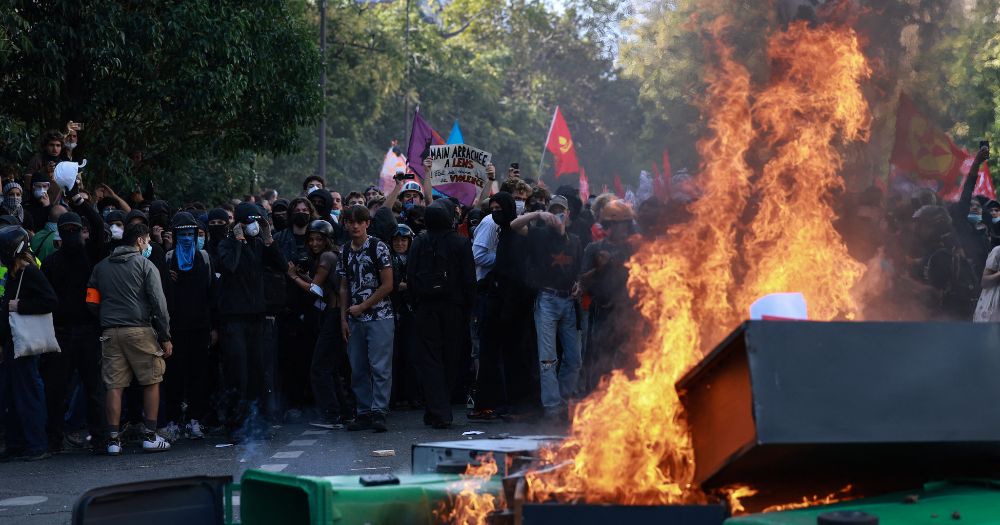
Protesters blocking schools and universities have been met with riot police armed with batons as well as tear gas and stun grenades.
Images of the protest show protesters setting up flaming barricades, made up of dustbins and bicycles, while arson attacks have also been carried out against schools.
Tear gas and grenades
One incident saw a 15-year-old lose a hand to a grenade.
It is not yet known if he had been struck by the grenade or if he had picked it up, although The Guardian reports that his mother claims he had not picked it up.
France’s interior minister, Laurent Nuñez, said that the use of such grenades was temporarily suspended but defended police tactics, saying that officers did not intervene when protests were peaceful.
He also reported that 761 police officers had been wounded in the protests, while 215 teenagers and 89 school staff had been injured.
Le Monde reports student protesters denying initiating violence against the police, with a group in Rennes saying that riot police had arrived suddenly and “tear-gassed everyone.”
The protesters held a sign saying “Old enough to be tear-gassed but not to protest.”
Fiscal trouble and budget cuts
With many of the students involved in the protests likely too young to vote, it remains to be seen how it will affect France’s political dynamic.
The current French President Emmanuel Macron is term-limited, and elections to replace him are just over half a year away in April 2027.
Euronews reports that France’s borrowing costs have hit their highest levels since 2002 and its government debt is reaching 119 per cent of GDP.
It appears that the government has decided that cutting spending, except for interest and defence, is the way out of its current troubles, but the government holds a minority of seats in the French parliament, meaning that it cannot guarantee its solution will be supported.
This also means that the changes students, and some teachers, are demanding will have trouble finding funding in an environment where France is looking to slash government budgets.
Elections in April
This dire outlook has allowed formerly fringe politicians to come to the fore.
Some might be aware of far-right Marine Le Pen, who is all but certain to reach the second round of the presidential election, as she is polling at around 33 per cent support, according to Reuters.
Far-left leader Jean-Luc Mélenchon, is in second place, expected to attain at least 17 per cent of first-round votes, although polling suggests he will be roundly beaten by Le Pen in the second round.
An op-ed in The Guardian says that Mélenchon is a natural repository for the votes of the disaffected youth and those who share their sentiments.
In fact, the mayor who put himself between police and protesters is from Mélenchon’s party, La France Insoumise (LFI).
But The Guardian op-ed notes that Mélenchon’s Achilles' heel appears to be his foreign policy, described as pro-Russian, anti-NATO, anti-European Union, and near indistinguishable from that of Le Pen.
In previous elections, French presidents like Macron and Jacque Chirac have managed to hold off far-right challenges by assembling a left-centre coalition, as left-leaning voters held their noses and voted for the least undesirable of two options in the second round.
But given a choice between the two extremes, there is no recent precedent for how elections will go.