



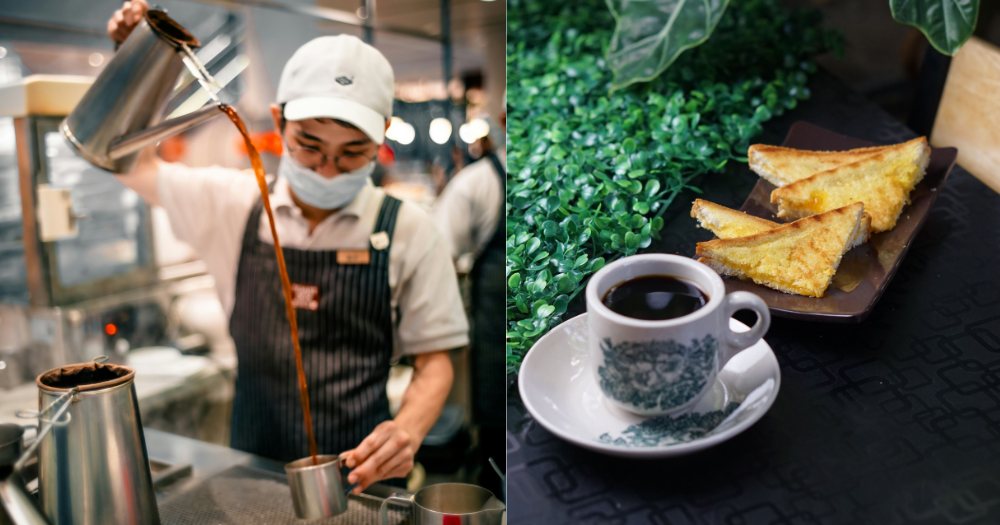
Left image by Madeline Liu/Unsplash, right image by Arief Setiawan/Unsplash
It’s hard to imagine Singapore’s landscape today without Kopi.
From its distinct sweet taste, to its many variations of C, Gao, Kosong, to the iconic way it is prepared by being poured and filtered multiple times through a cloth sock filter, this is a drink that is now a timeless part of our landscape.
For many of us, it has become our go-to perk-me-up drink in the morning. Plus, who can forget how this drink has even become part of a byword for having a chat: “la kopi”.
And yet, as ubiquitous as the drink is now in Singapore, it’s worth noting that once upon a time, Singaporeans were not kopi guzzlers, nor was the drink itself a part of our landscape.
Kopi began as a foreign European import
In fact, Kopi is very much a foreign import given that neither the Chinese, Malays or Indians have a tradition of coffee consumption, according to Culturepaedia.
Most of the elements that we now take for granted in kopi such as sugar, condensed milk and even filtering the coffee through a cloth bag actually have European origins, with the sock filter technique referenced in European records as far back as the 18th century.
In addition, tea was the dominant drink with both the Chinese and Indians during the colonial period, who were traditionally accustomed to tea grown in their native regions.
In comparison, coffee consumption in Southeast Asia was fuelled largely by the Dutch colonisation of Indonesia, which resulted in the establishment of vast coffee estates.
By the 1880s, Java alone accounted for 82 per cent of all coffee leaving the Dutch East Indies and approximately 18 per cent of world exports.
Within Singapore, much of our coffee supply at that time was likely sourced from these plantations and entered Singapore via British trading houses, which also supplied sugar and condensed milk from the United Kingdom.
However, at this point, coffee was still largely limited to colonial homes and European ships, prepared mainly by cooks and stewards from the Hainanese community due to the limited job options available for them.
The catalyst for Kopi’s evolution was scarcity
In perhaps a strange twist of irony, the catalyst for Kopi as a drink for the working class in Singapore was the collapse in production of coffee plantations in the Dutch East Indies.
A coffee-leaf rust epidemic struck the plantations across Java, which grew arabica beans, from 1880 to 1883, at the height of coffee production.
This resulted in the Dutch East Indies’ share of global production dropping to just two per cent by 1917, never to recover.
In response, the Dutch shifted to planting robusta beans, which is more resilient agriculturally, has higher yields, and is cheaper to grow.
Robusta beans also can contain up to twice the amount of caffeine found in arabica beans.
The tradeoff? The higher caffeine level means that robusta is far more bitter and lacks the complex flavours of arabica beans.
This made drinking robusta coffee black and without sugar highly unpleasant for many people.
Even so, the low cost and availability of the drink meant that it soon became the default choice for the working class in Singapore.
It was the Hainanese who cemented the drink as a part of our cuisine
The Hainanese were central agents in localising British coffee-drinking customs for everyday folk.
It was within the kitchens of Europeans where they learned the art of what would become the foundations of making kopi – filtering coffee through muslin or cloth bags and serving it black, or sometimes with fresh milk and sugar.
And in response to the rise of robusta beans, Hainanese coffee roasters began frying such beans with margarine and sugar to give them a caramelised tinge, adding salt midway through the frying, followed by even more sugar to round out the bitterness and create the deep taste profile of Kopi that has become so well-known.
Another important element to counter the bitterness of robusta beans included the use of condensed milk.
During the colonial period, fresh milk was an expensive premium commodity due to its perishable nature.
It was also frequently mixed with water or other milks to stretch milk supply, which raised public health concerns.
This therefore meant that fresh milk was mostly for Europeans. In contrast, condensed milk was safer and about 50 per cent cheaper, which meant it became one of the primary dairy options for locals.
The use of the cloth sock filter also remained, even as Europe shifted to metal and paper filters, due to the high cost of using metal and paper filters in Southeast Asia.
All of these techniques would be carried over in the post-World War 2 period when the Hainanese began opening their own coffee shops, or kopitiams, once the British began withdrawing from Singapore, complete with the iconic kaya and butter toast and soft-boiled eggs that we have all come to know and love.
So the next time you drink a cup of Kopi, you are in a way, drinking something that has come to symbolise the trajectory of Singapore’s development with its many twists and turns.
This branded article by Singapore Chinese Cultural Centre made the author crave for Kopi C Gao even though he prefers tea.