




News


Leadership renewal & continuity? We try picking PM Wong’s mind on Cabinet reshuffle
Evolution, not revolution.
July 23, 2026, 05:19 PM
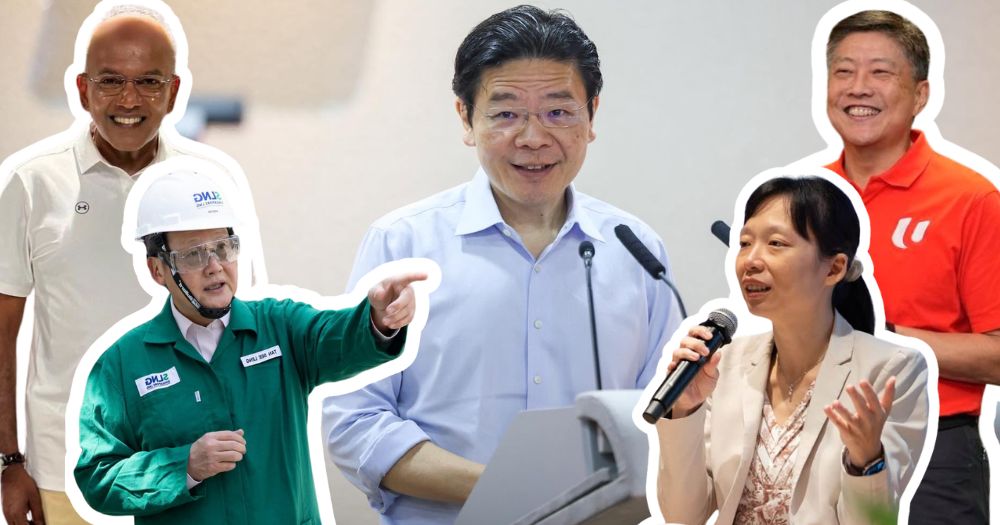
Image via Lawrence Wong/Facebook, K Shanmugam/Facebook, Tan See Leng/Facebook, Jasmin Lau/Facebook, & Ng Chee Meng/Facebook


Prime Minister Lawrence Wong’s cabinet saw its second reshuffle since the 2025 General Election, with a pack of younger ministers moving up through the ranks and significant changes to the makeup of the (former) Ministry of Trade and Industry.
K Shanmugam was made senior minister, Jeffrey Siow and David Neo were promoted to full ministers, Jasmin Lau became acting minister, Sim Ann was made 2nd Minister for Home and Foreign Affairs - to name just the most prominent of the promotions.
It also sees the return of Ng Chee Meng, who had requested not to be included in the government last year to take care of Jalan Kayu.
This all happened against the backdrop of the resignation of Faishal Ibrahim just days earlier, which saw Zaqy Mohammad appointed acting minister for Muslim Affairs in his stead, and further back, the decision of Koh Poh Koon to step back from government.
The return of symbiosis
In the cold light of day, the logic of Ng Chee Meng’s return to cabinet is not surprising.
When he requested not to be included in PM Wong’s first post-GE cabinet, PM Wong was clear he expected a secretary-general of NTUC to be part of his cabinet.
For reference, the cabinet had been without an NTUC Sec-Gen for an unprecedented six years, with a labour chief being part of the cabinet's makeup since Lim Chee Onn in the 1980s.
Ng’s time away from the cabinet was as a result of a shock loss in Sengkang to the WP’s GRC team.
Ng returns to cabinet at a time of economic disquiet, if not outright difficulty.
The spectre of jobless economic growth hangs over the economy and especially the government, with Deputy Prime Minister Gan Kim Yong warning of the prospect of economic growth without corresponding growth in jobs during the Economic Strategy Review earlier this year.
As professor Eugene Tan from the Singapore Management University puts it:
“All eyes will now be on how the NTUC promotes and protects workers' interests at a time of technological upheaval and changing demographics. With Ng’s return to Cabinet, the symbiotic relationship between the PAP and NTUC is reaffirmed.”
If Ng needs opportunities to show the public the lessons he has learnt in “the wilderness”, and how he will apply them to protect Singaporean workers’ jobs, he will not be short of them in the upcoming years.
Standard bearer
The cabinet reshuffle highlights two aspects of Senior Minister K Shanmugam’s tenure in politics.
As someone who has been in cabinet longer than most of our readers have been alive, his wealth of experience continues to be an asset for Wong, as it was for Lee Hsien Loong before him.
But it was something that was taking place on the sidelines of the cabinet reshuffle that also caught the attention of Singaporeans.
Just before the news of the reshuffle broke, Shanmugam posted a lengthy and detailed post about Faishal Ibrahim and the incident that had resulted in his resignation as a minister and an MP.
The post was simultaneously warm, humane, but firm, and clear.
With one hand, it pushed back against the tide of negative speculation about the former minister, and with the other, stated clearly what the PAP’s standards were.
This sets out to do two things at once: protect a “humble and hardworking man”, while also remind people what the PAP’s standards are and was unequivocal about the party’s determination to stick to them.
It is this ability to handle many problems with the same motion, and his instinct to both protect, reassure, and maintain standards, and his position as metaphorical bearer of standards that will be relied upon by a cabinet that will grow younger as it regenerates under PM Wong.
Tan See Leng evolves again
Tan See Leng’s evolution was something that I noticed at last year’s budget and again at this year’s.
I was referring to something that he had said about nuclear energy, and kept looking under the MOM section of speeches, trying to figure out 1) why MOM was entangled with nuclear power and 2) why I couldn’t find anything.
Of course, MOM had nothing to do with nuclear energy generation; these were speeches given as Minister-in-charge of Energy and Science & Technology, part of MTI, leading one to wonder if there was a bit of feature creep going on in his portfolio.
With MTI now the Ministry of Energy, Trade, and Industry, and Tan becoming the Minister for Energy and Industry, with Gan handling the Trade portion, the circle of his portfolio has been squared.
It reflects the government moving quickly to recognise the looming energy crisis: not caused by the war in Iran, but by the tremendous hunger for electrical energy an AI-enabled future demands, explaining why the government’s focus on nuclear power far predates February 2026.
The Iran War, foreshadowed by the initial attacks in 2025, added an even more dangerous and immediate dimension to the crisis, but by no means initiated it.
This also has the benefit of allowing Gan to focus more narrowly on an increasingly complicated trade environment, with the tariff policy of United States President Donald Trump signalling the start of a period of disruption and reorganisation, both amongst the great and middle powers.
No easy days
This move then opens the door for what many consider the surprise, or highlight, of the reshuffle, promoting Jasmin Lau to Acting Minister for Manpower.
And make no mistake, there is rarely an “easy” time to take over a ministry, but this is a particularly difficult time, for largely the same reasons as were outlined above for NTUC and Ng Chee Meng.
Lau acknowledged as much in her appointment, listing the various difficulties that workers in Singapore are, and will have.
Lau’s promotion and Ng’s return are linked in that way: AI fuelled disruptions and challenging employment environments.
And while they probably didn’t intentionally get a seasoned labour hand to come in to supplement a fresh manpower minister, they have it.
Several of the experts that Mothership spoke to highlighted Lau’s promotion as a recognition of the abilities she had shown so far, with the Institute of Policy Studies’ Teo Kay Key noting that her promotion was a recognition of Lau’s abilities.
Evolution, not revolution
The reshuffle, as are most reshuffles, is an indication of evolution, not revolution.
Most of the changes can be said to have been telegraphed early; surprise is not really a virtue of governance, but not so much so that everything was predictable.
Eugene Tan noted that the pace of getting new generations of leaders was traditionally a long process, spanning “10 to 15 years”.
While that is true, it does feel that the pace, almost imperceptibly, picked up on Wednesday.