News


PM Wong says S'pore 'far away' from 6.9 million population, just trying to maintain stability
At one point, PM Wong quipped "how do we get to 10 million when TFR is so low?"
June 09, 2026, 05:55 PM
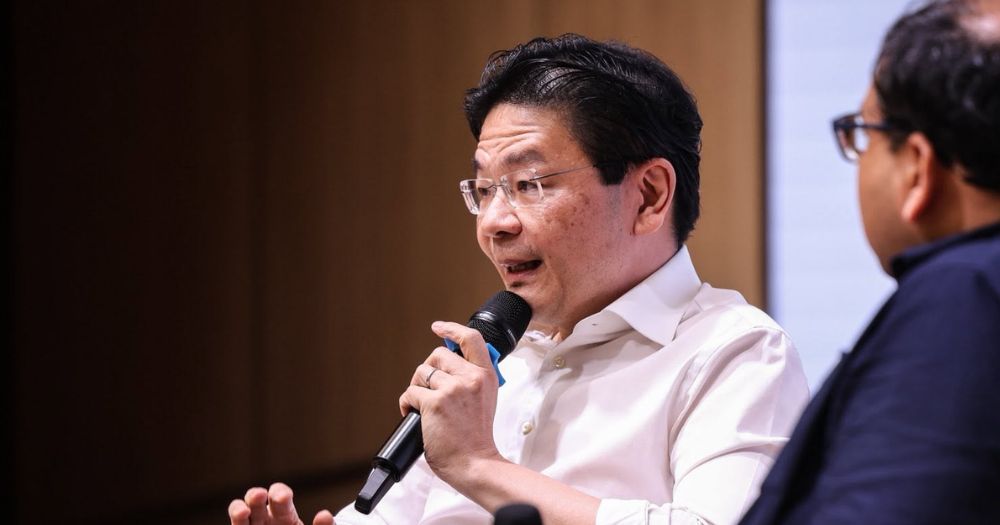
Image via Lawrence Wong/Facebook

 Population projections that suggested that Singapore might achieve a population of 6.9 million by 2030 now seem unlikely, said PM Lawrence Wong on Jun. 8 at the Singapore Press Club's Eminent Speaker Series.
PM Wong said that his government's goal was to make the country a friendly and conducive place for families, not just increasing its population.
He spoke about the challenges faced by countries in raising or maintaining their populations, calling it a global phenomenon that affected developed and developing nations alike, for which there was no clear solution.
Question parameters
The questioner asked whether, given Singapore's worrying 0.87 per cent TFR, there would be an updated population white paper with new population planning parameters, or whether Singapore was looking at a more stable population figure as the country neared its initial 6.9 million projected population.
The questioner was referencing an unofficial population planning figure mentioned by architect Liu Thai Ker of about 10 million, as well as the 2013 Population White Paper that projected a total population of between 6.5 million and 6.9 million residents by 2030.
They also asked that if such an updated population planning parameter were to be set, it would present an opportunity to re-imagine Singapore as a country with more protected green and blue spaces for conservation, in order to do more to push forward the vision of a city in nature.
Low TFR challenges
PM Wong initially quipped, "How do we get to 10 million when the TFR is so low?".
Regarding the challenge of population and fertility, he said that Singapore should have some humility, noting the global nature of the challenge.
Previously, it was believed that population decline would only affect affluent societies, but PM Wong observed that even developing countries were currently facing declining birth rates below replacement levels.
He called it a "global phenomenon" for which no one really knew the reason why, nor did anyone have a solution.
Several countries had used a lot of resources to try to stop the decline and to encourage marriage and parenthood, but without enduring success.
Not giving up
But he said that his government had not given up, and that the task force led by Minister in the Prime Minister's Office Indranee Rajah continued to look for solutions.
He said that the government was thinking about the issue less as a procreation incentive or baby bonus but rather what it could do to create a more family-friendly environment in Singapore.
"It is a move away from the idea of giving incentives for marriage and procreation, but think more about what are the moves we can make to really make life better for families in Singapore."
Families, PM Wong said, are a key pillar of Singaporean society, and the government wanted Singapore to be a place that is "friendly and conducive for families to thrive and flourish," adding that the task force was thinking about specific moves and when ready, he would be happy to share them.
On immigration
In their initial question, the former journalist had referenced a suggestion that Singapore might import labour as a way to grow its population, and PM Wong addressed that as well.
PM Wong emphasised the immigrant roots of Singapore's population, saying that Singapore had traditionally been an open society that welcomes people.
He said that the Singapore government would continue to control the flow of immigration, to make sure that new arrivals shared Singaporean values, ways of life, and would be able to integrate.
But given controlled immigration flows and low fertility rates, he cast doubt as to whether Singapore's population would meet the 6.9 million projection of the 2013 White Paper, suggesting that Singapore was "a long, long way from getting there."
Instead, he stressed that immigration and population growth would likely, at best, maintain Singapore's population stability and avoid population decline.
Green and blue spaces
Given those factors, he referenced an earlier question about technology and artificial intelligence, saying that if Singapore did not have that many new immigrants and new arrivals, then Singaporeans needed to harness technology well in order to achieve their goals and become more productive.
Singapore, he said, would always make sure that it had green and blue spaces regardless of its population parameters.
PM Wong said that Singapore would always make sure that it was able to accommodate whatever its population was and make room for green and blue spaces.
It would continue to strengthen Singapore's biodiversity and make Singapore a city in nature.