Abroad


How a country with a population the size of Ang Mo Kio made it to the World Cup
A small island has welcomed its diaspora back to play for it, and others have noticed.
June 11, 2026, 10:58 AM
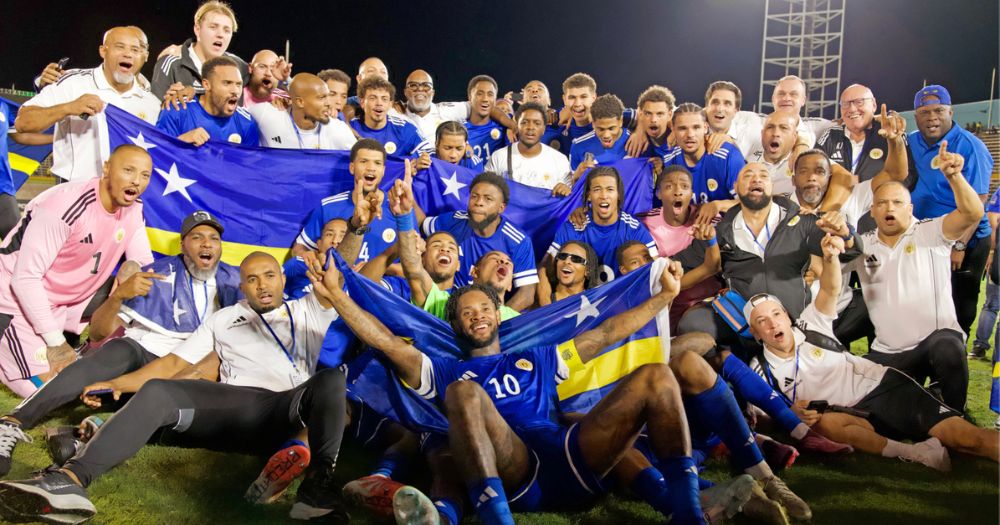
Image via thebluewaveffk/Instagram


Curacao is a small island with a population of about 140,000 people, and yet somehow the tiny island nation has managed to work its way into becoming the smallest country to ever qualify for the World Cup.
The country, ranked 82nd in the world, has taken advantage of good planning, but also of changes to the World Cup’s organisation, to put together its first qualifying team in the nation’s short history: it gained formal independence in 2010.
It’s like Ang Mo Kio qualified for the World Cup
Curacao has a population of just under 160,000 people, which is (roughly) the population of Ang Mo Kio, its area is about two-thirds that of Singapore.
But there are just about as many people of Curacao descent in the Netherlands as there are in Curacao itself, just under 150,000.
So technically, this is like if Ang Mo Kio and Sengkang made the World Cup.
Curacao is an independent nation, but is part of the Kingdom of the Netherlands.
This means Curacoans hold Dutch passports, allowing them to move to the Netherlands and settle for work or study.
This Netherlands-based diaspora is something that Curacao has made limited use of until recently.
Gilbert Martina, head of Curacao’s football federation, speaking to Sports Illustrated and CBS, said that prior to 2016, only three or four players with Curacao heritage had played for the national team.
This began to change when they appointed Dutch and Barcelona striker Patrick Kluivert first as the national team manager, and then as an advisor.
Football heritage
Kluivert is of Curacao heritage on his mother’s side, but was born in Amsterdam.
He came through the legendary Ajax youth program, with whom he would make a name for himself, scoring the winning goal in the 1995 Champions League.
He was also prolific for the Netherlands national team, scoring 40 times out of 79 caps.
Suffice to say, he was well acquainted with the quality of youth training and professional play available in Europe.
Kluivert knew that players of mixed heritage were an advantage that countries like Curacao could take advantage of: the Netherlands certainly did.
Even now, players with Curacaoan heritage help fill the Netherlands National Team’s ranks, the most famous of which is probably Arsenal’s Jurren Timber and his twin brother Quintin.
It's coming home
He advised the Curacao national team, then 182nd in the world, that they should expand their recruitment beyond the island’s shores, a suggestion that garnered resistance from both local players and officials.
But Kluivert would stage a match between the best of the island’s local players and a selection of diaspora players that saw the diaspora team win 7-1, showing them what was possible.
Even as far back as 2017, articles on Curacao’s team note the “star power” that Kluivert brought to the team that helped encourage diaspora players to put on the Curacao shirt, something that has endured through the years.
But the team has also caught a wave where it has become more common for diaspora players to play for the national teams of their origins.
One example is Wilfred Zaha, formerly of Manchester United and Crystal Palace, who grew up in England and was probably good enough to play at least a peripheral role in the national team, having played for the English under-19 and under-21 teams.
But for whatever reason, Zaha was not called up to England, and in 2016 decided to play for the country of his birth, the Ivory Coast, or Cote d’Ivoire.
Zaha is one of several examples of former potential England international players taking their parents’ countries to the World Cup: Iraq’s Zidane Iqbal grew up in Manchester, England’s Kobbie Mainoo was seriously courted by Ghana, as was Scott McTominay for Scotland (McTominay was born in England).
(At this point, the author acknowledges a serious Manchester United bias.)
In fact, Curacao’s national team only boasts one locally born player: Tahith Chong, who grew up in the capital of Willemstad before being scouted by the Dutch team Feyenoord, and then moving to (sorry) Manchester United’s youth team.
Even their current manager, the 78-year-old Dick Advocaat, is Dutch.
Forty eight
Because of these reinforcements, “The Blue Wave”, as the Curacoa team is known at home, managed to earn direct qualification to the World Cup, beating Jamaica on the final fixture of the group qualification round, to knock out Jamaica, which was led by (sorry sorry) former Manchester United assistant manager Steve McClaren.
But it was helped in its endeavour by changes to the World Cup.
The World Cup has gradually expanded the number of teams represented at the tournament, going from 24 to 32 in 1998, and now from 32 to 48.
This meant that CONCACAF, the federation for North America and the Caribbean, now enjoyed six direct qualification slots, with an additional two possible spots through international playoffs.
At the 2022 World Cup, the federation was restricted to three direct slots and one playoff spot, and those three slots were taken by the towering giants (relatively) of Mexico, the United States, and Canada, by far the largest countries in the federation.
These three countries are now the 2026 tournament’s hosts, meaning they automatically qualify and now take up three of CONCACAF’s six direct slots, but it still leaves three open for other nations to take, more than was offered before.
Curacao grabbed the opportunity with both hands, riding its qualification wave to the last day of the group stages.
Another set of islands
Other countries have noticed too.
Like Curacao, Indonesia seeks to find players with Indonesian heritage from the Netherlands and beyond to fill its ranks, although it seems that dual nationality is far more complicated for them than Curacao.
Indonesia even hired Kluivert to helm their national team, although he has since left the coaching setup.
It has taken Curacao over a decade to get to this point, hardly overnight.
It has invested the country’s renewed interest in the sport into facilities, where its state-of-the-art artificial turf football field sits at the heart of a 15,000-seater stadium, a seven-row single-tier stand not quite surrounding the entire pitch.
In Curacao, their national team has been welcomed with enthusiasm, with some even thinking of selling prized personal possessions in order to attend the World Cup.
In fact, you can check the country’s tourism-related social media, understandably nothing not related to the World Cup is planned for June.
A decade ago, such opportunities were unthinkable, who knows if another will present itself?