Abroad


'Middle powers' like M'sia have duty to build bridges amid global uncertainty: M'sia PM Anwar
Our world suffers from a "shortage of clarity," he said.
June 10, 2026, 03:11 PM
Photo by Mothership


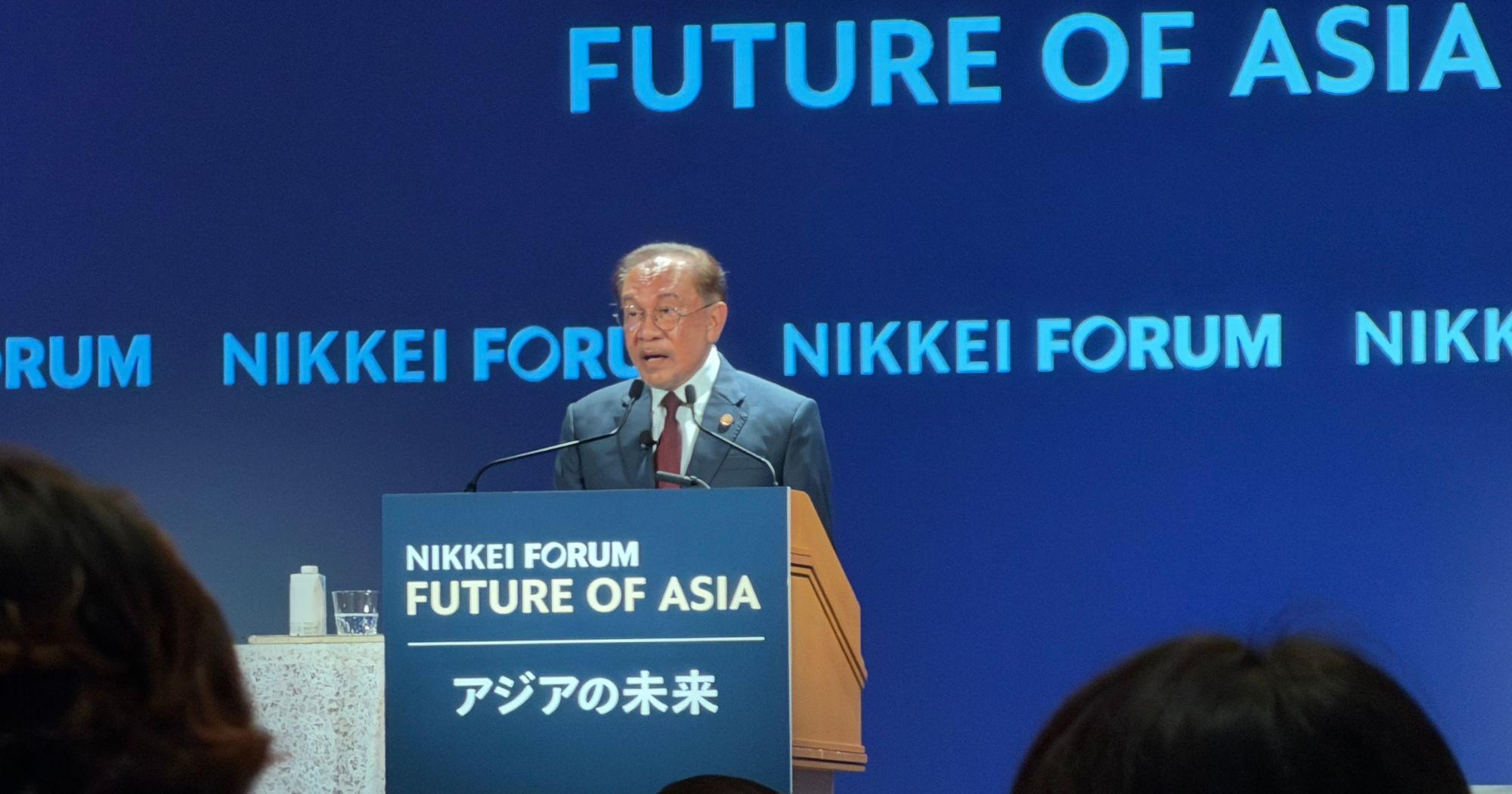
Malaysian Prime Minister Anwar Ibrahim criticised the growing tendency among major powers to weaponise economic interdependence, which causes vulnerability for other nations.
He was speaking at the 31st Nikkei Future of Asia conference, where regional leaders gathered in Tokyo, Japan to discuss ways to make Asia more resilient amid an increasingly uncertain world.
The prime minister noted that Malaysia, as a middle power, is "uniquely positioned" to build bridges and consensus where others see divides.
Geopolitical rivalry
Anwar noted that export restrictions and industrial policies are increasingly shaped by geopolitical rivalry.
"Supply chains, technology, critical minerals, finance, and market access are increasingly viewed through the lens of rivalry rather than mutual benefit," Anwar said.
While these may be harnessed as "instruments of statecraft" for major powers, they become a "source of vulnerability" for other nations, he said.
Turning to how Asia has prospered in the past through open trade, he suggested that today's challenges require fresh approaches and revitalised institutions.
He added that "middle powers" like Malaysia have a "particular responsibility" in this endeavour.
"We may not possess overwhelming power, but we possess credibility. We understand the aspirations of developing nations and the concerns of advanced economies," he said.
He said that Malaysia is "uniquely positioned," to build bridges and consensus where others see divides.
He added that Malaysia is fortunate to have colleagues within ASEAN who share this commitment to engaging with others, viewing the positive outcomes of free trade, and connecting with all countries and powers.
Strategic competition risks dividing the region into competing spheres, he added, forcing countries like Malaysia to take sides.
Strategic uncertainty
Anwar also called for greater clarity among world leaders, saying that many have yet to free themselves from the "old paradigm in geopolitics," in which "the strong continue to be invested in suppressing the weak".
He stated that the uncertainty in today's world is "strategic", where leaders are still dictated by realpolitik and hegemonic considerations in their striving for power.
He cited the tragedy in Gaza, Lebanon and Middle East tensions as examples that demonstrate the "fragility of peace and the limits of international consensus".
He also noted the power rivalry in the Asia region, such as the South China Sea disputes and the nuclear threat posed by North Korea.
"Navigating this strategic uncertainty warrants more than passive compliance or passive acceptance of the state of play," Anwar said.
It is therefore the duty of political leadership to provide clarity to these "strategic flux" and not condone the excesses of realpolitik, he said.
"We need leaders with the courage and conviction to call out the injustices and hardship that continue to plague us, and to advocate for a more proactive approach to peace and progress," he added.
Collaboration and clarity
Anwar argued that the world currently suffers from a "shortage of clarity", rather than a shortage of power.
He ultimately called for collaboration among different nations, saying:
"The challenges before us are simply too complex for any one nation to address alone, so rather than capitulation, the answer lies in collaboration, encapsulating cooperation, trust, and strengthening institutions capable of bringing people together."