



Abroad


US SecDef Pete Hegseth urges Asian allies to 'step up' & increase defence spending to 3.5% of GDP
He emphasised the days of "free-riding" on U.S. military power and investment are over.
May 30, 2026, 12:06 PM
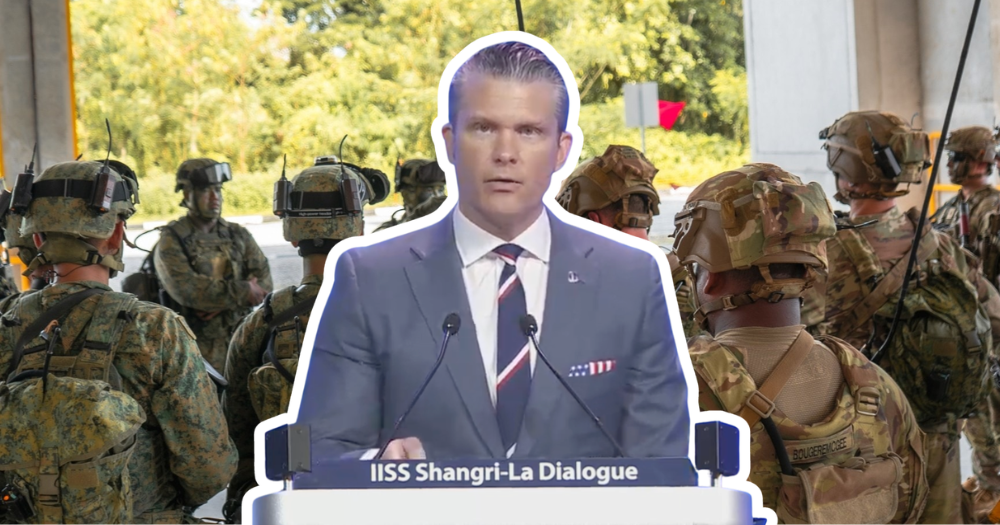
Photos from The International Institute for Strategic Studies' YouTube and The Singapore Army's Facebook


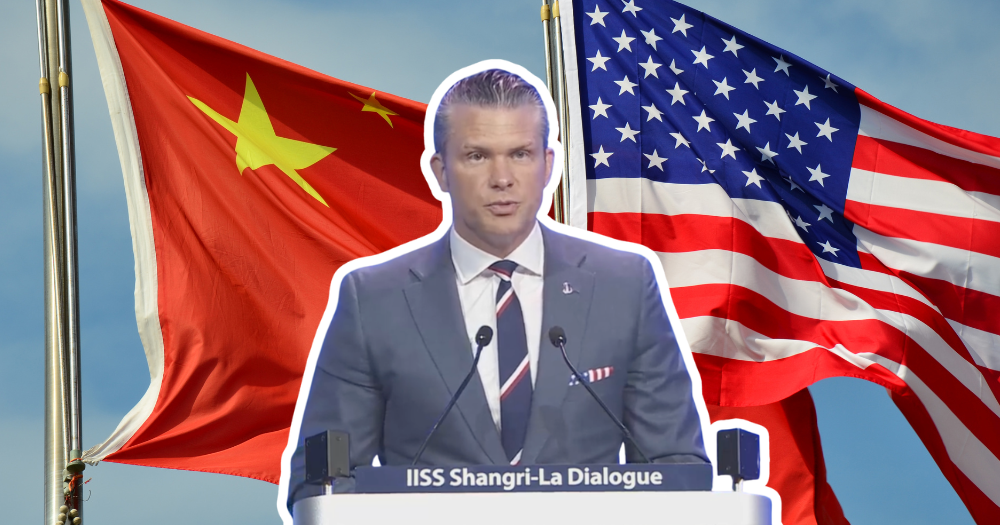
The United States Secretary of Defense Pete Hegseth called on U.S. allies in the Asia Pacific to "contribute more" to sustaining peace and stability by increasing defence spending to 3.5 per cent of their gross domestic product (GDP).
The U.S. seeks to work together with Asia to keep the region free of any dominant hegemon, he said at the 2026 Shangri-La Dialogue in Singapore on May 30.
"For too long, the security of this region has rested disproportionately on American military power," he asserted.
He characterised it a "burden" the U.S. cannot and should not carry alone, and emphasised that security alliances must be a two-way street without so-called "freeloading".
"The era of the United States subsidising the defence of wealthy nations is over.
We need partners, not protectorates. We seek alliances built on shared responsibility, not dependency.
This is the maturation of our alliances in a new era."
'True partners' will be moved to the front of the queue
In ramping up defence spending, the U.S. is leading the way by pledging a US$1.5 trillion (S$1.9 trillion) investment in its military, Hegseth said.
"We demand 3.5 per cent from our allies and partners, and we are going well beyond that number," he added. "We expect every single ally and partner to match that kind of resolve."
He promised benefits for such nations that rise to this challenge and "embrace responsibility as true partners", and they will be moved to the "front of the queue".
These benefits include expedited arms sales, deep industrial base collaboration, and expanded intelligence sharing.
The U.S. will prioritise working with "model allies" who are ready to defend their national interests, Hegseth said.
"For those who believe they can continue to free-ride on the generosity of the American taxpayer, hear us now. Those days are over.
Allies who refuse to step up and carry their own weight for our collective defence will face a clear shift in how we do business."
Countries stepping up
There has been progress in sharing the security burden in the Asia Pacific, Hegseth noted.
He referenced several Asian countries who have been boosting their defence spending, such as South Korea, who has pledged to spend 3.5 per cent of their GDP on defence.
He also commended the Philippines for increasing its defence spending by 12 per cent, Japan for working to accelerate its defence transformation, and Australia for committing to integrate more deeply with U.S. joint forces across Southeast Asia.
Singapore has also "consistently punch(ed) above its weight" by investing heavily in its military and serving as a vital hub for U.S. logistics activities and rotational deployments.
For the rest of Southeast Asia, Hegseth highlighted Malaysia and Asean's efforts to support diplomacy during the Thai-Cambodia conflict, and the deeper military cooperation that Indonesia, Thailand, and Vietnam have built with the U.S.
Advancing shared interests
Hegseth said that the U.S.'s military approach is not one of isolation, but focuses on defending their national interests through partnerships.
"America first does not mean America alone," he explained, adding that partnerships driven by practical interest is "the most realistic and reliable foundation for enduring peace in the Pacific".
The U.S. also measures "true partnerships" by the sovereign strength and capabilities brought to bear by each member.
"Our approach asks Pacific nations to do what many are already eager to do: invest seriously in their own defence, contribute more to collective security, and work with the United States in pragmatic ways that advance our shared interests."
Hegseth invited Asians to join the U.S. in "building a team of strong, self-reliant nations fully capable of defending their own sovereignty while contributing to our collective security".