News


Trump seeks 'respectful relations' with China but US military might preserves stability: Pete Hegseth at Shangri-La Dialogue
The U.S. will use both dialogue and military effort to sustain "a lasting and favourable balance of power" in the region, he said.
May 30, 2026, 10:15 AM
Photos from The International Institute for Strategic Studies' YouTube and Canva


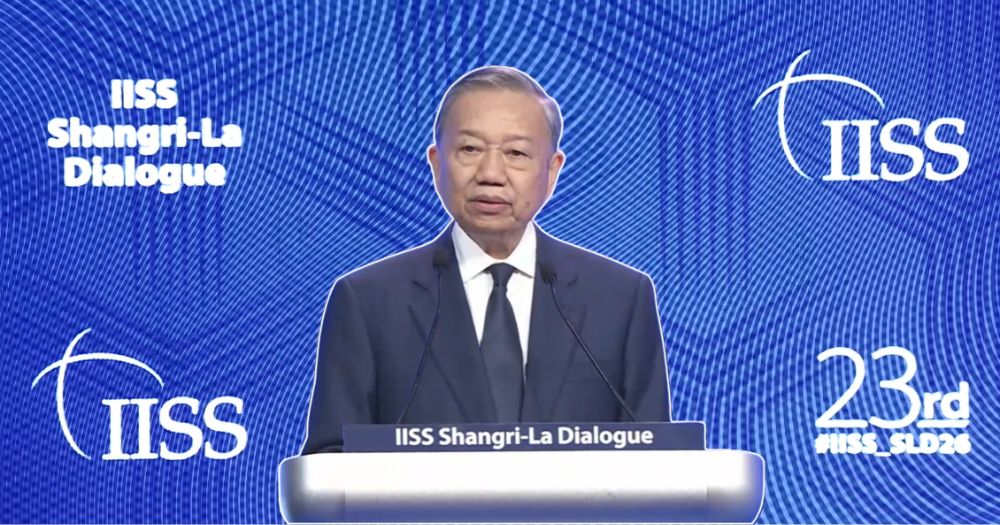
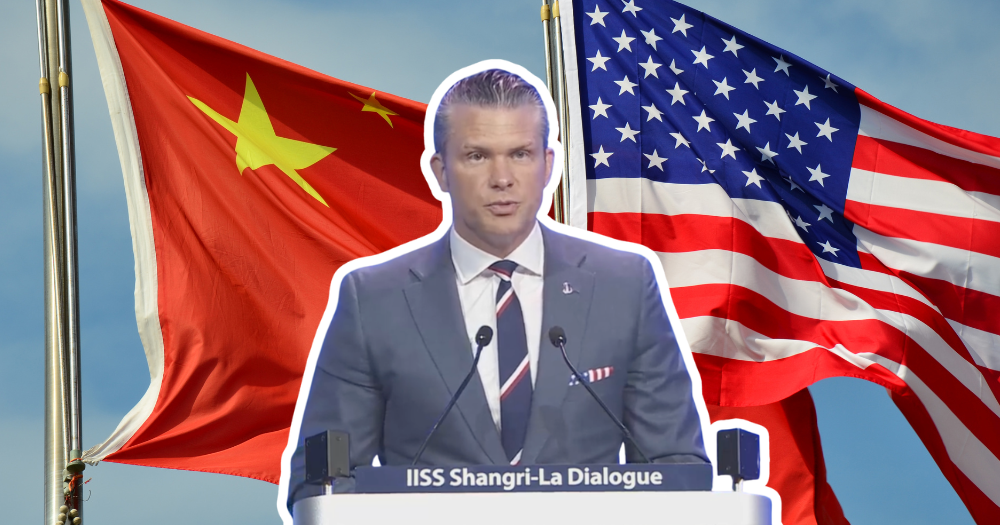
The United States seeks a stable peace with China, but also notes the "alarm" in the Asia Pacific region by China's "historic military build-up and the expansion of its military activities," U.S. Secretary of Defense Pete Hegseth said.
Speaking at the 2026 Shangri-La Dialogue in Singapore on May 30, he described relations between the U.S. and China under U.S. President Donald Trump's leadership as "better than they've been in many years".
Trump and his administration seek a stable peace, fair trade, and respectful relations with China, by taking a strong, quiet, but clear approach, Hegseth added.
He said that the "truly historic" discussions between Trump and Chinese President Xi Jinping during Trump's visit to Beijing in May 14 and 15 reinforced this foundation.
"They agreed that the United States and China should build a constructive relationship of strategic stability based on fairness and reciprocity, reaffirming that while our nations will vigorously protect our respective interests, we can secure practical, mutually beneficial agreements where our interests align."
Pairing dialogue with military strength
At the same time, the U.S. will also rely on its military might to underwrite its position even as it engages in dialogue.
Hegseth said his department, which he referred to as the War Department, seeks to ensure that Trump always negotiates "from a position of unquestionable strength" in order to sustain regional and global peace.
He explained that the department has been meeting more frequently with its Chinese counterparts to maintain open lines of military-to-military communication, which can allow them to coordinate, deconflict, and reduce the risk of miscalculation.
Their dialogue is not a sign of capitulation in either direction, he went on, but a "practical guardrail" to preserve the relationship the two countries' leaders seek at every level.
"While a decent peace is our goal, make no mistake, America is a Pacific nation, and we insist that China respect our longstanding position in the region — and not just insist, but maintain the manifest military strength to underwrite it."
Preserving the balance of power
The U.S. is concerned about stability in the Asia Pacific because the region has profound implications for the country's security and prosperity, Hegseth noted.
He called the region "the world's largest and most dynamic market area", and said that the U.S.'s defence department has been directed to set military conditions to achieve "a lasting and favourable balance of power" in the region.
Much of their concern about preserving this balance of power has to do with China.
"A Pacific dominated by any hegemon would unravel the regional balance of power and undermine the equilibrium we all seek to preserve."
He added that his department has been working hard to prevent any such unravelling, not through "needless confrontation", but with measured and deliberate strength.
"This is a model our Asian partners vastly prefer and have long followed. Our allies across Asia do not seek constant escalation, rhetorical theatrics, or a region defined by public confrontation.
What they want, and what the United States delivers, is strength that is discipline, resolve that is steady, and leadership that is confident enough to speak and walk softly while carrying a big stick."