



Court


Bloomberg's lawyer says ministers seeking 'most defamatory meaning possible' in article, Davinder Singh says Bloomberg's reading of article 'unconventional, incorrect'
Final arguments.
May 22, 2026, 04:46 PM
Top photos courtesy of Rafael


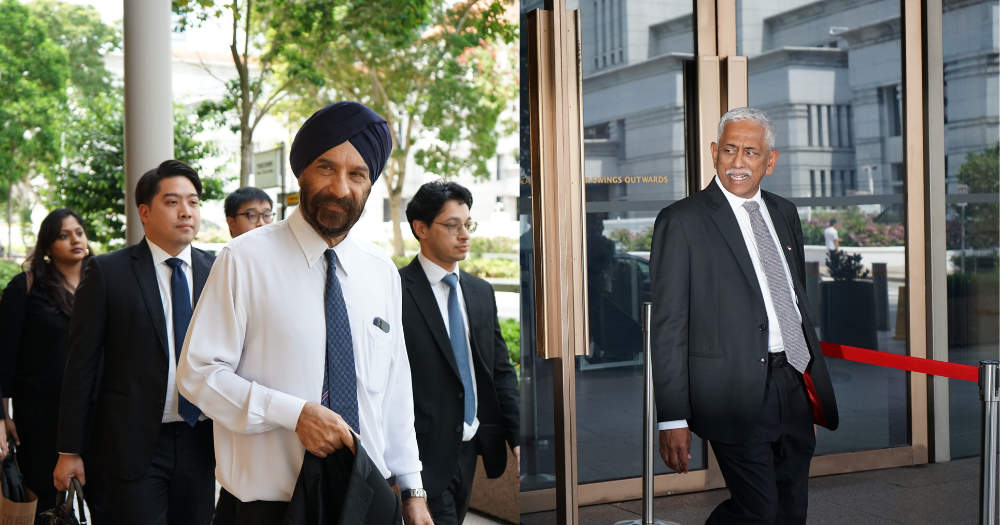
Senior Counsel Sreenivasan Narayanan, acting for media outlet Bloomberg and its reporter Low De Wei, said that the court should consider how an “ordinary reasonable reader” would have understood Low's article when it was published.
He said the article should not be viewed through the “sensitivity of the claimants” or the narrative built during cross-examination, adding that “what [was] not defamatory [was] now being argued as being defamatory”.
Narayanan was speaking in court on May 22 for the closing submissions of the Bloomberg defamation trial.
Minister for Home Affairs K Shanmugam and Manpower Minister Tan See Leng are suing Bloomberg and Low over a Dec. 12, 2024 article titled "Singapore Mansion Deals Are Increasingly Shrouded in Secrecy", which discussed Good Class Bungalow (GCB) transactions, caveats, trusts and the use of structures that keep some ownership details private.
The article also referred to Tan’s purchase of a Brizay Park GCB and Shanmugam’s sale of a Queen Astrid Park bungalow.
Defence: Article was about public transparency, not wrongdoing
Sreenivasan submitted that the article was about public concern over rising GCB prices, wealthy new migrants buying such properties, and the extent to which some transaction details are publicly available.
He said the article’s focus was on “what is available to the public, not what is available to the government”, adding that Bloomberg had described two different types of property records, even though the article did not specifically name REALIS (a URA platform with information on the Singapore property market) or INLIS (an SLA portal to obtain property and land survey information).
Justice Audrey Lim asked whether the public would know, simply from reading the article, that those descriptions referred to REALIS and INLIS.
Sreenivasan replied that members of the public “might know”, as one database was described as relating to caveats while the other concerned ownership records.
According to him, the article did not suggest that the government lacked information on GCB transactions or that either minister was involved in money laundering.
“The words used were harder to track, not impossible to track.”
He added: “Nobody has suggested that the government does not have the information, and nobody has suggested that either of the claimants are somehow involved in money laundering.”
Claimants: Bloomberg trying to "rewrite" article
Responding for Shanmugam and Tan, Senior Counsel Davinder Singh said the defendants had adopted an “unconventional and incorrect approach” on how the article should be read.
Singh argued that the question was not the “focus” of the article, but whether any paragraphs in it were defamatory of the claimants.
Singh said:
“It would appear that an ordinary reader would read secret to mean something different from absolutely secret.
“If you tell someone something is secret, do you have to tell someone that, ‘No, no. What I mean is it's not absolutely secret, it's partially secret’.”
Singh also questioned the defence’s argument that the article was only about purchases.
If that were so, he asked, why was Shanmugam, who was a seller, mentioned in the article at all?
Dispute over “political fodder”
A key point in Singh’s submissions was the article’s reference to Shanmugam’s property sale having become “political fodder”.
The Bloomberg article stated that Shanmugam’s Queen Astrid Park property was bought for S$7.95 million in 2003 and sold for S$88 million in 2023, and that opposition politician Chee Soon Juan had questioned how the valuation was determined and who the new owner was.
Singh argued that the phrase “political fodder” suggested scandal or controversy.
He said the article placed Shanmugam’s sale near references to secrecy, opacity and money laundering-related measures in the UK and New York, and that a reader would understand the article as implying wrongdoing, especially when it references the phrase, "source of wealth".
“Source of wealth makes no sense unless it’s about money laundering,” he argued.
Defence says claimants were "overly sensitive"
Sreenivasan rejected the claimants’ pleaded meaning, which was that the article falsely meant Shanmugam and Tan took advantage of a lack of checks, balances or disclosure requirements to transact property in a non-transparent way and avoid scrutiny, including possible money laundering scrutiny.
He argued that Shanmugam, as a seller, could not decide whether a caveat was lodged or whether the purchaser used a trust.
Sreenivasan said the claimants were trying to import a strained argument that Shanmugam’s “silence” had somehow been bought, even though this was not part of the pleaded defamatory meaning.
He argued: “What is not defamatory is now being argued as being defamatory.”
He also described internal Bloomberg references to Shanmugam as “irreverent” and perhaps disrespectful, but argued that such language did not amount to “targeting”, “venom” or a secret agenda.
He went on to describe: “People talk about powerful people behind their backs in irreverent terms. Children talk about their parents that way sometimes.”
POFMA and continued publication of article
The two sides also clashed over Bloomberg’s reliance on responsible journalism.
Sreenivasan argued that Bloomberg had taken steps such as referring to industry experts and making multiple attempts to obtain comments.
He said Tan had been told specifically that his transaction would be described as “off radar”.
On the Protection from Online Falsehoods and Manipulation Act (POFMA) correction direction issued against Bloomberg’s article, Sreenivasan said POFMA did not require Bloomberg to take the article down.
“POFMA is not censorship,” he said, adding that he himself had defended POFMA in international forums because it allows one to say what they are thinking, as long as the link to the government fact-checker website Factually is also provided.
He added that exercising one’s rights under POFMA should not be treated as an aggravating factor in a defamation claim brought by a private citizen.
What Bloomberg did after POFMA
Singh disagreed, saying that if Bloomberg wished to rely on responsible journalism, it had to consider the range of possible meanings available to the writer, not only the meaning Bloomberg now advanced in court.
Singh submitted that the case was “unprecedented” in terms of malice and aggravation, relying in part on the continued publication of the article, and Bloomberg’s addendum stating that it stood by its reporting despite the POFMA correction direction.
He added that Bloomberg did so even though the evidence was they did not check with Low about whether the statements were false or not.
He also argued that Bloomberg took active steps to draw more attention to the article by removing the paywall after the correction direction was issued, to gain "wider publicity", and pointed out that while Bloomberg said it "stood by" its reporting, it did not challenge the POFMA correction direction or make an appeal to the minister when it was first issued.
Bloomberg complied with court orders: Sreenivasan
Sreenivasan rejected allegations that Bloomberg had suppressed documents or acted improperly, saying the defendants had merely contested disclosure applications and complied with court orders.
He also responded to Singh’s argument that the reading of a Ministry of Law email in court was done to “play to the gallery”, saying the email had been given to him only while Low was still on the stand and that he could only put it to the witness in open court.
Case in brief
The suit centres on Bloomberg’s Dec. 12, 2024 article on GCB transactions, which included references to trusts, non-caveated deals, privacy, anti-money laundering concerns and the property transactions involving Shanmugam and Tan.
The ministers’ case is that the article conveyed defamatory meanings suggesting they had taken advantage of secrecy or weak disclosure requirements in their respective property transactions.
Bloomberg and Low deny the defamatory meanings and maintain that the article was a factual report on a matter of public interest.
The matter is before Justice Audrey Lim.