Abroad


'Isn't it strange?': Japan defence minister addresses 'new militarism' accusations, compares with China at 2026 Shangri-La Dialogue
Japan’s defence minister Koizumi Shinjiro delivered his remarks at the 2026 Shangri-La Dialogue in Singapore on May 31.
May 31, 2026, 11:51 AM
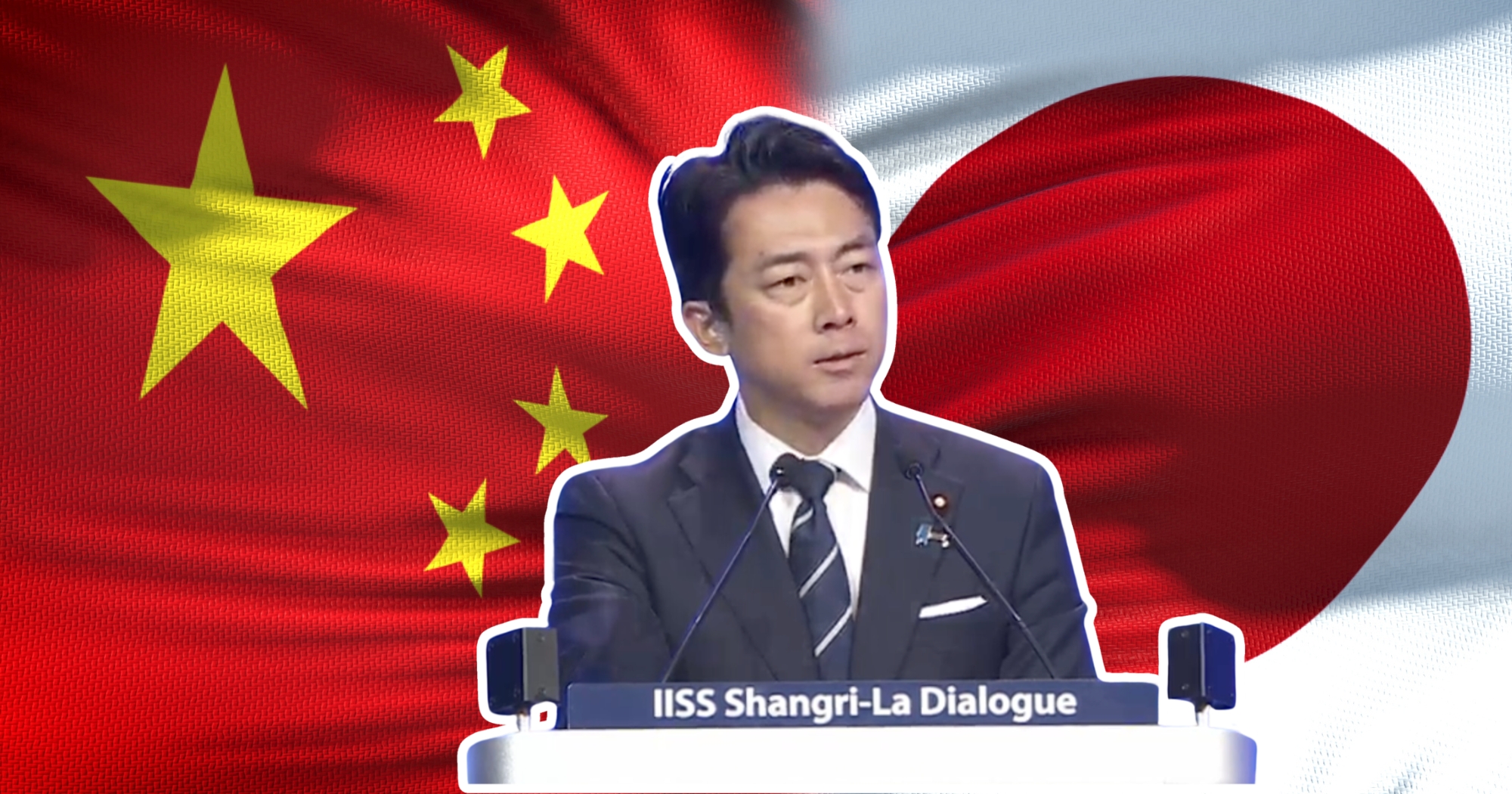
Photos from The International Institute for Strategic Studies' YouTube and Canva


"There is a country that has a huge arsenal of nuclear weapons and strategic bombers," said Japan's defence minister Koizumi Shinjiro, in remarks almost certainly directed at China.
Speaking at the 2026 Shangri-La Dialogue in Singapore on May 31, he noted: "Japan has neither of such weapons, and yet Japan is labelled new militarism."
He added: "Isn’t it strange?"
'Sad' he couldn't meet China's defence minister
The major annual defence summit taking place from May 29 to 31 in Singapore, where regional leaders and military officials are expected to discuss Asia-Pacific security issues, saw Koizumi noting that "Japan's past as a peace-loving nation has been valued by the region and by the international community."
Koizumi, the son of former Japanese prime minister Junichiro Koziumi, said that since the end of World War II, "Japan has consistently respected international law, including the Charter of the United Nations, and has made sincere efforts to maintain and strengthen a free and open international order."
He added that direct and candid dialogue is needed and highlighted that "Japan's door to dialogue is always open".
To that, he also said he felt "sad" that he could not meet his Chinese counterparts.
Chinese Defence Minister Dong Jun, for the second year in a row, has not attended the SLD.
Koizumi's remarks about "new militarism" came after China's foreign ministry spokesperson Guo Jiakun said on May 12, 2026, that Asia-Pacific countries should be "clear-eyed" and jointly reject the "reckless moves of Japan neo-militarism."
'Genuine reconciliation'
During the question-and-answer session, Chinese delegate Shen Zhixiong said he was very pleased that Koizumi had mentioned "new militarism" in his speech.
However, he pointed out that while Japanese leaders had recently expressed condolences at the Australian War Memorial to Australian soldiers who lost their lives during the Second World War, victim nations in Asia had supposedly not received an apology or expression of remorse from Japan.
Noting that China believes "genuine reconciliation must be based on a reflection of history that treats all victim nations equally", Shen wanted to know if the Japanese government was "prepared to respond in an equally serious and unequivocal manner to the concerns of China, South Korea, and the victim nations of Southeast Asia regarding the history of the Second World War".
He added that this would create the conditions for "mutual trust” and regional security".
Japan-Philippines defence relations
Koizumi also received a question from Renato Cruz de Castro from the Philippines, who noted that the Philippines and Japan had signed a comprehensive strategic partnership.
Calling it "an act of two sovereign nations and primarily intended for regional security", he added that China declared the agreement "null and void" and projected it as an "act of Japanese militarism" and a "threat to peace".
In that regard, he asked how the Philippines and Japan would address China's efforts to put their security partnership in a negative and bad light.
Addressing the meeting between Philippines President Ferdinand Marcos Jr and Japan Prime Minister Sanae Takaichi a few weeks after the Xi-Trump Summit in Beijing, he also asked how the summit influenced Manila and Tokyo's "calculation to forge a security partnership".
Japan answers
Following the questions, Koizumi said that Japan's defence policy was not aimed at any specific country.
He pointed instead to China's growing military spending and expanding military capabilities "without sufficient transparency", and called it a concern for Japan and the international community.
However, Koizumi said he previously expressed to Dong that it is essential to have persistent, candid dialogue and communication without turning away from concrete and difficult issues, precisely because challenges exist.
"Japan's door is always open. The Minister of Defence will continue to use, the Ministry of Defence will continue to use various channels and every available opportunity to communicate firmly with the Chinese side. So please give my best regards to my counterpart. Thank you."