



News


Why is Trump fighting to open a waterway that was open just a month ago?
If it can't be fixed, don't break it.
April 06, 2026, 05:55 PM
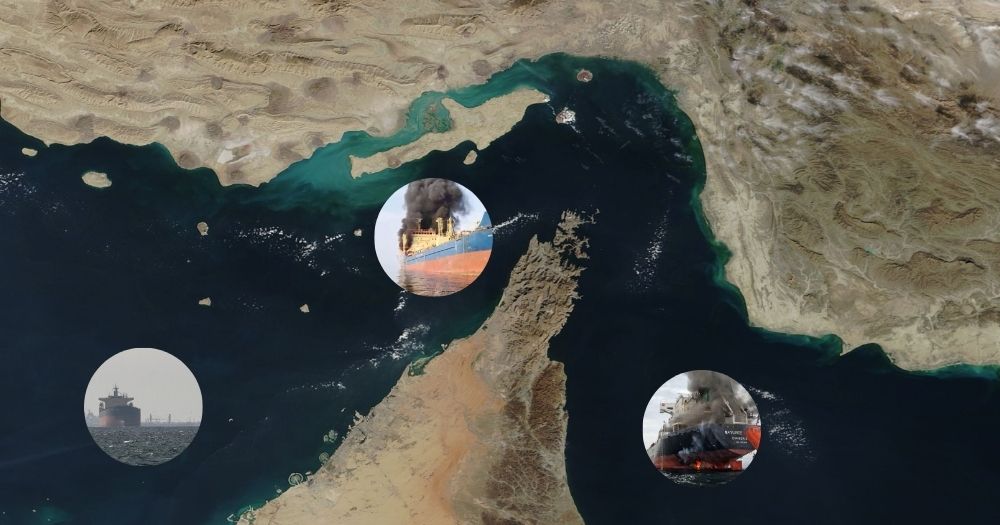


If the past month has done nothing else, it’s put the Strait of Hormuz on everyone’s map in a way it hasn’t been in half a century.
Even if you wanted nothing to do with geopolitics, to paraphrase Leon Trotsky, geopolitics has an interest in you.
And since we can no longer afford the petrol to drive away from this conversation, let's talk a little bit about why U.S. President Donald Trump is trying to reopen the Strait of Hormuz, especially when it was already open just a few weeks ago.
Narrow waterway
By now, most will be aware of the Strait of Hormuz, the narrow waterway (33km at its widest point) that separates the oil and gas rich states of Saudi Arabia, Kuwait, Iran, Iraq, Qatar, the United Arab Emirates from the rest of the world (although Iran and Saudi Arabia have access to non-Gulf waterways, they remain the primary export route).
The Strait falls within the territorial waters of Oman and Iran, but international shipping enjoyed “transit passage” during peacetime.
Maritime law expert Natalie Klein of the University of New South Wales, writing for The Conversation, states that the Strait is “used for international navigation between two high-seas areas, and thus defined under international law as an 'international strait'.
While the waters are subject to the sovereignty of Iran and Oman, all other states’ ships have navigational rights through the strait as long as they pass through "continuously and expeditiously.”
TL;DR: You can pass through, just be quick and keep moving.
Wartime
But that’s the law as it applies in peacetime.
Klein notes that in wartime, belligerent states, the states involved in the war, are not required to keep their straits open, and Iran is certainly at war, even if no one has formally declared it.
It also apparently considers itself not just at war with the United States and Israel, the two countries that attacked it directly, but also with almost all of its neighbouring states, because they housed U.S. military bases on their soil.
To underline that point, Iran has attacked U.S. bases and infrastructure targets in those countries, leading to a significant degradation.
Because of this, Iran has declared the Strait closed and has proven that it has the motivation and the means to do so.
Means and motivation
It has deployed a fleet of airborne and an armada of seaborne drones, attacking targets from the Bay of Basra in the north to the Gulf of Oman in the south.
When people hear “drone”, they may think of the Shahed-style loitering munition, made famous when Iran sold them en masse to Russia for use against Ukraine.
And while those are certainly in use, they also have seaborne drones of multiple types, the simplest being remote-controlled wooden boats filled to the gills with explosives.
A comment made by shipping analyst, historian, and YouTuber Sal Mercogliano, commercial shipping doesn’t stop when merchant mariners think all their ships will be hit.
It stops when ship owners, who have invested millions, if not billions, in their tankers, believe that any one of their ships could be hit.
In that way, the old IRA adage comes again to the fore: those trying to open the strait have to be lucky (to spot and stop every attack) all the time.
Iran only has to get lucky and strike a target once to reset the confidence clock at zero.
Tanker War
A simple, though not 100 per cent effective, way of shoring up that confidence is by guarding convoys of ships as they pass through the Gulf and the Strait.
This was done during the infamous Tanker War, which ran from 1981 to 1988.
The Iran-Iraq war, when the two countries fought a bitter war that ended in stalemate, also had an adjacent battle which saw both sides attempt to disrupt shipping through the strait (ironically, both sides export their oil from the northern end of the Gulf, meaning they both have to take the longest possible, and most dangerous, route out of the area).
By the late 80s, the United States was so tired of the situation that it deployed its navy to the Gulf to escort ships through the waterway, although at no small cost to its own ships and sailors.
Curiously, this was not done in this most recent conflict.
Ships vital for these sorts of efforts are not present in the area; the two destroyers configured to act against naval mines were docked in Penang at the start of hostilities, for reasons still unclear.
Cowards?
The other effort that Trump is attempting to open the Strait is simply to get someone else to do it for him.
He has goaded, nudged, belittled, and outright declared as cowards the countries that depend on the Gulf states for oil, namely the European and Asian states.
All have declined to join the war effort, or even send ships to help convoys, with commentators from those countries taking a “you broke it, you buy it” approach to the war.
How long that attitude can last remains to be seen.
Fuel prices and prices of oil and gas by-products like fertilisers are skyrocketing.
Rock the boat
Except for fertiliser, where the shipments there have simply stopped, perilous considering now is the spring planting season, so no matter what happens next, be prepared to remember this even after August, during the harvest.
But things can get worse: some analysts have said that in the next two weeks, the fuel crisis could go from catastrophic to apocalyptic.
The tankers that carry oil and gas from the Middle East that set out before the war are still on their way to their destinations, as explained in this article by the Brookings Institution.
They are only now beginning to arrive in Far East Asia or the Americas, and that means we are only now really entering a time where countries are really going to compete with each other for fresh supplies of fuel.
Even if the war ended tomorrow, and assuming no further disruptions to shipping, and ignoring the damage done to infrastructure already, it will be May before the full impact of the war is known.
Top image via Wikipedia, Reuters, and chaywat.hn.sithth.nu.sithth.nu/Facebook