
News


Is Trump really 'talking to himself' on the Iran war?
The answer is no, but not as definitively as we'd like.
March 29, 2026, 02:07 PM


It has been around five weeks since the U.S. and Israel launched strikes against Iran.
What started with a decapitation strike that killed many of Iran’s senior leadership has turned into an expensive stalemate, with Iran reminding the U.S. that they don’t really need a senior leadership to cause chaos in global shipping.
With many countries looking to enact energy rationing of some kind, many must have felt some kind of relief when U.S. President Donald Trump announced that he was negotiating with the remaining leaders of Iran to bring the war to a negotiated end.
But Iran responded with mockery, suggesting that the American president was delusional, even mocking him by saying he was “talking to himself”.
And this begs the question: Is Trump talking to himself? Or is he negotiating with Iran? And if so, who?
Obviously, facts on the ground are difficult to discern, both sides having their reasons to play their cards close to their chest.
2-minute sizzle reels of stuff blowing up
Let's start with the most concerning suggestion: That the U.S. president is essentially negotiating with himself to end the war.
The genesis of this concern is reports that suggest Trump is receiving less than honest information about how the war is going, and instead is given a daily briefing that contains a “two-minute sizzle reel” containing just footage of “stuff blowing up”, as reported by NBC News.
This is said to give Trump the impression that the war is going very well and that he is negotiating from a position of strength.
Trump has made a number of pronouncements in the past month, such as saying on Mar. 11 that Iran’s missile capability was largely destroyed, but attacks continue, such as the one on Dimona, where Israel’s main nuclear research facility is housed, occurring 10 days later, showing that perhaps it wasn’t as destroyed as initially thought.
The claim that Trump is negotiating with himself is essentially the position that Iran was willing to fight to the bitter end, no matter the cost.
But it should be noted that the mockery of Trump’s position largely comes out of Iranian embassies, such as the one in South Africa, which is pretty far from an official government spokesperson.
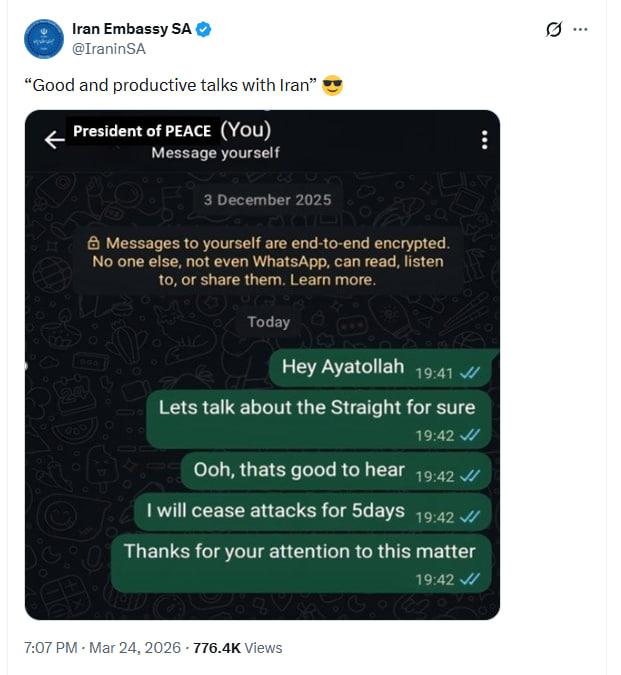 Image via @iraninsa/X
Iran's proposals
By all indications, some kind of negotiation is taking place, with the Pakistani government acting as the chief mediator, although other governments, like Malaysia, have offered their services in this regard.
One of Singapore’s most senior former diplomats, Bilahari Kausikan, has weighed in, saying on Mar. 25 that he believed that direct talks were already underway (do note, he was offering an opinion, not sharing specific knowledge).
Trump issued a 15-point proposal to end the war that Iranian media said was rejected out of hand, and that the end of the war would happen on Iran’s terms, not Trump’s.
But highlighting the fact that they are looking for some kind of end to war is the fact that they then issued a 5-point proposal, published by the Iranian outlet Press TV:
- A complete halt to "aggression and assassinations" by the enemy.
- The establishment of concrete mechanisms to ensure that the war is not reimposed on the Islamic Republic.
- Guaranteed and clearly defined payment of war damages and reparations.
- The end of the war across all fronts and for all resistance groups involved throughout the region.
- Iran's exercise of sovereignty over the Strait of Hormuz is and will remain Iran's natural and legal right, and it constitutes a guarantee for the implementation of the other party's commitments, and must be recognized.
Iran is clearly responding, so some type of talks are taking place, which is a sign that both sides want hostilities to end.
No-hit list
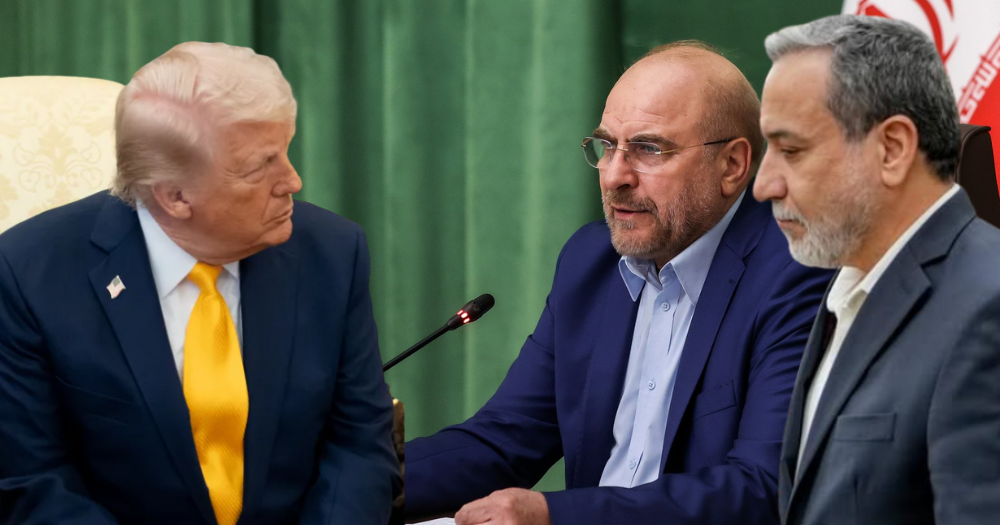
Another indication was a report in The Wall Street Journal on Mar. 25 that Iran’s Foreign Minister Abbas Araghchi and Speaker of Parliament Mohammad-Bagher Ghalibaf were taken off a U.S. and Israeli “hit list”.
The reprieve is reportedly “temporary”, but suggests that Pakistan’s leaders, who pressed for the reprieve, with an unnamed source telling Reuters that “if they were also eliminated then there is no one else to talk to”.
This suggests that Iran’s senior leadership is now worryingly thin, especially in light of the fact that the incumbent Supreme Leader, Mojtaba Khamenei, son of the assassinated Ali Khamenei, has not been seen in public since the start of the war.
Field command and no control
If that leadership tier should thin even more or be eliminated, chaos might ensue but there is no guarantee the Iranian regime will collapse, or even that the war might end.
An Al Jazeera report says that command of Iran’s fleet of mobile launchers has been given to field commanders, meaning that missile attacks can continue regardless of how many senior leaders are killed.
It might even mean that similar autonomy has been given to commanders of drone forces, meaning that attacks on neighbouring states and Strait of Hormuz shipping can continue unabated, as Iran’s preparation for this conflict appears to have been quite robust, down to hiding missile stockpiles and resupply.
The only thing such forces would lack is someone senior enough to tell them to stop.
Top image via White House Gallery, @mb_ghalibaf/X, & @araghchi/Instagram