News


Tearful reunions at Changi Airport as S'poreans return on 1st Dubai flight since Middle East conflict
“Almost every other day, you could hear loud explosions."
March 05, 2026, 01:28 PM
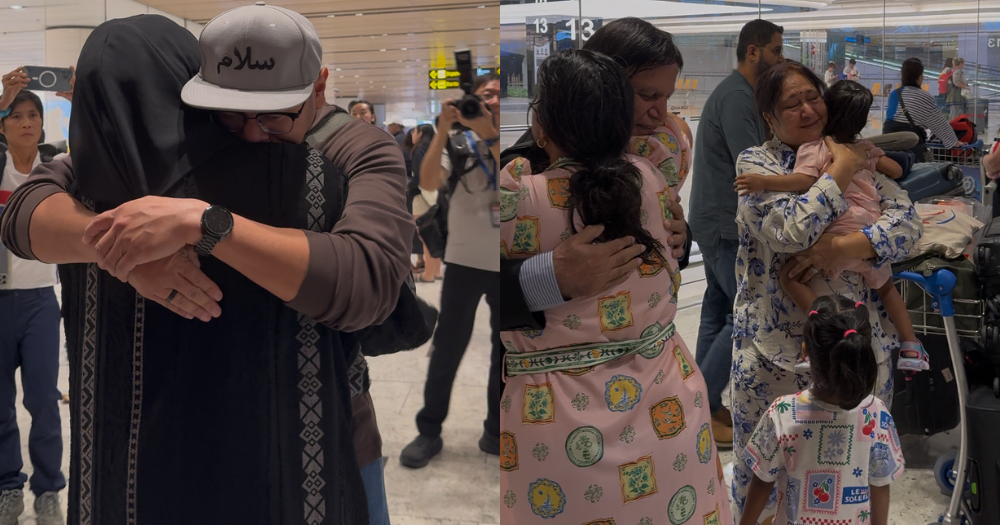


Families embraced loved ones at Changi Airport as the first flight from Dubai carrying Singapore residents, who were stranded by the escalating conflict in the Middle East, landed this morning (Mar. 5).
Emirates flight EK314 departed Dubai at about 9pm local time on Wednesday (Mar. 4) and touched down in Singapore shortly after 8:15am.
The arrival came after widespread flight cancellations across the region following hostilities involving Iran, Israel and the U.S., which led several countries to close their airspace.
Airlines had earlier announced that only a limited number of flights would operate as the situation unfolded, with Singapore Airlines and Scoot cancelling several flights between Feb. 28 and Mar. 1.
For some passengers, the moment of stepping onto Singapore soil marked the end of days of uncertainty abroad.
Tearful reunions at Changi Airport
Among those returning was Muhammad Hafiz bin Noorahman, a board member of humanitarian organisation Mercy Relief, who had been in the region carrying out aid work when the U.S.-Israel war on Iran intensified.

At the arrival hall, he ran towards his wife and embraced her in an emotional reunion.
“I’m very grateful to finally touch down in my homeland,” he told Mothership, visibly relieved.
Hafiz had travelled with colleagues to the West Bank in Palestine to support relief and development projects, including initiatives involving water treatment, agriculture and food aid in refugee camps and villages.
However, the worsening security situation forced the team to shorten their mission.
“We managed to do quite a number of things there, but because of the situation we had to cut the trip short,” he explained.
Explosions were a regular occurrence
During his time in the region, Hafiz said the sound of explosions became a regular occurrence.
“Almost every other day, you could hear loud explosions,” he recalled. “You get goosebumps hearing them, and we even saw missiles flying overhead.”

“They [the locals] told me, 'brother, don’t worry, don’t worry', that it was normal for them [...] People were still going to work and carrying on with their daily lives.” he said.
Through alerts on his phone, Hafiz received warnings about missile strikes and instructions for residents in some areas to seek shelter, though he noted that such facilities were not always available in Palestinian areas.

Now back in Singapore, his priorities are simple.
“I just want to spend time with my family,” he said.
Uncertainty as conflict escalated

At Changi Airport, Ashok K. Batura, Honorary Consulate-General of the Consulate of the Republic of Malta, and his wife were greeted by their daughter and grandchildren, who held up a brightly decorated “Welcome Home” sign covered with colourful stickers.
He said the uncertainty surrounding flights had weighed heavily on travellers.
“Everyone was worried about whether we could take off or not,” he said. “But everything went well in the end.”
For families waiting in Singapore, the situation had been difficult to comprehend.

“People back home cannot imagine what is happening over there,” he said. “It’s a war, you know, anything can happen.”
While in Dubai, he said authorities were closely managing the situation on the ground.
“There was a lot of commotion at the start, but we were constantly receiving updates."
At one point, he said, officials reported that more than 100 missiles had been intercepted, preventing potentially devastating damage.
“If even one had landed, it could have been disastrous."
Throughout the crisis, he credited Singapore’s diplomatic missions in the region for keeping travellers informed.
“They gave constant updates and advice, and they shared contact numbers so people could reach them."
Singapore’s Ministry of Foreign Affairs (MFA) had earlier said there were no reports of Singaporean casualties in Iran, Israel or the wider Middle East region, but advised Singaporeans to defer all travel to the region.
Singapore’s embassies in the region had similarly advised Singaporeans to stay indoors and avoid going out unless necessary.
Relief at returning home

As the arrivals hall continued to fill with hugs, smiles and relief, many other passengers also said they were simply grateful to be back in Singapore.
For economist Carl Rajoo, returning home had taken several attempts.
“It was stressful,” he said. “You think you’re going home, but the flight gets cancelled again and again.”
Rajoo said the uncertainty persisted until the final hours before departure.
“Even today’s flight wasn’t guaranteed,” he said. “But when I saw on the news that the flight was scheduled to arrive in Singapore, I felt there was a bigger chance it would actually happen.”

When Mothership asked what went through his mind when he first heard the loud bangs and explosions during the conflict, he laughed before replying: "Very negative stuff.”
Cynthia, a 63-year-old Singaporean who had been on a holiday in the Middle East, echoed similar sentiments.

“We heard the bombs, and it was very frightening,” she said. “Some people saw missiles exploding in the sky with smoke and fire.”
Despite the anxiety of the past few days, the Singaporeans Mothership spoke to shared a similar sentiment upon finally touching down.
They were simply looking forward to spending time with their family and loved ones again.
All photos by Mothership