


News


PM Wong is attending China's Boao Forum. What's it about, & why is it significant?
Basically China's version of the World Economic Forum.
March 25, 2026, 11:42 PM


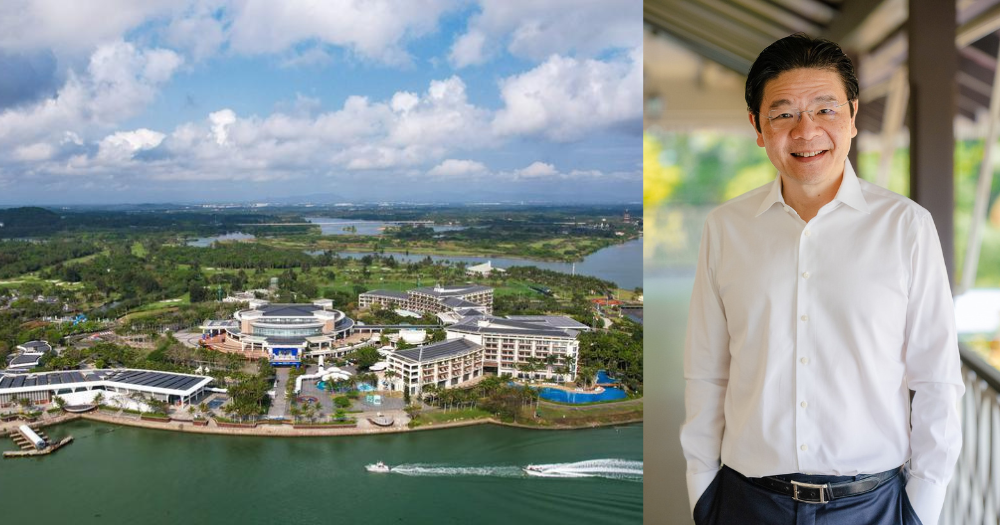
Prime Minister Lawrence Wong is making an official visit to Hainan and Hong Kong, China from Mar. 25 to 28.
In line with his trip, he will deliver a keynote address at the Opening Plenary of the Boao Forum for Asia (BFA) conference in Bo'ao, Hainan, the Prime Minister's Office (PMO) said on Mar. 24.
While it isn't the first time a Singaporean premier has make his appearance at the annual high-level conference, this marks PM Wong's first attendance since taking office in 2024, and his second official visit as PM to China.
But what exactly is the BFA, who will be there and why is PM Wong's attendance this year significant?
The Asian Davos
The Boao Forum for Asia, or BFA, is a non-governmental, non-profit organisation that provides a dialogue platform for governments, enterprises, experts, and scholars to discuss key issues in Asia and the world.
It was founded by 26 member states, including Singapore, in 2001, the same year China joined the World Trade Organisation (WTO).
Sometimes touted as the "Asian Davos (or World Economic Forum)", the BFA was originally meant to promote integration economic integration in Asia, but now focuses on pooling "positive energy for the development of Asia and the world", according to its official website.
It has traditionally been attended by Asian heads of government, but has also featured leaders from outside of Asia such as Australia, Norway, Russia, Brazil and South Africa.
High-profile, non-political figures like billionaires Bill Gates and George Soros have also once made appearances.
This year's forum
This year's conference, themed "Shaping a Shared Future: New Dynamics, New Opportunities, New Cooperation", is held from Mar. 24 to 27.
The forum will see about 2,000 representatives from over 60 countries, bringing together leaders from government, business, and academia.
Zhao Leji, the third-ranking member of Standing Committee of the Political Bureau of the Chinese Communist Party (CCP), will lead China's delegation this year with a keynote speech. He will also meet with PM Wong.
While it is unclear what will be highlighted in Zhao's speech, China's vice premier Ding Xuexiang used his speech in 2025 to pledge stronger policy support for his country's economy.
PM Wong, who is similarly expected to make an address this year, is one of a handful of top foreign leaders at the forum.
He is joined by South Korea's prime minister Kim Min Seok, Kazakhstan's first deputy prime minister Roman Skylar, Sri Lanka's speaker of parliament Jagath Wickramaratne and Azerbaijan's speaker of the National Assembly Sahiba Gafarova.
Singapore's ex-foreign minister George Yeo also spoke on a panel discussion of the forum on Mar. 24, where he encouraged Hainan, not traditionally a major trading partner with Singapore, to establish free trade agreements in services with Asean countries, specifically Singapore.
PM Wong will be the third Singaporean premier to speak at the forum.
In 2003, then-Prime Minister Goh Chok Tong delivered a keynote address while Singapore was among the early participants.
Goh was subsequently also inducted into BFA's board of directors in 2010 and continued being an attendee at the summit until 2017.
Most recently, Senior Minister Lee Hsien Loong, then in his capacity as Prime Minister, also made a keynote address at the 2023 iteration of the forum.
He spoke on deepening regional integration within Asia and beyond, sustaining U.S.-China relations and ensuring Asia remains interconnected.
Why this year's forum is significant
This year's forum comes amidst rising global tensions and strains to the global economy due to the ongoing Iran war.
"Against a backdrop of rising geopolitical tensions, economic fragmentation and technological transformation, the event is widely expected to provide forward-looking insights and "Boao solutions" for a world in search of certainty," its website wrote, spotlighting four increasingly discussed themes.
They are:
- Multilateralism to anchor certainty
- Regional cooperation as a stabilising force
- Innovation and AI unlocking new growth drivers, and
- Openness and inclusive development for a shared future.
Singapore and China have long-established economic ties, stemming from 35 years of diplomatic relations.
China was Singapore's largest merchandise trading partner from 2013 to 2024, and its third-largest trading partner for services trade in 2024.
Since 2013, Singapore has also been China’s largest foreign investor in terms of investment flow.
Visit after Japan
PM Wong's appearance at the BFA, coming on the tails of his visit to Tokyo, Japan earlier this month, also marks his first meeting with the Chinese government since China-Japan ties soured in November 2025 over remarks Japanese PM Sanae Takaichi made in parliament.
PM Wong addressed the tensions on Mar. 18 at the wrap-up interview of his Japan visit, emphasising that Singapore can be friends with both China and Japan despite tensions between the two countries.
"The history is important, we cannot forget the history," he said.
"But at the same time, we do not allow ourselves to be trapped by history. Remembering the past does not mean we cannot move forward to forge a mutually beneficial relationship with Japan."
He added, "Of course, not all countries in the region feel the same way."
He reaffirmed that Singapore is a friend to both China and Japan, adding that China "knows about [his] visit" to Japan and has continued to invite him to the Boao Forum nonetheless.
“We do not see this as a zero-sum affair. Having good relations with one does not come at the expense of another.”
Outcomes of previous iterations
In previous years' iterations of the BFA, initiatives on sustainability, trade and geopolitics emerged, some of which continue to be relevant today.
In 2018, Chinese president Xi Jinping announced plans to open up China's economy, including lowering tariffs on imported autos amid brewing trade tensions with the U.S.
The declaration came after China filed a complaint to WTO against then-first-term U.S. president Donald Trump's tariffs on imported steel and aluminium.
Xi also introduced China's Global Security Initiative in the 2022 conference, a commitment to uphold global sustainable security by eliminating the root causes of international conflicts and to abide by the principles of the UN Charter.
"Security is the precondition for development. We humanity are living in an indivisible security community," he said then.
China's relationship with its main economic rival U.S. has also been a recurring topic of discussion.
At the 2025 conference, former U.S. secretary of commerce Carlos Gutierrez told state media Xinhua that both countries "have to be together for humanity's common good".
"Humanity doesn't improve if we are on different sides," he said.
Gutierrez also urged panellists at the forum to consider what a “new system” would be if the world failed to return to a rules-based trading system guided by the WTO.
His comments came amidst Trump's steel and aluminium tariffs against China, Canada and Mexico, and about a week before the introduction of Trump's now-notorious global "Liberation Day" reciprocal tariffs.
Top images via Xinhua & Lawrence Wong/Facebook