News


How is Iran still managing to export millions of oil barrels even with the war & bombings?
Around the region, consumers have felt the impact on their wallets and at the petrol pump, with petrol and electricity prices rising across Asia.
March 23, 2026, 10:21 AM
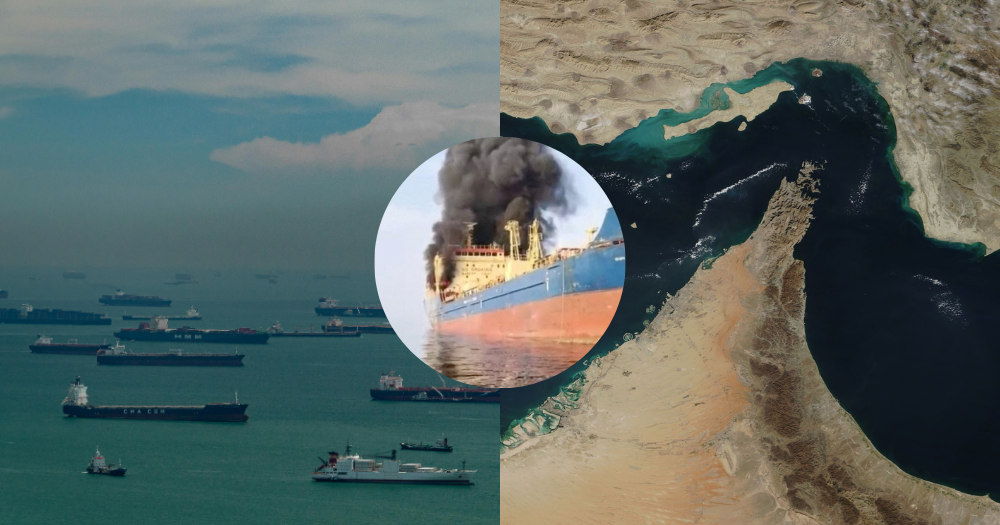

 On Mar. 18, the Associated Press reported that Iran had managed to export over 16 million barrels of oil since the start of the U.S. and Israel’s bombing campaign against Iran on Feb. 28.
Dire Straits
The three-week-long war against Iran has seen the price of oil rocket to around the US$100 (S$128) a barrel mark, and high energy prices have led to fears of economic slowdown or recession.
Some analysts believe that if the war were to be prolonged, prices could rise as high as US$150 to US$200 (S$192 to S$256) a barrel.
Around the region, consumers have felt the impact on their wallets and at the petrol pump, with petrol and electricity prices rising across Asia.
The main cause for the increased prices is the fact that hundreds of ships and tens of millions of barrels of oil are now trapped on either side of the narrow Strait of Hormuz, as Iran threatens to retaliate against the war by attacking shipping.
Perhaps the most surprising thing to know about the military campaign against Iran is that it has not had a debilitating impact on how much oil Iran is exporting.
Shipping forecast
A report by global shipping analyst Kpler estimated more than 16 million barrels of oil had been exported by Iran since the start of hostilities on Feb. 28, about 840,000 barrels a day.
According to a 2024 report by the U.S. Energy Information Administration estimated that Iran was exporting around 1.5 million bpd in 2023, and sources such as Vortexa generally agree with that amount.
So while Iran’s oil exports have been severely affected, they are still significant, especially when compared to their neighbouring countries, whose exports are all but frozen due to possible Iranian attacks.
How Iran has done this has two relatively simple explanations:
Jask
Iran has an oil export terminal at Jask in the Gulf of Oman, on the other side of the Strait of Hormuz, so tankers loading there do not need to pass through the strait.
It is not known precisely how much oil can be exported through the Jask facility, but a CNBC report indicates that the facility was previously rarely used, but since the start of the war, it has seen significant "renewed activity".
Kharg
However, most of Iran’s exports pass through a facility at Kharg Island, over 400 kilometres westward from the Strait, or in other words, deep inside the Persian Gulf and highly affected by the Strait’s closure.
It handles 90 per cent of Iran's exports and is the main port through which Iran's oil is exported.
Kharg was attacked by the U.S. in recent weeks, although the attacks targeted military facilities, not export infrastructure.
However, rumours are that the U.S. might attempt a land invasion of the island in the near future, with an amphibious assault ship with over 2,000 marines, the USS Tripoli, believed to be on its way to Iran.
Running the gauntlet
The corollary to the second factor is that the tankers filled with Iranian oil still have to transit the Strait of Hormuz.
The Strait is so busy that two lanes have been designated in international waters, one lane for entry and one for exit, and both these lanes are effectively closed at the moment, although not officially so, as U.S. defence secretary Pete Hegseth noted, saying the only thing preventing shipping was Iran shooting at passing ships.
That said, for obvious reasons, tankers carrying Iranian oil are having an easier time passing through the strait, i.e. probably being shot at less, but are also probably bypassing the official lanes.
Marine Shipping Analyst Sal Mercogliano suggests that the “chokepoint” of the Strait of Hormuz has been turned into a “checkpoint”, with the Iranian government operating checks on a handful of ships in the strait-within-a-strait that is the Larak Qeshm Gap, a body of water between two Iranian-controlled islands.
Analysts have tracked several ships of Indian and Pakistani origin transiting through the gap and then taking routes that significantly differ from usual through the Strait of Hormuz, and it is suggested that countries such as China might negotiate directly with Iran’s government to do the same.
The BBC has also reported that over 100 ships have taken a more “YOLO” approach to getting through: they simply turned off their identification systems and ran the gauntlet, hoping not to get hit.
Sanctioned behaviour
But at the time of this article, a surprising piece of news dropped: The U.S. has dropped sanctions on some Iranian oil.
Iran's oil has been under sanction for nearly 40 years, with a brief interlude between 2015 to 2016 after the signing of the Joint Comprehensive Plan of Action (JCPOA), an Obama-era plan to address concerns about Iran's nuclear program.
Sanctions on Iran were reimposed by the U.S. in 2017 during the first presidential term of U.S. President Donald Trump, after he dismantled the JCPOA.
Ironically, despite Trump and the government of Israel not endorsing the JCPOA, it was a suggested breach of its inspection regime that provided the justification for the 2025 attacks on Iran.
As a result of the sanctions, Iran has exported far more oil than it has actually sold, with much of the oil “on the water” or “floating”, stored in large tankers that roam the seas, waiting for an opportunity to offload their stock.
Drop it like its hot
USA Today reported that U.S. Treasury Secretary Scott Bessant suggested that sanctions might be dropped on the floating oil, specifically, in a similar way that sanctions were recently dropped on Russian floating oil, but maintained on export oil.
This might seem like a technicality to some, but it remains an odd way that the U.S. might use to try to mitigate the impact of its war.
Despite the fact that the end of the war has been heralded by Trump for the better part of the past two weeks, it remains unclear how or when it will end.
Both sides are attempting to become more flexible, in Iran’s case, in how it physically transports oil, and for the U.S., how it restricts it.
But this simply explains why Iran's oil has been allowed to continue to be exported, despite tanker seizures related to other conflicts like Ukraine and Venezuela.
In the short run, the money it gains is unlikely to turn the tide of the war, but further restricting its exports will lead to oil prices spiking even further.
At the moment, the main threat to the U.S. campaign isn't Iran, it's the domestic political and economic fallout.
Top image via Wikipedia, Canva, & Reuters