News


S'pore rebuts Australian podcast's 'baseless claims' calling S'pore '1-party state', 'autocracy'
The discussion centered on Singapore's political system and the removal of former LO Pritam Singh.
March 17, 2026, 02:59 PM

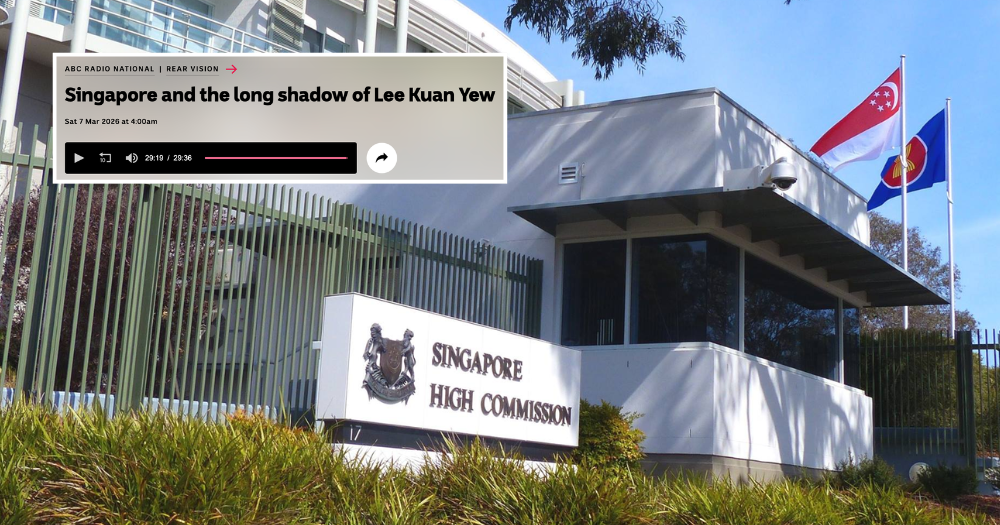
 A podcast episode on Australian news outlet ABC Radio National has been debunked as containing "baseless claims" by Singapore's High Commissioner in Canberra, Anil Nayar.
The episode, titled "Singapore and the long shadow of Lee Kuan Yew", discussed Singapore's political landscape while centred on the Jan. 15 ousting of Singapore's former Leader of the Opposition (LO) Pritam Singh.
Among others, it called the nation a "one-party state", an "autocracy" and "verging now on a flawed democracy".
The episode's host, Antony Funnell, and several of his commentators also scrutinised the Group Representation Constituencies (GRC) system, calling it a "tactic" to obstruct the opposition.
'Baseless claims'
Nayar called the episode's presenters' words "baseless claims", in a response issued by the Ministry of Foreign Affairs (MFA) on Mar. 17.
He said: "From listening to your programme, your audience would not have known that Singapore, alone among Southeast Asian nations, has never declared a state of emergency or suffered martial rule, and never once failed to hold regular elections, throughout its history as an independent nation."
"Nor would they have heard that almost every constituency was contested in last year’s general election, which saw the largest number of candidates from multiple parties and independents in our history."
Nayar also debunked claims that the GRC system was designed as a "roadblock".
He argued that the Workers' Party's (WP) victory in two GRCs in recent elections, faring better than Single Member Constituencies (SMCs), proves that GRCs are not insurmountable.
Podcast did not mention Pritam Singh's conviction of lying to a Parliamentary committee
Nayar also discredited the episode's discussion of Singh's removal as LO, saying that it failed to mention the "key fact" of his criminal conviction for lying to a Parliamentary committee.
He also took issue with a commentator's "serious allegation" of the impartiality of Singapore's judiciary in political cases, saying it was made with no evidence.
"Singapore’s courts are widely respected internationally for their integrity, professionalism, and independence," said Nayar, who added that the claim "beggars belief".
"We are not surprised that the commentators chosen for the programme were critical of Singapore’s system. Some have expressed similar views for decades, and made repeated predictions of Singapore’s political collapse."
In spite of this, Singapore has confounded these predictions while its political system and electorate evolve, Nayar added.
He slammed the news outlet: "What is surprising is that the ABC, a reputable national broadcaster, aired a programme that presented such a one-sided account and fell short of the standards of journalistic rigour that your listeners would expect."
Claims made in the episode
The nearly 30-minute long episode was released on Mar. 7 by the Australian public service radio network.
Funnell called Singh "no ordinary opposition leader", adding that "his tenure in that position came and recently went at the whim of the ruling People's Action Party, the PAP."
"That he was sacked not by his own side, but by the party he opposes says much about the peculiar nature of what Singapore calls its democracy."
'One-party state', 'flawed democracy'
Funnell further cited critics in calling Singapore a "one-party state" and verging on a "flawed democracy".
A commentator said: "While it's free and fair, on election day, there are a wide range of roadblocks set up to make it very challenging for anyone but the longtime ruling party, the People's Action Party, to win."
"It's verging now on a flawed democracy, but it's still really competitive authoritarianism."
Doubling down on this claim, Funnell further referred to Singapore's political system as an "autocracy".
Lee Kuan Yew
Referring to founding Prime Minister Lee Kuan Yew, he said, "He was urbane, he was articulate, but he was also ruthless, wasn't he?"
Michael Barr, an Associate Professor at Flinders University and a frequent commentator on Singaporean politics, replied, "Absolutely."
Barr added: "Those two things, autocracy and collegiality, he always struggled to make those mix, and there was no question, when he was around, he was the epitome of the clever autocrat."
Another commentator, Hong Kong Metropolitan University's Stephan Ortmann, claimed that Singapore became a one-party state after Lee and his Cabinet consolidated power by "using all kinds of methods to get rid of the opposition".
'Tactics' and the GRC system
The host and his commentators also delved into what they referred to as the PAP's "tactics" in consolidating power, especially after losing their first seat to the WP's J.B. Jeyaretnam in 1981.
These included changing the Constitution and rules for the eligibility for presidency, they alleged.
The introduction of the GRC system in 1988 was also cited as an example of such, with Funnell claiming it has traditionally benefitted the PAP.
National University of Singapore's (NUS) Gillian Koh pointed out that the system has been routinely criticised for making it difficult for smaller opposition parties to contest.
"It's what you call a hyper majoritarian system. It seems to raise the barriers of entry for small parties," she said.
Funnell said suggested that "old political habits die hard", in light of Singh's removal from his post.
"It is so hard in Singapore to fight...any political fight, against the government, and still be around to fight the next one," he alleged.
Top images via ABC Radio & Singapore High Commission in Canberra