



News


Why is Trump threatening to attack Iran again after 'obliterating' their nukes just last year?
Mothership Explains.
February 27, 2026, 07:23 PM


On the evening of Jan. 18, 2026, the USS Abraham Lincoln, a U.S. Navy nuclear aircraft carrier, transited through the Singapore Strait, travelling westward.
It was making its way to the seas off Iran and is now one of two aircraft carriers within striking distance of Iran, even engaging in anti-drone operations.
Alongside the carriers is an armada of warships, as well as hundreds of fighter jets, bombers, and associated support aircraft, waiting for a potential conflict between the U.S. and Iran to break out.
But why is a conflict between the U.S. and Iran brewing now, especially after the supposedly decisive series of airstrikes in June 2025 was meant to put Iran’s threat to bed?
The Great Satan
Relations between the Islamic Republic of Iran and the United States have never been friendly, but it has rarely devolved into open conflict.
This was true until June 2025, when long-simmering tensions between U.S. ally Israel and Iran finally came to a head.
After the United Nations nuclear weapons watchdog, the IAEA, said it could not verify a significant proportion of Iran’s nuclear stockpile, Israel decided to target Iran’s nuclear programme in a nearly two-week-long bombing campaign.
But the most critical portions of that programme were held in underground bunkers that could only be attacked when the U.S. joined Israel’s campaign and used its bunker-busting bombs.
U.S. President Donald Trump lauded his military’s efforts as “perfectly executed” and said that Iran’s nuclear program had been “completely and totally obliterated”.
So the question of “why now” looms.
Why now?
Outlets such as Vox and Bloomberg, echoed by publications like Foreign Affairs, question the motivation and timing of Trump’s threats against Iran.
There are rumblings, vociferously rejected by Trump, that even the U.S. military’s highest-ranked officer, the Chairman of the Joint Chiefs of Staff, Daniel “Razin” Caine, has misgivings about the military venture.
The UK, usually a staunch ally, has reportedly not given permission for its airbases to be used in strikes on Iran, resulting in the U.S. basing a significant proportion of its F-22 fighters in Israel.
CNN has speculated on three factors that together suggest a reason for military action: Iran’s missile arsenal, the violent crackdown on protestors, and its nuclear program.
Missiles
During the Feb. 24 State of the Union Speech, Trump claimed that Iran would soon possess missile technology that would allow it to strike the U.S. mainland, something that sites like NBC News disputed (the ‘soon’ part, not that Iran was working on it).
But the concern doesn’t emanate from nowhere: Iran has long supplied proxies like Hamas and Hezbollah with rockets that they used to attack Israel.
In the 2025 conflict, Iran retaliated directly by showing previously unused missile capability by launching hundreds of missiles directly from Iran to Israel.
Nuclear devices are only one component of a nuclear arsenal; just as critical are the weapons used to deliver them.
Iran’s missile capability is thought to remain largely intact, as it was not the main target of the 2025 campaign, so a new wave of airstrikes might seek to target them more directly.
Protests
Humanitarian concerns regarding Iranian anti-regime protestors seem an unlikely reason by itself for the U.S. to commit to a regional conflict, but it could be an indication that the Iranian regime is weaker than ever.
Either Israel or the U.S., or both, might seek to take advantage to force diplomatic concessions or enact regime change.
However, it should be noted that one consistent aspect of Trump’s “peace president” rhetoric is lamenting the loss of civilian life, and the Iranian regime's response to the protest allegedly resulted in thousands of deaths; and Trump reacted by threatening military intervention.
Nuclear
But the real question is Iran’s nuclear program, which is unlikely to be as permanently destroyed as Trump indicated, and Iran likely retains some capability to reconstitute its nuclear program.
A leaked report in 2025 suggested that the Iranian program was only minimally affected by the bombing campaign, which the Trump administration deftly deflected by calling the leaker a “loser”.
Nonetheless, Trump promised in his State of the Union speech that Iran would never be allowed to have a nuclear weapon, but said he was willing to make a deal to allow that to happen.
“We are in negotiations with them,” Trump said. “They want to make a deal. But we haven’t heard those secret words: we will never have a nuclear weapon.”
PRESIDENT TRUMP on IRAN: My preference is to solve this problem through diplomacy, but one thing is certain: I will NEVER allow the world’s number one sponsor of terror to have a nuclear weapon.
We have to be strong. It’s called peace through strength. pic.twitter.com/0CPKHtvQDt
— Department of State (@StateDept) February 25, 2026
Negotiations
Those negotiations are ongoing in Geneva, Switzerland, between U.S. Special Envoy Steve Witkoff and Iran’s Foreign Minister Abbas Araghchi.
Agrachi, as quoted by security publication The War Zone, said that Iran would defend itself if attacked, and indicated that the sheer number of U.S. bases in numerous Middle Eastern countries meant that if hostilities broke out, the whole region could be engulfed in conflict.
Other countries in the region are likely not looking forward to open hostilities between Iran and the U.S., but Iran is not beloved in the region, especially not by regional powers like Saudi Arabia, which spent many years fighting Iranian proxies in Yemen.
But Reuters reports that Iran is willing to make significant concessions to avoid war, suggesting moving up to half of its highly enriched uranium overseas, or allowing U.S. companies into its oil and gas sector.
Nonetheless, it appears more and more likely that, if not war, an attack is coming.
Gang of eight
In the U.S., the so-called "gang-of-eight", a bipartisan group of senior lawmakers, have been briefed by Secretary of State Marco Rubio on Iran, which last occurred right after Trump's Venezuela intervention.
Senate Minority Leader Chuck Schumer, a Democrat, spoke to the press, simply saying that "This is serious, and the (Trump) administration has to make its case to the American people".
Following today’s classified briefing on Iran by Secretary of State Marco Rubio to members of the Gang of Eight, Senate Minority Leader Chuck Schumer, (D-NY), stated to reporters, “This is serious, and the administration has to make its case to the American people.” pic.twitter.com/VWv76XdO9N
— OSINTdefender (@sentdefender) February 24, 2026
Meanwhile, in the rest of the world, the usual concerns about wars in the Middle East continue, increased energy price uncertainty, and possible threats to shipping in the region.
But those with longer memories might find symbolic resonance with the Abraham Lincoln transiting the Singapore Straits in January, where once again, the U.S. is taking focus off the Indo-Pacific to adventure in the Middle East.
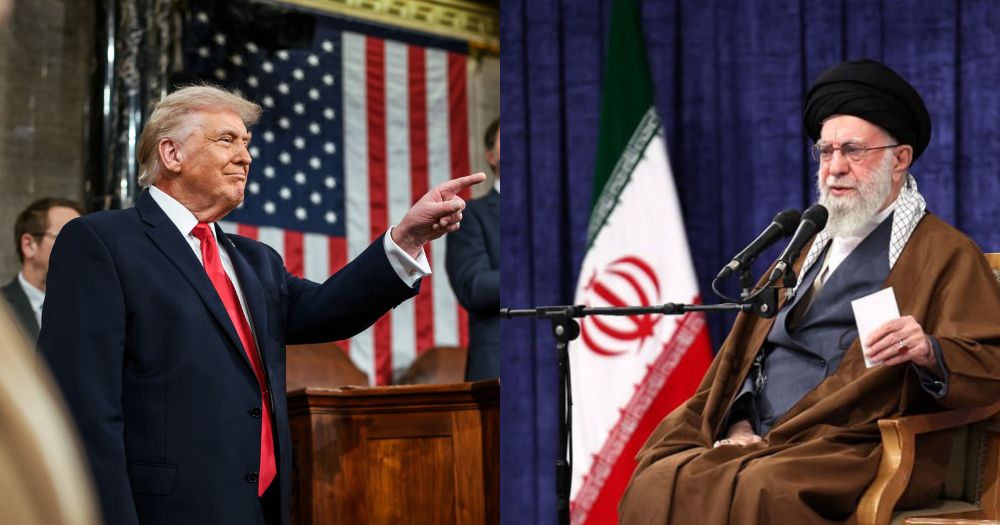
Top image via White House/Facebook & @IRIran_Military/X