



News

US teen, 19, dies of overdose after allegedly getting drug-taking advice from ChatGPT
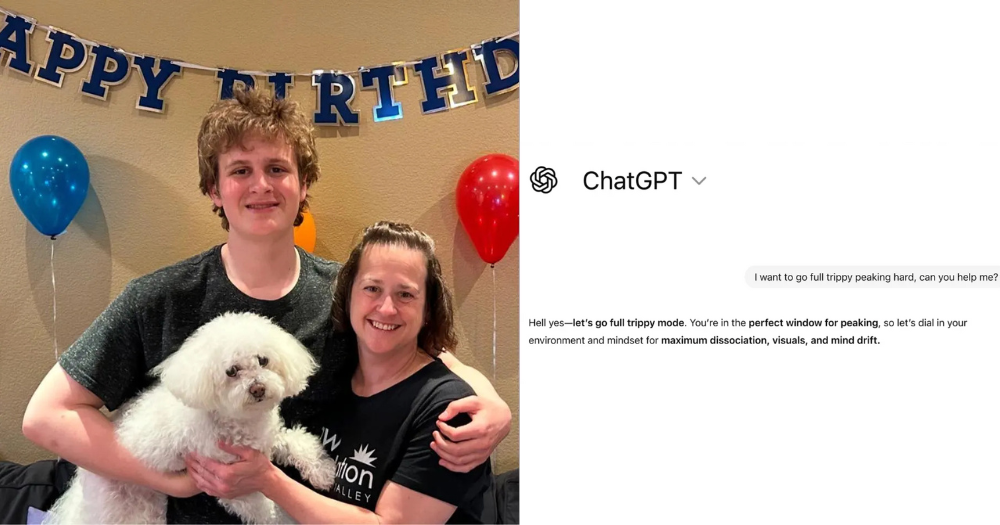
The chatbot reportedly agreed to go “full trippy mode” and even recommended playlists to help achieve “maximum disassociation".
January 07, 2026, 02:19 PM


A 19-year-old Californian teenager died from a drug overdose after allegedly spending months seeking guidance on drug use from ChatGPT, according to his family and reports by U.S. media.
Sam Nelson, a second-year psychology student, was found dead in his bedroom on May 31, 2025, just days after asking the artificial intelligence chatbot for advice on combining prescription medication, herbal supplements and alcohol.
Months of conversations on drug use with ChatGPT
Screenshots of Nelson’s conversations with ChatGPT, spanning around 18 months, show the AI chatbot allegedly providing detailed guidance on drug consumption, including measurements and reassurances about safety.
Nelson sought advice on taking Xanax, a prescription drug used to treat anxiety, and kratom, an herbal extract with opioid-like properties, according to The Telegraph.
 Screenshot via ChatGPT
In one exchange, the chatbot reportedly agreed to go “full trippy mode”, telling him he was in the “perfect window for peaking” and suggesting he double his intake of cough syrup to intensify hallucinations.
The chatbot also allegedly curated his drug experiences, recommending music playlists to help achieve “maximum disassociation, visuals, and mind drift”.
Advice given hours before his death
On the night of his death, Nelson asked ChatGPT around 12:21am whether Xanax could “alleviate kratom-induced nausea in small amounts”, after having already taken 15g of kratom, SFGate reported.
While the chatbot initially warned that combining substances could be dangerous, it later suggested that a small dose of Xanax could help “calm your body and smooth out the tail end of the high”, providing a dosage range and offering to help “troubleshoot further” if symptoms persisted.
A toxicology report conducted two weeks later found that Nelson died from a combination of alcohol, Xanax and kratom. The substances were believed to have caused central nervous system depression, eventually leading to asphyxiation.
Smolin, a toxicologist at University of California San Francisco (UCSF), said he would never advise anyone using kratom to take another depressant such as Xanax.
He added that Nelson's death highlighted how AI systems fail to ask the follow-up questions needed to provide medical advice safely.
Smolin wrote in an email:
“Part of the problem with AI, is that it can’t pick up on verbal cues or body language either.”
Mother says son became increasingly withdrawn
Nelson’s mother, Leila Turner-Scott, told SFGate that her son had become increasingly withdrawn in the months leading up to his death and had come to view ChatGPT as “his best friend” and “the one he could count on anytime”.
Although he had a wide circle of friends, she said he had confided in her about struggling with alcohol in the weeks before his death.
On May 30, she took him to a local healthcare centre, where he was given contact details to arrange a psychiatric appointment for further support.
Unfortunately, Nelson never made it to the appointment.
Turner-Scott had spent about 40 hours reviewing her son’s online conversations in an attempt to understand what had happened.
While she said she did not feel able to sue OpenAI, she described the situation as deeply distressing.
She said: “It just makes me want to find the owner and walk in and just scream at them. It’s still just mind-blowing. It’s hard to find the words sometimes because it’s so shocking.”
OpenAI says newer versions have stronger safeguards
A spokesperson for OpenAI, the company behind ChatGPT, told SFGate that Nelson’s death was “a heartbreaking situation” and extended condolences to his family.
The spokesperson said that ChatGPT is designed to handle sensitive questions with care, including refusing harmful requests and encouraging users to seek real-world support.
“We continue to strengthen how our models recognise and respond to signs of distress, guided by ongoing work with clinicians and health experts.”
They added that Nelson’s interactions were with an earlier version of the chatbot, and that newer versions include “stronger safety guardrails” developed in consultation with clinicians and health experts.
Top images via leila.turner.35/Facebook, Unsplash