News

S'pore MRT lines less reliable in 2025 than 2024, but more punctual
The drop in reliability was due to the poorer performance of 4 MRT lines.
January 17, 2026, 01:17 PM
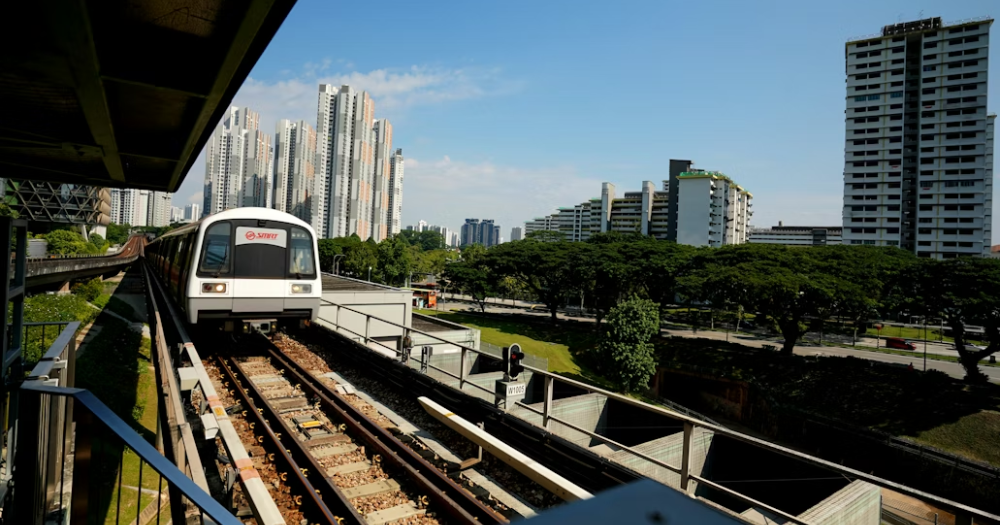

 Singapore's MRT network was less reliable in 2025 than it was in 2024, according to statistics released by the Land Transport Authority (LTA) on Jan. 16.
Out of the five MRT lines measures, which excludes the Thomson-East Coast Line (TEL), four MRT lines experienced a downward performance from the previous year.
The Circle Line was the sole line to perform significantly better than in 2024.
The metrics used to measure the train network's reliability was mean kilometres between failure (MKBF), or how far a train travels before encountering a delay of more than five minutes.
The report is based on a 12-month moving average of the MKBF, including December 2025.
Slight drop
In 2025, all five lines measured a total of 1.606 million train-km travelled between delays, compared to 1.982 million train-km in 2024.
While a drop, it still remained above Singapore's rail reliability target of one million train-km.
Here is the breakdown of each line's performance:
Downtown Line (DTL)
The DTL clocked 2.787 million train-km in 2025, a sharp drop from 8.131 million train-km in 2024.
North East Line (NEL)
The NEL clocked an average of 2.198 million train-km, a drop from 2024's 4.101 million train-km.
East-West Line (EWL)
The EWL measured 1.265 million train-km, down from 1.687 train-km in 2024.
North-South Line (NSL)
The NSL clocked in 1.099 million train-km in 2025, a slight drop from 2.485 million train-km.
Circle Line (CCL)
The CCL clocked 2.464 million train-km, an increase from 919,000 train-km in 2024.
This was the only one of the five measured lines to see an improved performance.
Train punctuality
Train punctuality also saw an overall improvement across the network, from 99.35 per cent in 2024 to 99.38 per cent in 2025.
The EWL, CCL and DTL saw an improvement from the previous year, while the NSL and NEL saw a slight dip.
99.84 per cent of MRT trains also completed scheduled trips within two minutes of their scheduled times in 2025, up from 99.78 per cent in 2024.
However, the EWL was the only one to see an improvement in this aspect, increasing by 0.4 per cent.
All other lines dipped slightly from 2024.
Top image via Jonathan Khoo/Unsplash