News

S'pore woman shares father's 'distressing experience' over wheelchair procedure at Scoot check-in
They were allegedly told to "just go home".
December 08, 2025, 05:06 PM


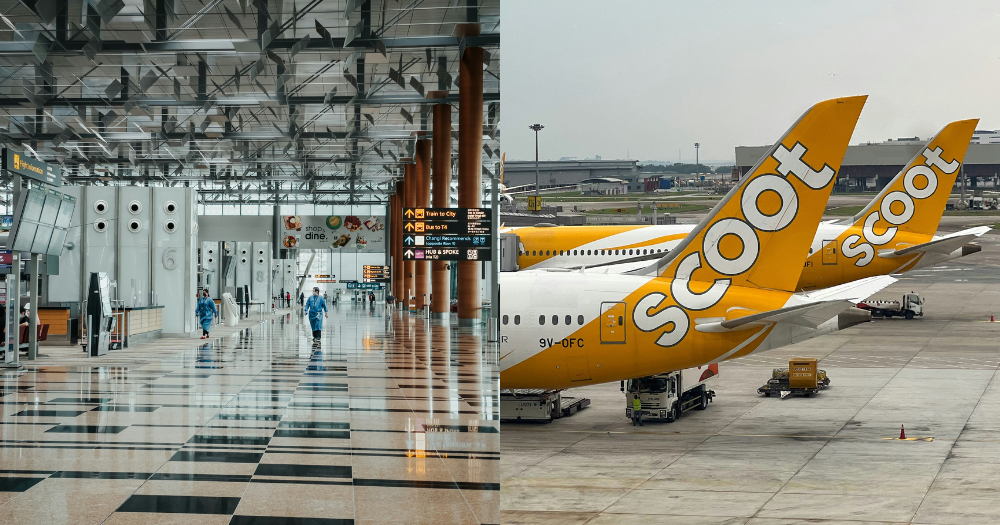
A Mothership reader said she had a "distressing experience" while departing from Changi Airport Terminal 1 on Nov. 30.
Speaking to Mothership, the reader, who wished to stay anonymous, said that she was travelling with her parents, younger sister and four-year-old son, and the family was headed to Bali on a Scoot flight.
The reader’s father, who is wheelchair-bound, uses a personal motorised wheelchair.
Not allowed to use own wheelchair in transit area
The family arrived at the airport at about 5:10am and queued at the Special Assistance check-in counter.
According to the reader, they were later informed by staff that her father would not be allowed to continue using his own wheelchair after check-in, and would have to switch to an airport-provided one instead.
The reader said this did not tally with their previous travel experiences, when her father had been allowed to use his personal wheelchair within the transit area till he reached the boarding gate.
Staff would then take the wheelchair for loading, and pass the wheelchair's battery to the family to hand-carry onboard, the reader explained.
However, staff allegedly said that this was "not allowed under the new policy".
The reader also asked if they could make a short stop so the reader’s father could get food before taking his medication, but was told that he had to be pushed "directly to the gate".
"Just go home"
The reader described the staff's tone as "cold and inhumane".
When the reader asked to speak to a manager, the reader claimed that the managers who attended to them were "impatient" and "showed no empathy".
According to the reader, one manager allegedly told them to "just go home", adding that they have sent many passengers home before.
"We felt helpless and cornered," the woman said.
Wheelchair battery allegedly not allowed on the aircraft
The reader said the situation escalated when staff later informed them that the father's wheelchair battery was not allowed on the flight at all, either as checked baggage or hand-carry.
According to the reader, the wheelchair battery was 240Wh.
This, the reader said, was not the case for their past flights, where they were allowed to hand-carry the removable battery.
The reader added that a staff member at an adjacent counter said the battery was allowed onboard, but the check-in staff attending to the family dismissed this.
The family eventually decided to leave the battery behind for a relative to collect.
They also had to purchase food on board, so her father could take his medication.
Staff at gate surprised battery was left behind
Contrary to earlier instructions, airport staff pushed the reader’s father in his own wheelchair all the way to the gate.
After the family boarded, another staff member entered the aircraft and appeared surprised that the battery had been left behind.
She apparently said that it could have been hand-carried on board.
However by then it was too late to go retrieve it.
As a result of leaving the battery behind, the reader said they had to push her father manually throughout the trip.
The reader has since written to Scoot and Changi Airport seeking clarification and has yet to receive a response from them.
Policies on personal mobility equipment
According to Changi Airport Group's (CAG) website, passengers who are planning to travel with personal mobility equipment are encouraged to contact their airline in advance to make arrangements.
The airport also provides complimentary self-assist wheelchairs across all terminals, which can be loaned from information counters in each terminal’s departure, transit, and arrival halls.
Battery-powered wheelchairs are also permitted as checked luggage only, though passengers can contact their airline in advance to ask if special conditions apply.
Scoot's website states that up to two lithium batteries, up to 160Wh each, per passenger may be carried onboard and must fall within cabin baggage limits.
Mothership also understands a single-battery powered mobility aid cannot exceed 300Wh
Scoot's response
In response to Mothership's queries, Scoot said they apologised for the family's experience.
Scoot says they comply with the International Air Transport Association’s (IATA) regulations for the carriage of battery-powered wheelchairs.
"Lithium batteries powering mobility aids must meet all test requirements specified in the UN Manual of Tests and Criteria, Part III, subsection 38.3. Lithium batteries without UN38.3 certification will not be accepted for carriage, and proof of compliance is required at check-in."
For removed batteries, they said the capacity "must not exceed 300Wh for a single-battery powered mobility aid or 160Wh each for those powered by two batteries".
"Passengers are required to check in their wheelchairs as checked baggage upon departure, and Scoot can provide assistance to and from the aircraft with advance notice.
We expect our counter staff to be respectful and professional at all times. If staff are found not to have met these standards, counselling and retraining may be mandated.
Scoot added that more information on requirements for passengers needing special assistance is available on their website.
Top photos via Unsplash