News

'They took our oil... & we want it back': Trump on oil in Venezuela
What's the U.S. military buildup in the Caribbean really about?
December 19, 2025, 04:50 PM

 “They took all of our oil not that long ago, and we want it back,” United States President Donald Trump said to the press on Wednesday, implying perhaps a further motive beyond anti-narcotics operations in the seas off Venezuela, and the U.S. military build in the Caribbean over the past several months.
Boat strikes
In recent months, the U.S. has attacked more than 20 boats in the waters off Venezuela, often targeting them with drone strikes while at sea, accusing the boat crews of smuggling drugs meant to be sold in the U.S., reportedly killing over a hundred people, according to CNN and the BBC.
On Dec. 18, at the direction of @SecWar Pete Hegseth, Joint Task Force Southern Spear conducted lethal kinetic strikes on two vessels operated by Designated Terrorist Organizations in international waters. Intelligence confirmed that the vessels were transiting along known… pic.twitter.com/CcCyOgYRto
— U.S. Southern Command (@Southcom) December 19, 2025
On Dec. 10, it was reported by outlets such as Al Jazeera that U.S. military forces had seized, or hijacked, as AJ later said in a comment piece, an oil tanker off the coast of Venezuela,
Early on Dec. 17, Trump posted on Truth Social that the U.S. would be implementing a blockade of all sanctioned oil tankers going in or out of Venezuela.
His post also accused the government of Venezuelan president Nicolas Maduro of using oil revenue to finance themselves, and also other crimes, such as drug and human trafficking, although he did not say why those crimes could not finance themselves.
This portion was in keeping with what Trump had said before about his motivations for targeting Venezuela, which, in September, Reuters reported him threatening “terrorist thug smuggling drugs” into the U.S., saying he would “blow you out of existence”.
"We want it back"
But his Dec. 17 post revealed that there might be other motivations on Trump’s mind.
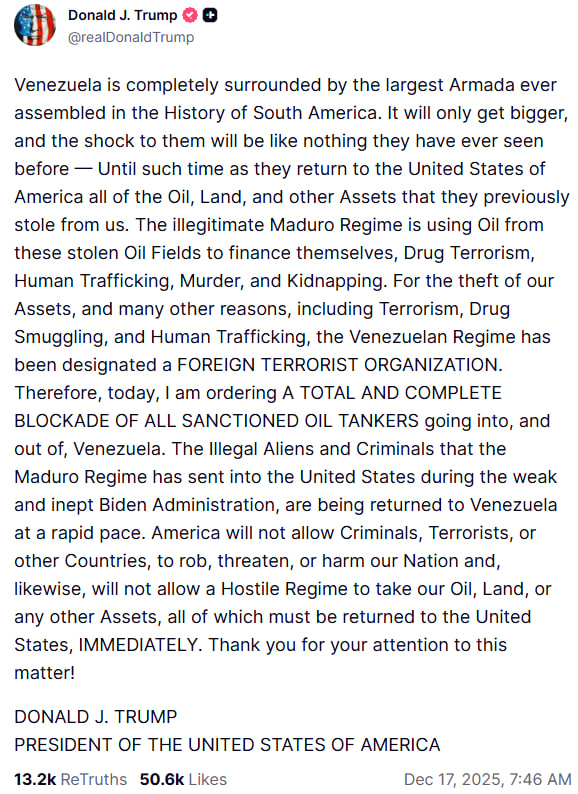 Image via Truth Social
Trump accused the South American country of stealing “Oil, Land and other Assets” (SIC) from the U.S., demanding their return.
Dec. 17, Sky News and several outlets spoke with Trump outside Air Force One, where the U.S. president was asked a question about the ongoing military buildup around Venezuela and the blockade of its ships, to which he said:
“You remember they took all of our energy rights. They took all of our oil from not that long ago, and we want it back, but they took it. They illegally took it.”
What is Trump talking about?
Venezuela is an oil-producing country, part of the OPEC cartel, and is said to have the largest oil reserves in the world.
As reported by Al Jazeera, U.S. companies helped develop the country’s oil industry in the early 1900s.
Like many other countries, in the 1960s, Venezuela would nationalise its oil industry, but many U.S. companies remained involved in the industry through licenses or other similar means.
In the 1990s, however, leftist strongman Hugo Chavez seized these assets, nationalising them in 1998.
The U.S. under George W Bush would impose sanctions on the country, which remains to this day, even under Chavez’s successor and protege, Maduro.
Trump has a long-running beef with Maduro and Chavez, having accused them of all manner of crimes, from drug smuggling to interfering with U.S. elections, the latter with very little proof.
Maduro, on his part, has been accused of interfering with Venezuelan elections.
Blockade or quarantine?
Trump’s Dec. 17 statement implies that he considers the events of nearly 30 years ago a wrong to be righted, and that oil has become yet another major consideration in his administration’s considerations.
The blockade itself has raised many concerns as well.
Under international law, a naval blockade may be considered an act of war, as reported by the AP.
However, experts and U.S. officials the AP spoke to said that the “blockade” was more akin to a “quarantine”, as the action was targeted towards particular ships, not all ships travelling to Venezuela.
The wording is reminiscent of the 1960s era Cuban Missile Crisis, where the U.S. instituted a similar quarantine against ships it accused of carrying military supplies, particularly parts that would have contributed to a Cuban ballistic missile program.
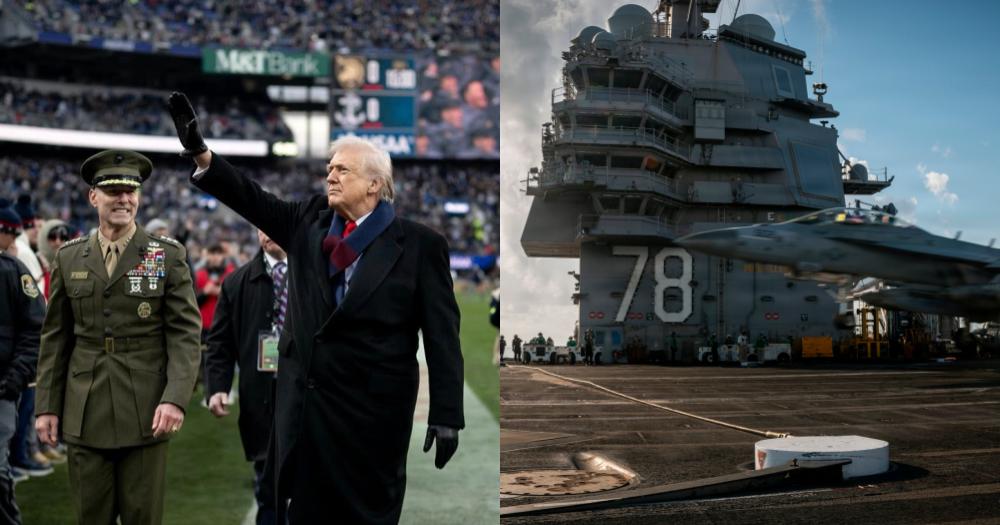
That crisis ended with diplomatic negotiations. It is not clear how this one will end as the U.S. continues a massive military buildup in the Caribbean, having deployed at least one aircraft carrier to join the fleet in the area.
According to the BBC, the buildup includes sending several attack aircraft to the area, even reopening a military base in Puerto Rico that had been closed for two decades, as well as moving “thousands” of troops into the area.
There are concerns that the U.S. is planning military strikes on Venezuela, with some experts even suggesting that an invasion is possible, although influential security blog War on the Rocks said a “U.S. ground invasion is the least likely but most consequential scenario”.
Related story
Top image via White House/Facebook & U.S. Southern Command/X