News

SMRT launches trial of new air-con & monitoring systems, 92 trains to be equipped by mid-2030s
New air-conditioning system, among other features.
December 18, 2025, 03:00 PM
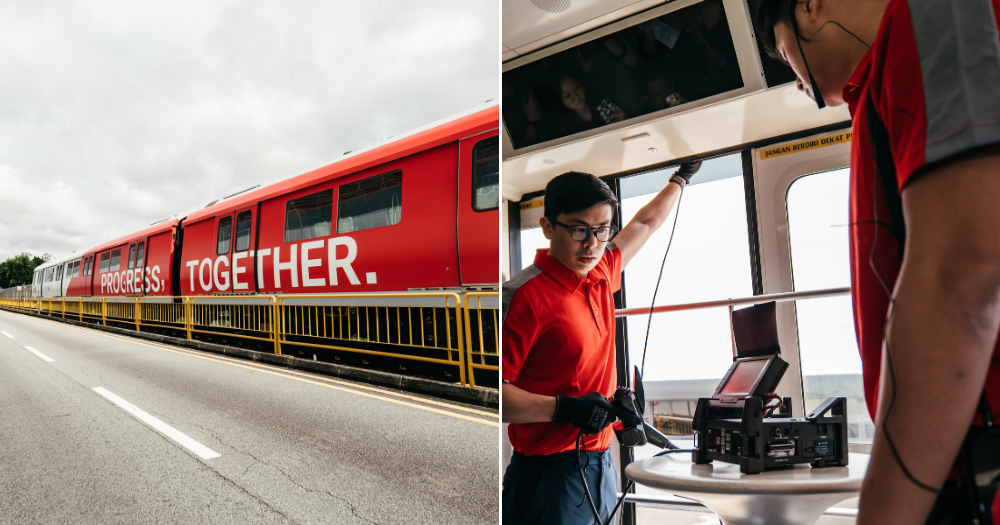


SMRT has launched a trial of various technologies, including monitoring systems, that will provide continuous and real-time data on train components and subsystem health.
It will also trial a new air-conditioning and ventilation system to replacing ageing ones.
The trial will be conducted via a proof-of-concept train, which will be upgraded with the equipment.
Once validated, they will be further fitted on 91 trains in Singapore's rail fleet as part of efforts to improve reliability and commuter comfort.
New air-conditioning, monitoring systems
According to a Dec. 18 media factsheet from SMRT, the proof-of-concept train is a fifth-generation train that has operated on the North-South Line (NSL) and East-West Line (EWL) since 2017.
It will be fitted with several features.
A Condition Monitoring System will enable the continuous monitoring of the health and performance of critical train components and systems.
This will provide an additional layer of early detection, SMRT said.
Before this, the monitoring of critical subsystems was done through a single integrated platform, called the Train Information and Management System.
Additionally, sensors, coupled with data analysis, will provide continuous, real-time assessment of the performance of main structural components like car-bodies and bogies.
Previously, this was done on an ad-hoc basis and only when required.
Another technology to be validated is the Bogie Monitoring System, which is designed to monitor the condition of critical bogie components.
Up till now, there were no on-board systems to monitor and provide feedback on the condition of bogie components in real time, according to SMRT.
The resulting failure of bogie components had previously caused the six-day EWL disruption in 2024.
Apart from train health monitoring, the proof-of-concept train will also trial upgraded air-conditioning and ventilation systems to replace ageing ones.
Identify faults ahead of time and ensuring comfort
"By validating these technologies ahead of time, SMRT is taking a proactive approach to improving rail reliability through a better understanding of the latest technologies, testing alternative solutions and enhancing commuter comfort," the rail operator said.
"The intent is to identify faults before they happen," it continued.
According to SMRT, the trial will run until May 2026, and the new systems are slated to be launched on passenger service trains in the mid 2030s.
Top image via Mothership