News

Law Society president-elect Dinesh Singh Dhillon to give up position after 'legitimate concerns' raised by members
Quite a saga.
December 18, 2025, 02:37 PM


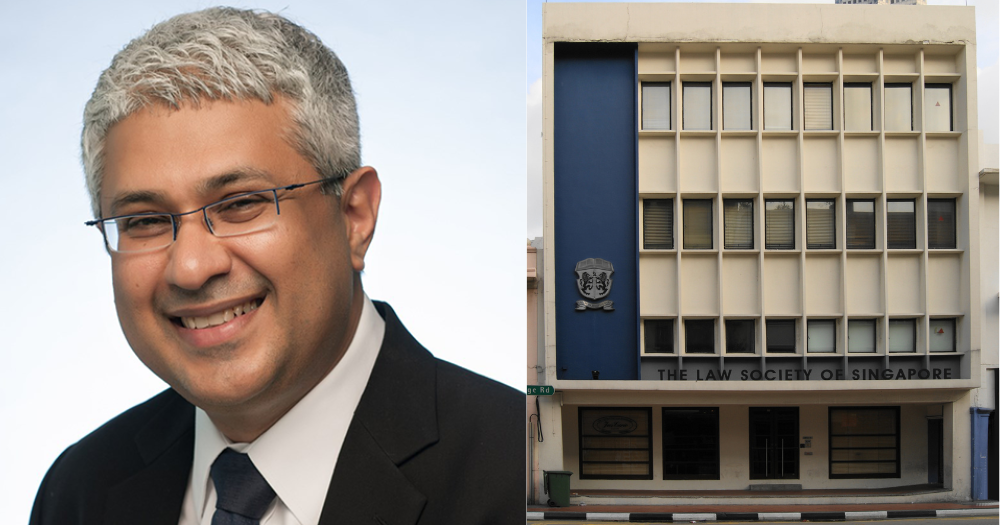
Lead counsel Dinesh Singh Dhillon, the president-elect of the Law Society of Singapore (LawSoc), has chosen to give up his position.
He did so in the light of "legitimate concerns" raised by members, according to The Straits Times.
They'd called for an Extraordinary General Meeting (EGM) to seek a vote of no confidence in the council members who'd voted for him.
But what exactly were these concerns, and who is Dinesh anyway?
Veteran lawyer
The man in question is a veteran lawyer who is co-head of Allen & Gledhill's international arbitration practice.
He was a member of the 2025 LawSoc council, previously honorary treasurer, and chairman of Pro Bono SG.
On Nov. 17, the LawSoc announced that it had elected Dinesh to helm the council, following an internal vote.
He was slated to replace outgoing president Lisa Sam Hui Min.
Non-elected elect
But this prompted backlash among members of the legal community.
As it turns out, Dinesh was a member of the council — but he'd been appointed, not elected.
Typically, council members are voted in by the members of the LawSoc.
But under the Legal Profession Act, the Law Minister, currently Edwin Tong, can appoint up to three members to sit on the council.
Dinesh was one of the three in the 2025 circle. This means he joined the council as a statutory member, not an elected one.
The LawSoc council consists of 21 people — three ministerial appointees, three co-opted by the council, and 15 elected members.
All council members serve a two-year term.
Independence of the bar questioned
Following the election, a group of lawyers called for an extraordinary general meeting (EGM) to protest Dinesh's presidency.
These included former LawSoc presidents Peter Cuthbert Low and Chandra Mohan K Nair, who proposed and seconded the motion respectively.
The group argued that only someone who had been elected by members of the LawSoc should serve as its president.
This was to "uphold confidence in the independence of the bar", according to the letter.
The EGM was subsequently called for Dec. 22, some time after the initial request was made to the LawSoc on Nov. 24.
They also called for a vote of no confidence in the council members who'd voted for Dinesh.
Stepped aside
Several days before the EGM was due, Dinesh agreed to step aside and give up his presidency.
This was after a Dec. 17 meeting with LawSoc members, ST reported.
He did so in the interest of preserving unity for the Bar, and in the light of "legitimate concerns" raised by members.
Vice-president-elect Tan Cheng Han, a veteran lawyer who is a senior consultant at Wong Partnership, will take over the helm as president.
Meanwhile, Dinesh will take up the vice-president role.
The lawyer further promised not run for the presidency in 2027 unless he gets voted into the council next year.
The new roles will take effect at the Dec. 22 EGM.
Decision to run was in good faith: LawSoc
The LawSoc council said that Dinesh had contested for the position of president "in good faith and of his own desire, in an effort to contribute to the Bar".
"There is no issue as to the independence or competence of (Mr) Dinesh as president of the Law Society," it added.
He had run against incumbent vice-president Samuel Chacko and won by a slim margin, reported CNA.
In the document proposing the role changes, signatories — including Low and Chandra, who had called for the EGM — acknowledged that Dinesh's election was in accordance with established procedure and law.
They also said that the issues raised in their proposed motions had been addressed, and agreed to withdraw them for the EGM.
No express rule
In a media statement, LawSoc acknowledged that Dhillon is the first president-elect to be a statutory member appointed by the Law Minister.
But there is no express rule that prohibits statutory members from being elected as president, it pointed out.
Ministerial appointees have also previously held lesser office-bearer roles, namely vice-president and treasurer.
The new proposed eligibility criteria will be circulated to all members for review and tabled for final approval at the annual general meeting in 2026.
Top image from Pro Bono SG and Wikipedia/Smuconlaw