News

S'pore teachers work about 6 more hours a week than international average: OECD survey
47 work hours a week, on average.
October 07, 2025, 09:01 AM
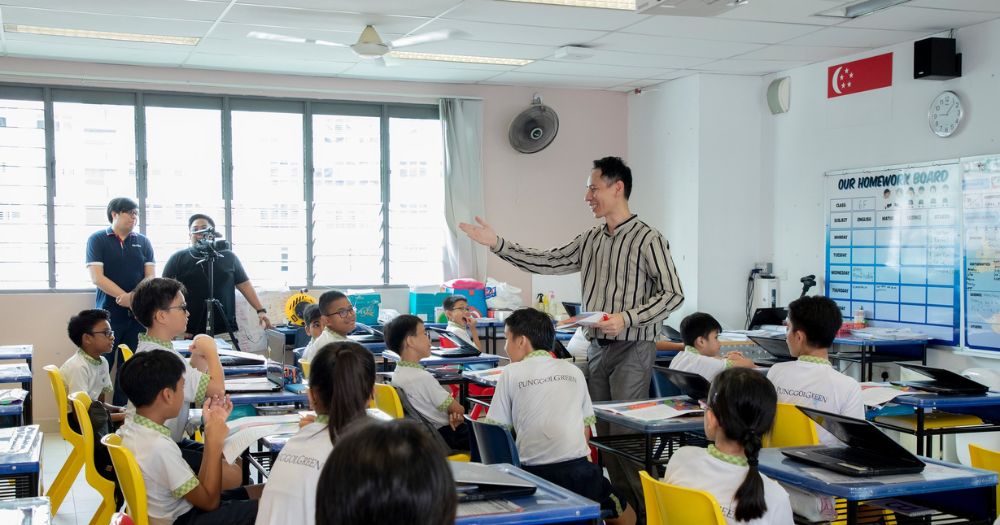


Teachers in Singapore reported working about 47 hours a week on average, which is six hours longer than the average work hours of their international peers.
However, Singapore teachers spend about 18 hours a week on classroom teaching, which is lower than the international average of about 23 hours.
Meanwhile, Singapore teachers spend more time than the international average on non-teaching tasks, such as lesson planning and co-curricular activities (CCAs).
Notably, Singapore teachers also showed one of the highest adoption rates of online and hybrid teaching, as well as artificial intelligence (AI) to facilitate learning.
These were findings from the 2024 Teaching and Learning International Survey (TALIS), conducted by the Organisation for Economic Co-operation and Development (OECD) released on Oct. 7.
About the survey
TALIS 2024 surveyed a sample of 3,500 teachers and principals in Singapore, across all 145 public secondary schools and 10 randomly selected private secondary schools.
Participants self-reported their perceptions on areas such as teachers' workload and stress, job satisfaction, use of technology, teacher education and professional development.
The survey was conducted from April to August 2024.
This is the fourth time the survey has been conducted, with Singapore most recently participating in 2018.
Longer work hours for S'pore teachers, less classroom time
In TALIS 2024, Singapore teachers reported working an average of 47 hours per week, up from 46 hours in 2018.
This is about six hours more than the OECD average of 41 hours per week.
Similar to 2018, Singapore teachers reported spending less time than their international peers on classroom teaching.
The survey found that Singapore teachers spent 18 hours per week on classroom teaching (a figure unchanged from 2018), five hours less than the OECD average of 23 hours.
An MOE spokesperson said: "This should not be viewed as teachers spending less time on core teaching duties, but rather, as a deliberate policy design requiring educators to also dedicate time to students' non-academic development."
Instead, more time is spent on out-of-classroom tasks, like lesson planning, student counselling, co-curricular activities, and communication with parents.

The top three most commonly reported sources of stress were:
- Having too much administrative work (53 per cent)
- Having too much marking (49 per cent)
- Being held responsible for student achievement (45 per cent)
However, from 2018, Singapore teachers reported spending less time marking students' work (6.4 hours in 2024) and roughly the same amount of time on administrative work (four hours in 2024).

The Ministry of Education (MOE) said in an Oct. 7 release that it has been examining ways to lighten the workload of teachers.
This includes a pilot feature to allow parents to electronically submit documents for their child's absences, such as medical certificates.
MOE said it has also invested in automated marking features and AI assessment tools in the Student Learning Space (SLS) platform to ease marking workload, and laid out clearer guidelines for boundaries on after-hours communication with parents.
Retention stable despite more stress, lower salary satisfaction
In the study, 27 per cent of Singapore teachers reported experiencing stress "a lot", which is higher than the OECD average of 19 per cent.
Compared to 2018, the share of Singapore teachers who experience stress "a lot" has increased by four per cent.
Teachers under the age of 30 are more likely to fall in this category than their colleagues aged 50 and above, the study found.

Job satisfaction among Singapore teachers also saw a slight dip, with 87 per cent in 2024 saying they were satisfied with their jobs (down by two per cent from 2018).
Additionally, between 2018 and 2024, teachers' satisfaction with their salaries decreased by 17 per cent, although this is still markedly higher than the OECD average of 39 per cent.

Nevertheless, job retention remained largely unchanged from the 2018 edition, with 29 per cent of teachers in Singapore saying they intended to leave teaching in the next five years.
According to an MOE spokesperson, intention to “leave” the teaching profession in this context includes leaving for other non-teaching jobs within MOE (e.g., HQ posting), rather than leaving the teaching force entirely.
"Such career opportunities are not as readily available in other education systems, and are useful for professional growth," the spokesperson added.
Since 2018, the average annual resignation rate of teachers has remained stable at around 2 to 3 per cent, which is generally lower than other schemes in the civil service, the spokesperson added.

For teachers under the age of 30, the share of those looking to work elsewhere was 40 per cent.
However, this was a nine per cent drop from 2018, when 49 per cent said they intended to leave teaching in the near future.
Top adopters of AI, online learning
In a changing education landscape, the study also showed that Singapore teachers have one of the highest adoption rates globally for AI.
In TALIS 2024, 75 per cent of them reported using AI in their work, more than double the global average.

This includes the use of AI tools embedded into the SLS system that can generate lesson plans, analyse student learning needs, provide feedback and marking assistance, along with commercial AI tools.
Singapore teachers are also very familiar with online or hybrid learning, with 81 per cent working at schools that offer such lesson modes — more than five times of the OECD average.
An MOE spokesperson shared that currently, MOE only tracks the usage of AI tools, as it would be challenging to estimate the net time saved on AI utilisation given that teachers would likely fill up the time saved by engaging in other meaningful activities.
We remain committed to supporting teachers: MOE
On behalf of MOE, the director-general of education Liew Wei Li commended teachers' "unwavering dedication to their profession" and said she is heartened by society's recognition of their contributions.
She added:
"While we celebrate our teachers’ capability, MOE also recognises the unique pressures that our teachers face and remains committed to supporting them.”
Speaking at the launch of the TALIS 2024 results on Oct. 7, Minister for Education Desmond Lee said the study can inform Singapore's educational policies and systems to become better.
"We are committed to ensuring that the teaching profession remains attractive and rewarding for experienced educators seeking growth, as well as new graduates, and mid-careerists," Lee said.
"Growing and sustaining a high-quality teaching force underpins the quality education that all our students deserve."
Top image from MOE/Facebook