News

S'pore MRT & LRT rail reliability fell in Aug. 2025: LTA monthly report
LTA will be publishing the updates monthly instead of on a quarterly basis.
October 10, 2025, 05:58 PM
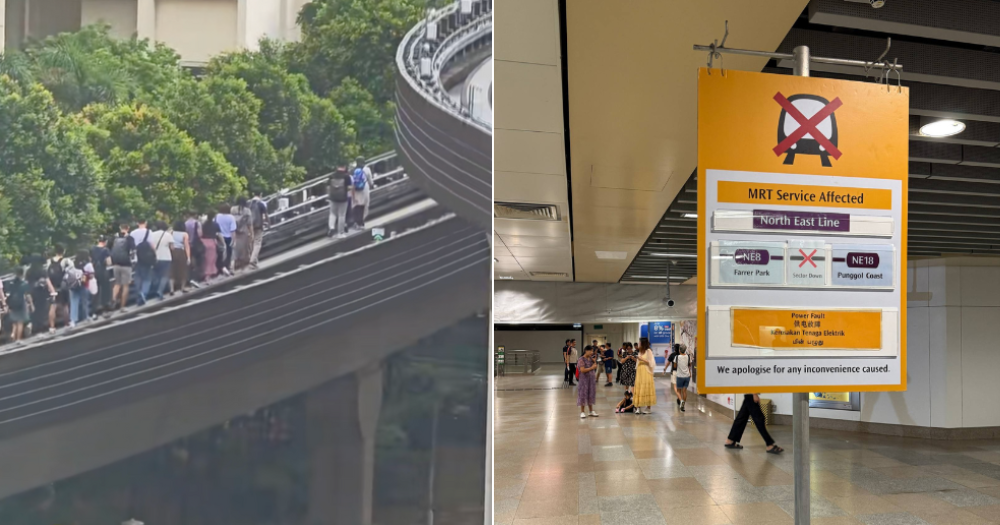


The rail reliability of the MRT network in Singapore as a whole decreased in August 2025, according to a monthly rail reliability update from the Land Transport Authority (LTA).
These monthly reports on rail reliability are a new initiative from LTA, as they were previously published on a quarterly basis since 2016.
In an Oct. 10 release, LTA said it decided to publish monthly rail reliability updates moving forward so as "to improve transparency and accountability."
This comes after Acting Minister for Transport Jeffrey Siow announced in Parliament on Sep. 22 that more data on rail reliability would be made publicly available, so interested commuters can have a fuller picture of the MRT network's reliability.
August update
LTA publishes its reliability data using a 12-month moving average of mean kilometres between failures (MKBF) — LTA's main indicator of rail reliability.
Based on the August report, the MKBF figure for delays of more than five minutes decreased to 1,740,000 train-km, down from 1,818,000 in July.
LTA's target for MKBF, set in 2017, is 1 million train-km between failures.
 Image from LTA
For individual lines, the North-East Line (NEL) saw the biggest drop in MKBF, from 4,262,000 in July to 2,142,000 in August.
Meanwhile, the Downtown Line (DTL) saw a drop from an MKBF of 4,131,000 in July to 2,760,000 in August.
The East West Line (EWL) saw a slight dip, while the North South Line (NSL) and Circle Line (CC) both increased slightly in terms of rail reliability.
 Image from LTA
The newest line — Thomson-East Coast Line (TEL) — saw two consecutive dips in MKBF, from 439,000 train-km in June to 373,000 in July and 311,000 in August.
The MRT network as a whole suffered two delays exceeding 30 minutes in August, one on the NEL and another on the DTL.
As for Singapore's LRT network, its MKBF dropped slightly from 442,000 train-km in July to 420,000 in August.
This was mostly attributed to a sharp drop in MKBF for the Sengkang-Punggol LRT — where two power faults in the same week resulted in delays of more than 30 minutes.
 Image from LTA
What to expect from monthly updates
"This revised monthly cadence is part of our ongoing efforts to improve transparency and accountability, and to provide the public with a clearer picture of how our rail network has been performing over time," LTA said on the monthly updates.
These updates will include the MKBF performance figures for the overall MRT network and for individual rail lines, as well as the number of delays lasting more than 30 minutes.
LTA will also look into publishing other indicators, such as the proportion of scheduled mileage travelled by revenue trains, as well as the punctuality of trains reaching each terminus station, the release said.
Additionally, LTA is studying further metrics to better reflect the impact of rail disruptions on commuters, which could include the number of commuter trips affected by rail disruptions, and the extent and duration of disruptions.
Monthly TEL updates can be expected
This is the first time LTA has published the Thomson-East Coast Line (TEL) figures in its rail reliability reports.
Its figures for MKBF performance and number of delays lasting more than 30 mins will continue to be published from this edition of the report onwards.
The decision to include TEL figures was because the TEL (up to Stage 4) has since accumulated one year of more representative data, LTA said.
However, LTA noted that for the relatively newer TEL, which operates with significantly lower mileage and lower ridership, MKBF will be less reflective of its reliability as compared to more mature rail lines.
LTA said the TEL is currently in its initial engineering "bathtub" stage, where teething issues — such as issues with the new signalling system — are expected as the system stabilises and matures.
As works on TEL Stage 5 are still underway by LTA in collaboration with SMRT and the original equipment manufacturers, more time is needed before the TEL's performance stabilises, said LTA.
"We expect the performance of the TEL to improve after it fully opens in 2026 and its operations have stabilised, such that its fault trends can be fairly compared with our other mature lines," the release said.
Related
Top image from yinjiaen/TikTok & Gawain Pek