News

M'sia's 1st PM once offered S'porean Malays free land in Johor. We have a multiracial S'pore today because no pioneer gen of Malays took it up.
This term we use so casually today has a backstory.
October 25, 2025, 12:16 PM

 On Oct. 14, Home Affairs Minister K. Shanmugam closed off his parliamentary ministerial statement with a pledge made by founding Prime Minister Lee Kuan Yew in 1965.
"Mr Lee Kuan Yew pledged this will not be a Malay nation, Chinese nation, Indian nation, and that all will be equal," Shanmugam said.
As he pointed out, the speech, made on the day Singapore became independent, has become a part of the nation's history that few today would remember.
However, what followed that was perhaps just as, or even more significant, as Shanmugam put it:
"Then-Malaysian Prime Minister Tunku Abdul Rahman said that he had asked the Johor State government to set aside 10 acres of land for any Malay in Singapore who wished to leave the newly independent country."
"... But not a single pioneer generation Malay took up the offer. They chose to stay in Tanah Singapura instead and build a home here."
Shanmugam said that it was the lack of uptakes for this seemingly attractive offer that resulted in the presence of Malays in Singapore today. It is also why multi-racialism exists now.
"We owe them so much," he added.
But what was the context behind those words, and why are they still important?
Pre-1965
Singapore's separation from the Malaysian Federation came on the tails on multiple issues in the alliance.
Among them was the Tunku's conviction that the large Chinese population in Singapore would threaten the fragile ethnic balance in Malaysia, a traditionally Malay-majority country.
Merger into the Malaysian Federation had been offered to Singapore, North Borneo (current day Sabah), Brunei and Sarawak.
Without the latter three states, the combined ethnic Chinese population (3.6 million) on the Malay Peninsula would have outnumbered the ethnic Malay population (3.4 million).
Yet events over the next two years would solidify the Tunku's fears.
GE1963
In 1963, the People's Action Party (PAP) achieved a resounding victory in the first post-merger General Election.
Winning 47 per cent of the votes, PAP swung the country away from the Singapore Alliance, a local chapter of the ruling Alliance Party coalition in Malaya.
This was a crushing blow to heavyweight Alliance Party member Umno, who was also the embodiment of traditional Malay nationalism.
To some, it indicated a radical swing in Singaporean Malay voters towards the PAP.
Tunku Abdul Rahman expressed his shock at the results, blaming "traitors among the [party] members" for allegedly persuading the Malay voters into a change of heart.
1964 race riots
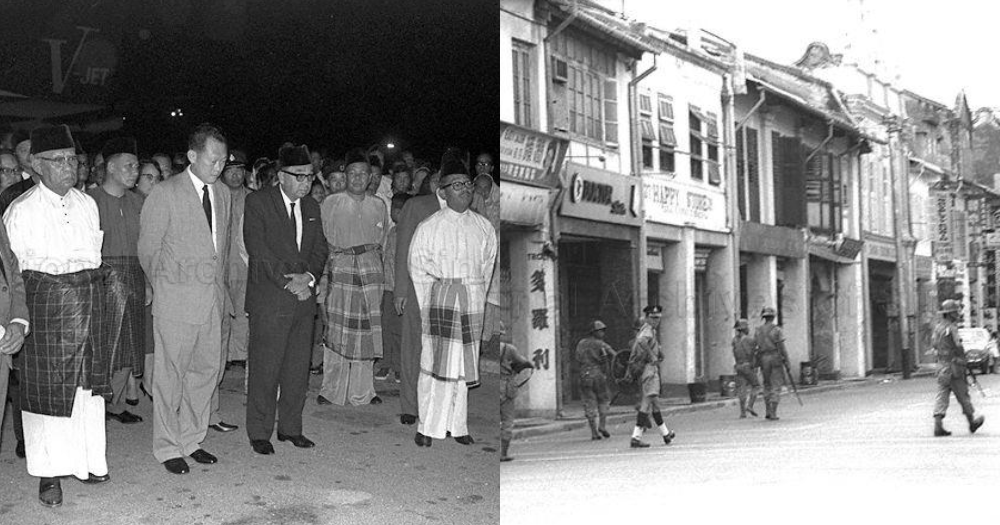
Months after merger, racial riots broke out in Singapore in 1964 between the Malay and Chinese communities.
It was alleged that activists within Umno incited the violence on Jul. 21, the Prophet Muhammad’s birthday.
The alleged campaigns in the days leading up to the riots were racially driven, accusing the PAP of depriving Malay Singaporeans of the special rights that Malays in other states of Malaysia had.
The Malaysian Constitution
A key element to note is the Constitution of the Federation of Malaysia, passed on its creation on Sep. 16, 1963.
As per the previous Constitution of 1957, it left intact the idea of preferential treatment accorded to Malays and the aboriginal people of the Malay Peninsula, or Bumiputera.
Article 153 of the Constitution in particular states that the King is responsible for safeguarding "the special position of the Malays and natives of any of the States of Sabah and Sarawak".
In practice, this meant prioritising Malays for positions in the public service, scholarships, educational and training privileges and special facilities.
Then and now, this article continues to be brought up in discussion for its accordance of preferential treatment to the Malay majority population.
A Malaysian Malaysia
The constitution was hotly debated in parliament in 1965 between Umno backbencher (and future PM) Mahathir Mohamad and Lee.
Mahathir accused Lee of being an “insular, selfish, and arrogant” type of Chinese who could not stand to see Malays "in a position to rule them".
Lee, while not opposed to the preferential treatment accorded to Malays, simply did not agree with The Alliance's belief that the policy could alleviate the poor standard of living of the Malays.
He emphasised that moves like making Malay the country's sole national language would not solve imbalances in social and economic development.
Lee also doubled down on the PAP's commitment to establishing a "Malaysian Malaysia".
“Why, if we wanted to become a Chinese state, would we merge with Malaya to become one country in the Federation of Malaysia?
Why would we want to oppose or threaten the Malays? Our duty, as Malaysian citizens, is to raise the standard of living for the Malays.”
The PAP could do it, he said.
"In ten years we will breed a generation of Malays, educated and with an understanding of the techniques of science and modern industrial management."
Separation
It all came to a head on Aug. 9, 1965 when Singapore made the decision to leave the Federation of Malaysia.
 Gif via National Archives of Singapore
After famously shedding tears on TV, Lee composed himself and spoke directly into the camera to Singaporeans.
"We are going to have a multi-racial nation in Singapore," he said.
"This is not a Malay nation, this is not a Chinese nation, this is not an Indian nation. Everybody will have his place. Equal – language, cultural, religion.
And we will carry on helping the Malays, as we promised to do."
The deal
In his 2000 memoir From Third World to First, Lee further mentioned a less-remembered event from that day.
Appropriately written under the subheading "Delicate Malay Issues", he talked about Tunku Abdul Rahman's offer of free land in Johor to Singapore Malays who had "felt abandoned".
"Few took up his offer," he wrote, "but their segregation had contributed to isolation and disaffection".
For a long time, Singapore's Chinese-majority population posed a threat to the dominance of the Malay race in the eyes of Malaysia's leaders.
But Lee's vision for an independent Singapore was not to allow a race to dominate, instead make them all equal.
His cabinet agreed.
Then-Minister of State for Education Abdul Rahim Ishak (who happened to be the younger brother of Singapore's first president Yusof Ishak) said in parliament on Dec. 16, 1965, "The only solution is for us of all races to live together peacefully and strengthen the foundations of a multi-racial, multi-cultural and multi-religious society."
Addressing the Tunku's land offer, Abdul Rahim questioned if it was in a bid to achieve "complete isolation" of Singapore by driving out all Malays and making Singapore a "Chinese city".
"He must be a mad man to help the creation of a second Israel in this world.
It goes against the grain of any sane Malay to leave Singapore, an island which is part and parcel of the Malay world, for party political reasons purely to satisfy the selfish political ambitions of certain people."
While the reason why the Tunku's offer was mostly rejected was not explicitly discussed in Lee's book, over the next 10 years, the government kept to their promise of improving the lives of Singaporean Malays, said Lee.
In rebuilding Singapore, they scattered and mixed citizens of all races across the country to prevent congregation.
The relatively lower standards of education of Singaporean Malays at the time were tackled with the implementation of Mendaki.
Malay and Muslim-related topics were sensitively handled, and Malays became represented in parliament after Group representation constituencies (GRC) had to include members of minority races.
Why did Shanmugam bring this up?
From his view, Lee's vision of a multi-racial society seemed to have come into fruition.
So why were his words brought up again in parliament by Shanmugam?
The purpose of Shanmugam's speech was to "reiterate the fundamentals of our approach to race, religion, and language, and its application in the political context", he said.
He made a serious call for Singapore's politics to be kept separate from racial and religious lines, after several attempts at inflaming racial and religious sentiments "for political gain" were recently made.
Most notably mentioned was Malaysia's Islamist political party PAS' open endorsement of Singaporean candidates in the middle of the 2025 General Elections on racial and religious basis.
The party also has a history of name-dropping Singapore and Singaporean figures, including Lee Kuan Yew, in recent years.
Shanmugam ended his speech by paying homage to the pioneer Singaporean Malays who had chosen to stay in the country.
"Let us remain faithful to the hopes and dreams and aspirations of our pioneers."
Top images via National Archives of Singapore