News

US may be forced to refund billions if Trump tariffs found illegal by Supreme Court
For now, they remain in place.
September 10, 2025, 06:13 PM

 U.S. President Donald Trump's sweeping tariffs will face their biggest hurdle in November, which is when a U.S. Supreme Court hearing on their legality will be held, according to Bloomberg.
Questions about the tariffs' legality have surfaced in recent months after a federal appeals court ruled on Aug. 30 that Trump had exceeded his authority as president by imposing them.
The federal law, which Trump used to implement the tariffs, was meant exclusively for emergencies, which Trump argued was the state of the trade imbalance in the U.S.
But the court ruled that imposing tariffs is not within the president's power and is instead the Congress's decision to make.
For now, the tariffs have been allowed to remain in place until early November, when the Supreme Court, for whom six justices were appointed by Republican presidents and three by Democratic presidents, will begin hearings on a "fast-track" schedule.
Implications
Bloomberg reported that the Republican-leaning Supreme Court's hearing could have a number of implications.
Should it rule in favour of the tariffs, Trump may invariably be handed the power to make major decisions against trading partners in his global agenda.
If ruled against, the U.S. may be forced to refund tens of billions of dollars to trading partners, as well as overturn a number of preliminary trade deals already struck with some countries.
Treasury Secretary Scott Bessent warned that the money refunded could be up to US$70 billion (S$89 billion) of the country-specific tariff duties collected by the government since the implementation of Trump's policies.
Republican-lean
But the Supreme Court has a clear conservative majority of six to three, and it has continuously ruled in favour of Trump's policies since his return to power.
CNBC reports that federal judges from lower courts, appointed by presidents of different parties and some even appointed by Trump himself, have expressed concern that the Supreme Court has been overturning lower court rulings with little or no explanation.
About 12 lower court judges were interviewed, and described a pattern that in their view, saw rulings overturned by the Supreme Court with little explanation after appeals by the Trump administration.
A report by The Hill indicated that between May and July of 2025, federal district courts, like the one that ruled against Trump's tariffs, have ruled against the Trump administration about 94.3 per cent of the time.
However, the Supreme Court has overturned those rulings to side with the administration in 93.7 per cent of the cases.
The Hill and CNBC articles also describe Trump putting lower court judges under public pressure, complaining about them via social media.
It is possible that the tariff ruling will follow a similar pattern.
Tariff time
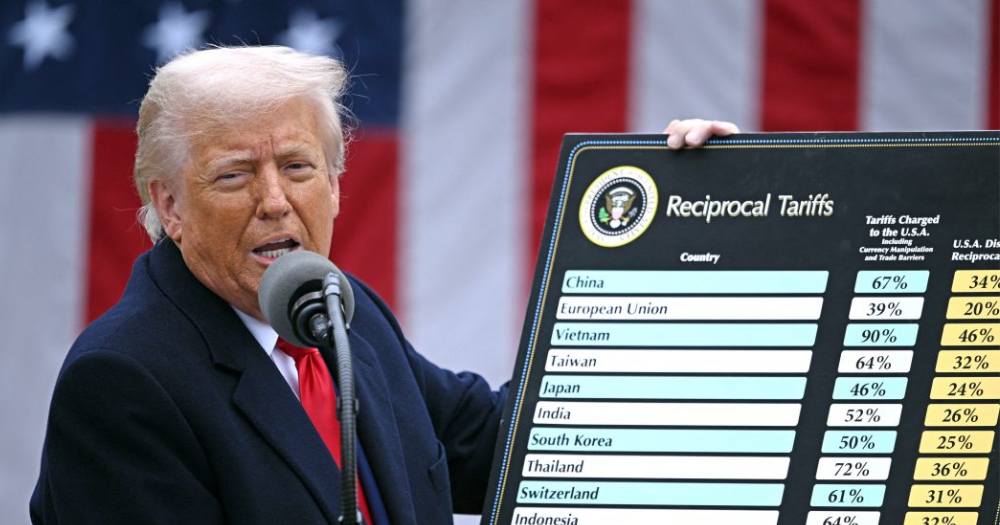
Earlier in April, Trump imposed sweeping tariffs of 10 to 50 per cent across most U.S. imports, in what he called "Liberation Day".
It has sparked off a trade war since, with countries rushing to negotiate deals with the second-term president under threats of further increases within stipulated deadlines.
Countries like Vietnam, Indonesia and Japan currently have trade deals struck with Trump, which have seen their tariff rates reduced to 20, 19 and 15 per cent respectively.
Singapore's tariff currently remains at the lowest rate of 10 per cent, although concerns remain over possible sector based tariffs, particularly in the pharmaceutical and semiconductor industries.
Trump most recently announced the resumption of trade talks with India, addressing Indian prime minster Narendra Modi as his "very good friend".
It is a significant change in tone from the souring relationship between both countries, with Trump most recently imposing a 50 per cent tariff, among the highest of its kind, on India as punishment for their import of Russian oil and weapons.
Top image via Brendan Smialowski/AFP