News

Orchestra of world order missing its conductor: Vivian Balakrishnan at the 17th Asean & Asia Forum
Singapore would not abandon international consensus, but needed to find other ways to move forward in positive and constructive manner.
August 06, 2025, 12:02 PM

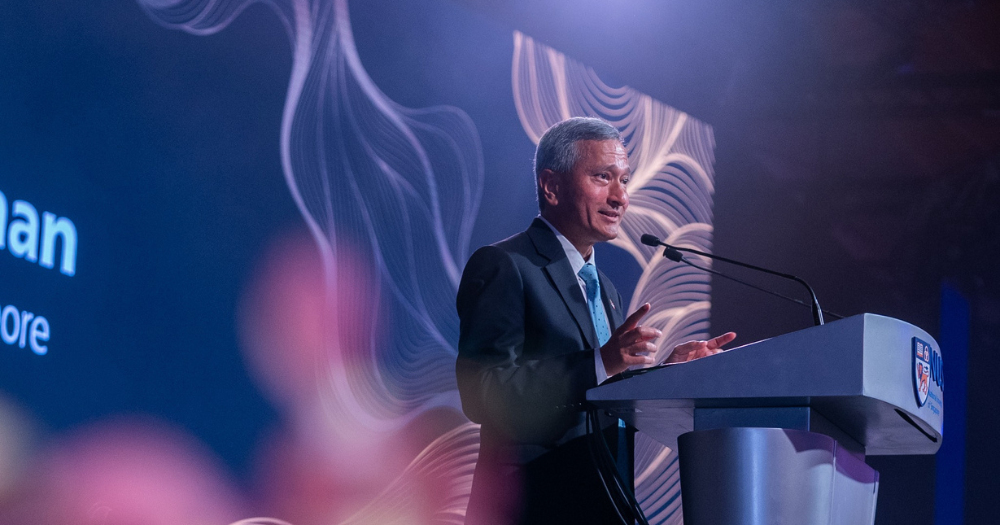
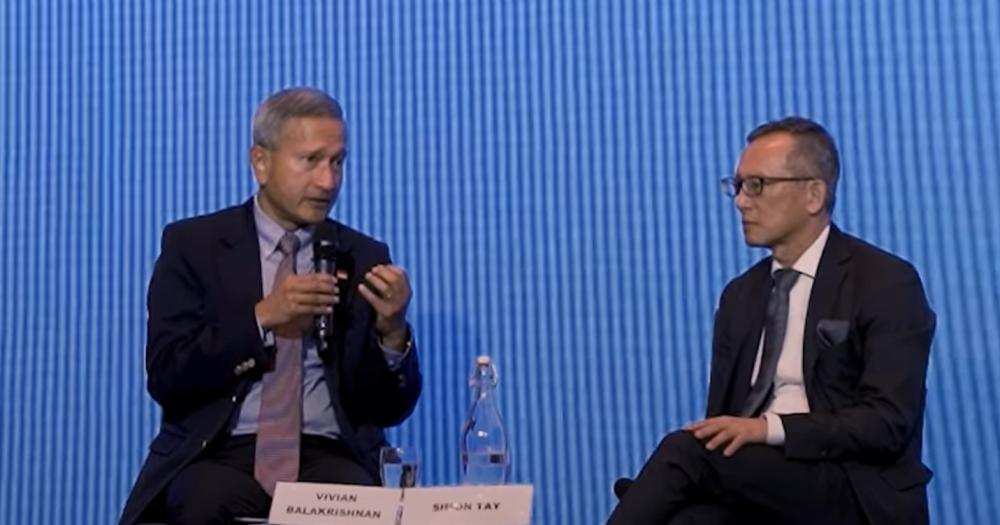
 Singapore’s foreign minister Vivian Balakrishnan spoke at the Aug. 5 Singapore Institute of International Affairs’ 17th Asean & Asia Forum, giving his views on global affairs, particularly the recent impact of United States (U.S.) policies.
His speech was part recap of how the first half of 2025 was going for Singapore, as it coincided with the return of Donald Trump as president of the U.S.
But it was also an elaboration of key approaches for Singaporean foreign policy, such as the need to remain omnidirectional and flexible, the difference between the two, and how all foreign policy begins at home.
Discordant
Vivian began with an analogy he said had been supplied by his staff: for the previous 80 years, the world was like an orchestra with an American conductor.
But now the conductor had “gone AWOL” and now the world had to move between the old order and the new, with the possible outcomes ranging from “a jazz ensemble” of improvisation and constant adaptation of countries to each other, or at worst: “complete chaos and cacophony”.
But he noted that the institutions of the old order, such as the United Nations, could no longer be entirely relied upon anymore.
Even international trade had seen evidence of a slowdown, even as Vivian observed that U.S. President Trump’s “Liberation Day” tariffs had not turned out "as bad" as they had initially seemed.
But they remained a drag on growth, and a negative impact on the previous multilateral trading system.
Bilateral arm wrestling match
Vivian voiced his major worry, that every trade agreement from here on out would be a “bilateral arm wrestling match”.
And the worry would not be confined to what the U.S. will do next, but that other countries might ape Trump’s approach in the future, thinking about how “to maximise advantage", like "Mini Trumps”, as the panel's moderator put it.
The moderator, SIIA’s chairman Simon Tay, spoke about a concept that had been introduced at an earlier session, the idea of “G Minus One”.
This was a reference to the G7 or G20 groupings, where countries gathered together to coordinate various efforts.
G Minus One represented a world with an absent U.S., where once it had been ever-present.
The impact on Singapore would be more than the 10 per cent baseline tariff that it is currently facing.
There would be second and third-order impacts, and that “every subsequent trade deal is going to be more fraught”, made worse by the fact that Singapore would likely be “the smallest stakeholder in the room”.
Omnidirectional and flexible
Tay asked Vivian about concepts that he had used before, when he described Singapore’s approach to foreign affairs as “omnidirectional” and as “flexible multilateralism”.
Omnidirectional was simply that Singapore would engage with every possible partner, but the idea of flexibility required more explanation.
Certain multilateral organisations that Singapore engaged heavily with, such as Asean and the World Trade Organization, required consensus.
But consensus could sometimes be a “straitjacket”, and while Singapore did not want to abandon consensus, there was a need to have a system where “as long as there are enough of us who want to move forward in a constructive and positive way, we will move forward”.
It was not about abandoning consensus or the compromise needed to find it, but ensuring that Singapore would not be “held back ad infinitum”.
Vivian also reflected on the journey that Singapore had taken over the past 60 years, saying that Singapore had been “primed” for that period, having key elements that worked well for it.
These include having an honest, competent government, working in concert with trade unions who “took a long term view of worker’s welfare” and a hard working and disciplined population.
The next 60 years would require going back to basics to “catch the new winds” from the technological revolution.
Related story
Top image via Mothership