Environment

NParks officer shoots water gel beads to 'guide' macaques away from Punggol HDB
Sign me up.
August 06, 2025, 12:06 PM
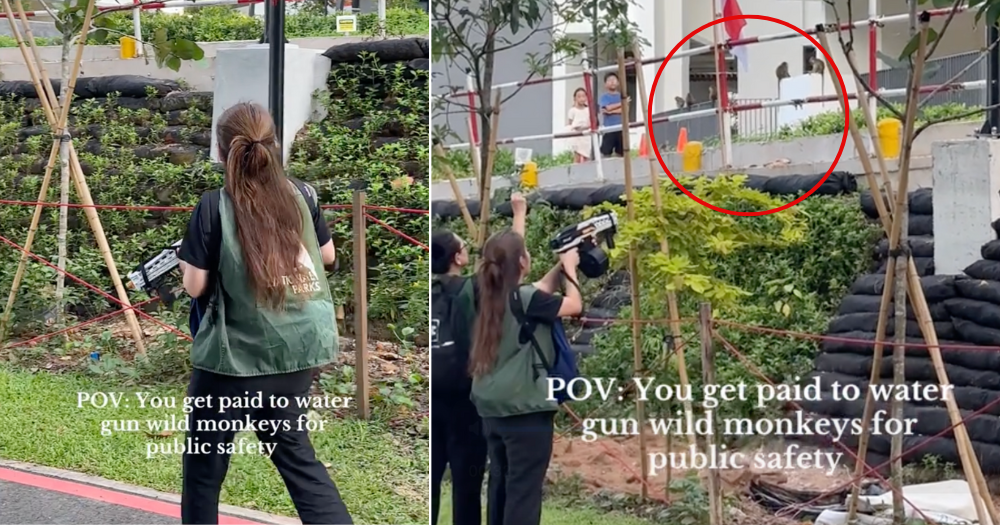


A National Parks Board (NParks) officer was recently seen shooting at long-tailed macaques at a Punggol Housing and Development Board (HDB) estate with water gel bead blasters.
This is a new measure to guide macaques away from residential areas and back towards forested areas, NParks said in a statement on Aug. 5.
Paid to water gun wild monkeys?
The unusual sight was captured in a clip shared to TikTok on Aug. 3.
Two NParks officers walked down a park connector, and eyed a group of wild monkeys gathering near Block 443B New Punggol Road.
The estate is located near the Punggol Settlement and Coney Island, which is known to have a population of long-tailed macaques.
A few monkeys were perched on a metal shelter, while others had climbed up to a second-floor ledge at the block.
One of the officers, who was armed with a water gel blaster, shot in the direction of the monkeys, and they scattered.
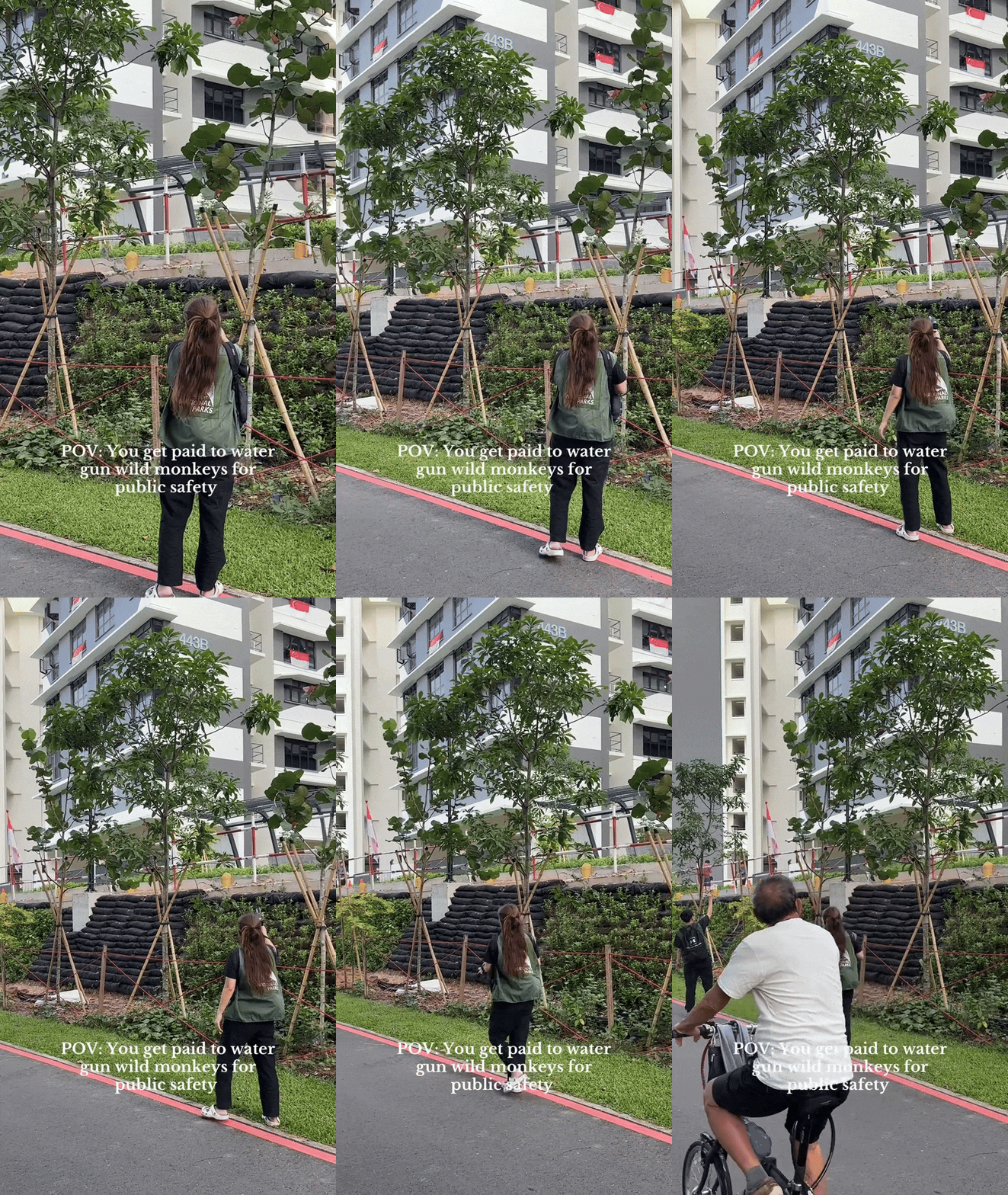 GIF of video from coconoteee/TikTok
Some residents, hearing the noise of the blaster, came over to see what was going on.
The clip was captioned, "POV: You get paid to water gun wild monkeys for public safety".
In the comments, some online users, possibly in jest, expressed their interest to apply for the job.
 Screenshot of comment from coconoteee/TikTok
 Screenshot of comment from coconoteee/TikTok
Others expressed concern that the animals might be harmed, or questioned why the direction of the shooting appeared to herd the monkeys back towards the HDB blocks.
Water gel beads used to guide macaques away from residential areas: NParks
In response to Mothership's queries, NParks group director How Choon Beng said that as part of monkey guarding efforts, NParks has been using water gel beads as an additional measure to guide the macaques away from residential areas and towards forested areas.
How said this is because some macaques have grown accustomed to existing monkey guarding measures.
"The loud noise generated by the device and scattering of the water gel beads also allow the range of guarding to be extended. Should there be any contact, the beads will burst upon impact and do not carry significant force at that range," said How.
Concurrently, NParks will continue to conduct regular monkey guarding patrols to herd the troop back into forested areas, How said.
It was previously reported that from Sep. 1, 2024, to Mar. 31, 2025, NParks received around 200 "feedback cases" regarding long-tailed macaques in Punggol.
The reports included sightings, intrusions into homes and rummaging of rubbish bins.
Residents who spoke to Mothership in March shared that they have seen the animals rummaging through trash, loitering along the nearby park connector, as well as climbing on the balconies of some of the HDB units.
One elderly woman even recalled being chased by a monkey and having to hide in a nearby public toilet.
NParks' approach to managing the monkeys
How said that NParks adopts a science- and community-based approach in managing wildlife in Singapore, including long-tailed macaques.
This is done through a combination of management measures, including:
- Undertaking studies to understand the population ecology of macaques,
- Minimising human sources of food by ensuring proper waste disposal and enforcement against feeding,
- Habitat modification such as removal of fruit trees,
- Guarding of macaques away from human areas and
- Removal of intrusive individuals from human dwellings
Since 2023, NParks has also been sterilising macaques at Coney Island Park and the Punggol vicinity as part of its long-term population control measures.
How said that NParks works with relevant authorities and community leaders on a multi-pronged approach to minimise human sources of food, and expanding outreach and engagements to the residents at Punggol on what to do when encountering macaques.
Enforcement efforts are also undertaken to deter illegal wildlife feeding activities.
How noted that long-tailed macaque populations are dynamic and can move between habitat patches in search of available resources, making them less dependent on a particular site for survival.
As such, NParks will continue to study their population long-term to understand their movement patterns and habitat use, which will inform ongoing population control measures, he said.
What to do when encountering macaques
If macaques approach you in the open, here's what to do:
- Remain calm and quiet and do not make any sudden movements or maintain eye contact with them.
- Look away and back off slowly.
- Keep away from the area until they have left.
- Keep plastic bags out of the sight of macaques when spotted. Macaques have associated plastic bags with the presence of food and will try to snatch them when they see them.
Members of the public may also call NParks' 24-hour Animal Response Centre at 1800-476-1600 for wildlife-related issues.
Top image from coconoteee/TikTok