Perspectives

Comment: PM Wong has his sights at the next GE & beyond by making sure the kids are alright
PM Wong said that the economic strategy is about jobs, jobs, and jobs.
August 18, 2025, 10:05 PM


With National Day behind us and Prime Minister Lawrence Wong having delivered his National Day Rally speech on Aug. 17, I want to point out something significant that took place in 1965.
That would be the release of legendary rock band The Who's debut album, "My Generation."
The album included the track which would be very useful for headline writers of the future: "The Kids Are Alright."
Well, are they?
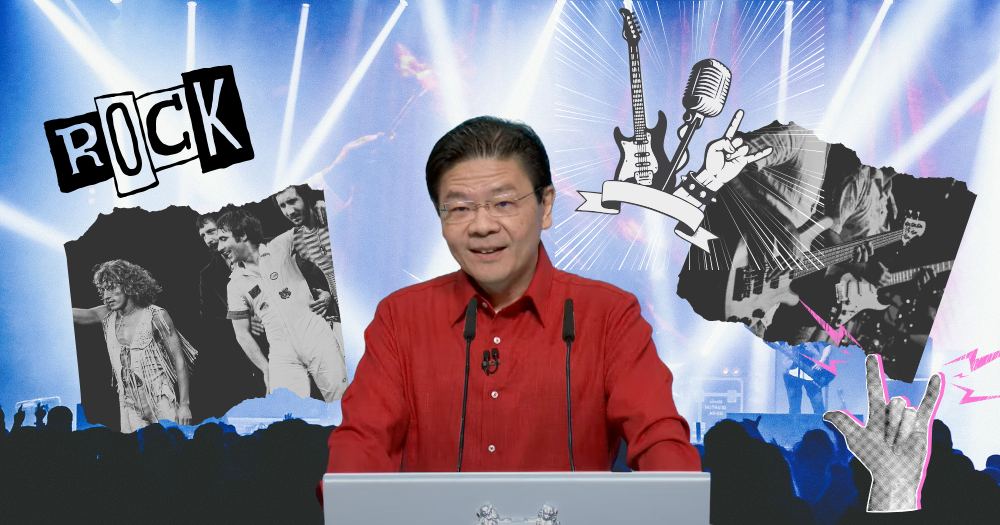
Maybe it was PM Wong's unexpected reference to English rock band Led Zeppelin that put me in a musical mind, but it really did seem as though he pondered the question prior to delivering the remarks:
"In the early 70s, we did not allow rock band Led Zeppelin to perform here!
If you do not know Led Zeppelin, you are missing out on the good stuff!"
A good chunk of his rally speech dealt with the challenges faced by a younger generation of Singaporeans.
PM Wong addressed the dangers of vaping for the first time and said that much tougher action will be taken against vaping.
He added that vaping will be treated as a "drug issue" with stiffer penalties imposed.
Subsequently, PM Wong moved on to other concerns faced by the youths of Singapore, from dangers of relying too much on AI to the challenging job market.
The latter has been made even more challenging not just by the AI wave, but also by the wave of tariffs announced by U.S. President Donald Trump.
While Singapore emerged with the so-called baseline tariff of 10 per cent, PM Wong was right to point out that this comes as little comfort, as the U.S. may at any time increase the tariff or impose heftier tariffs on sectors important to Singapore, such as semi-conductors.
Left unsaid was the damage that could be done if the U.S. and China, currently in the middle of trade talks, fail to reach an accord and escalate their tit-for-tat measures in a full-blown trade war.
Kickstart my heart
Instead of waiting for the hammer to fall, the government is proactively moving to address this with the announcement of government-funded traineeship programmes for ITE, polytechnic and university graduates.
It was not lost on me that PM Wong talked up the success of a Covid-era programme.
After all, the initial round of Trumpian tariffs caused the U.S. S&P 500 to crash on a scale not seen since, you guessed it, 2020.
While we live on a prayer that this global wave will ultimately turn out to be less damaging than Covid, the government is clearly anticipating challenges ahead.
PM Wong underlined this by informing us that if the economy worsens, the programme will be scaled up.
And he ended with a message of reassurance that brought to mind Singapore's founding Prime Minister Lee Kuan Yew, who asked Singaporeans to "never fear" as Singaporeans will witness Singapore's transformation to a metropolis in a decade.
"To all our students and young Singaporeans, I know that growing up is not easy. The world today can feel overwhelming. The future at times, distant and unclear.
But I say to you: do not fear.
You are not alone on this journey.
We see you, we hear you, and we will walk with you – every step of the way."
Political advantage? Why not.
Now "politics" is almost a dirty word in Singapore, and never more so when it comes to the actual politicians.
Policy discussion is commonplace, with even the uncles and aunties in the kopitiams able to hold forth on a wide range of topics from monetary policy, to property cooling measures, and relations between China and the United States.
But there is little official acknowledgement, whether from the incumbents or the loyal opposition, on how policy translates into votes.
Such a concept feels a little gauche for this country, where those engaged in politics prefer to be seen as pragmatic technocrats above the gutter of politics itself.
Policy, so the story goes, is only ever undertaken with a view towards benefiting the public no matter how they vote, with long-lasting impacts prioritised over short-term gains.
Perhaps that is how things must be in Singapore, with the public tacitly agreeing not to politicise issues if the politicians enact measures that don’t merely reward their own supporters, but the public at large.
Smells like teen spirit
Yes, the last election ended just a few months ago, but it is never a bad time for speculation.
It may not be hyperbole to predict that the next few months may be crucial to PM Wong's premiership.
The Trumpian tariffs and the potential end of the multilateral trade system that skyrocketed Singapore's development for much of the 20th century is not his fault, just as Covid-19 was not SM Lee Hsien Loong's, and the Asian Financial Crisis was not ESM Goh Chok Tong's.
But he can direct the government's response to this latest challenge, and it's fair to say that everyone in Singapore, regardless of how they vote, wishes him success in this endeavour.
If youth-focused policies like the government-funded traineeship work as they are supposed to and help young jobseekers find and keep employment during hard times, they may just keep them in mind by the time of the next general election.
And if the PAP wins big electorally by protecting Singaporean lives and livelihoods, then that's just good vibrations.
Top image from Wikipedia, Prime Minister's Office, Singapore/YouTube