News

Multiple myeloma still incurable but remission rates have improved to over 90%: NUS Professor in Medical Oncology
Singapore sees about 120 new cases per year.
August 14, 2025, 05:49 PM
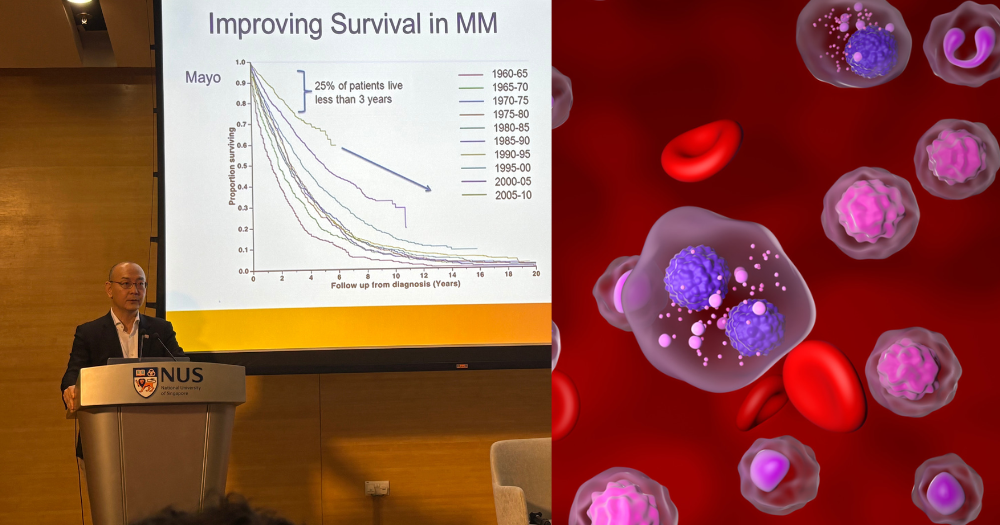

 The treatment and outcomes of multiple myeloma have improved tremendously over the last decade, doubling the chances and length of survival from the blood cancer.
While there is still no cure, the median survival for multiple myeloma patients today is 9.1 years, according to data from Singapore's National University Hospital.
This number is up from the median survival rate of three to four years about two decades ago, according to Yong Loo Lin Professor in Medical Oncology at NUS Medicine, Chng Wee Joo.
Chng, a haematologist by training, is also the vice president of biomedical sciences research at NUS, and a senior consultant for haematology at the National University Cancer Institute, Singapore.
On Aug. 14, Chng gave a talk at NUS University Hall in which he drew from his research over the past two decades to share about the recent advances and the promising future of multiple myeloma treatment.
What is multiple myeloma?
This cancer originates in plasma cells, a type of white blood cell primarily found in the bone marrow, crucial to help fight infections.
In multiple myeloma, abnormal plasma cells build up and produce abnormal antibodies, leading to various health issues in the bones, kidneys, and more.
Although it is the second most common type of blood cancer, it is considered a relatively rare cancer.
Singapore sees about 120 new cases per year, Chng told Mothership.
"The main challenge [in treating multiple myeloma] has been that the response to treatment does not last very long," he said.
However, with improved treatments, remissions now last longer, enabling patients to live longer.
Breakthroughs
As clinician scientists gained increasingly better understanding of the biology and genome of multiple myeloma, there has been rapid developments in drugs to control the cancer and delay its relapse.
Fourteen new drugs have been approved over the past two decades, and they are better than previous ones, Chng said.
"Remission rates for newly diagnosed myeloma with the treatment we provide currently are above 90 per cent," he told Mothership.
Despite these improvements, around 25 per cent of patients may live for less than three years, these are people identified as high-risk patients.
Many, about 15 per cent of patients, have long remission and "may well die of other conditions", according to Chng.
He shared about a recent trial using a combination of four drugs in younger patients that are fit for stem cell transplantation.
The results showed that they can have remission for up to 17 years before they have their first progression.
Treatments that produce such outcomes are available in Singapore, Chng said.
As newly diagnosed multiple myeloma patients receive this treatment and drug today, "we should see these patients living for [about] 18 years before the disease progresses", he added.
Many of the drugs are given as outpatient treatment, so patients need not stay in the hospital.
Although they may need to take medicine continuously, patients have a good quality of life in general, Chng said.
Controlling complications
Improvements in therapy with better disease control will help to reduce the complications that arise from multiple myeloma.
Some of the serious complications are bone fracture and the compression of the spinal cord, causing one to be partially unable to move their legs.
Multiple myeloma also reduces the patients' immunity, which can be further affected by treatment. As a result, they have an increased risk of getting infections, some of which may be life-threatening.
"Once complications develop, they may not be reversible even with treatment", Chng said.
Thus, as with all cancer, early detection is crucial, to provide effective treatment early before the complications develop.
Looking ahead
Chng called the latest advances "a great leap forward" and believes "it's going to be even better" due to better, newer drugs in the horizon.
The prediction for myeloma patients by 2035 to 2040 is that up to 50 per cent of patients could potentially survive for more than 20 years.
The direction is also moving towards more limited duration rather than continuous treatment.
"Myeloma patients have a lot of positive things to look forward to", Chng said.
Challenges, however, still remain.
There are still high-risk patients who are not able to survive long, and many patients who do not receive treatment.
Chng highlighted that the new challenge today is ensuring access to drugs.
"They are very expensive and not all are covered by subsidies or insurance, so not all patients can afford the treatments", he explained.
Top images by Wu Xueting/Mothership and NUS