News

'Entirely legitimate' for US voters today to ask why they should pay to uphold global system: Vivian Balakrishnan
Explaining tariffs in the land of tariffs.
July 21, 2025, 04:35 PM
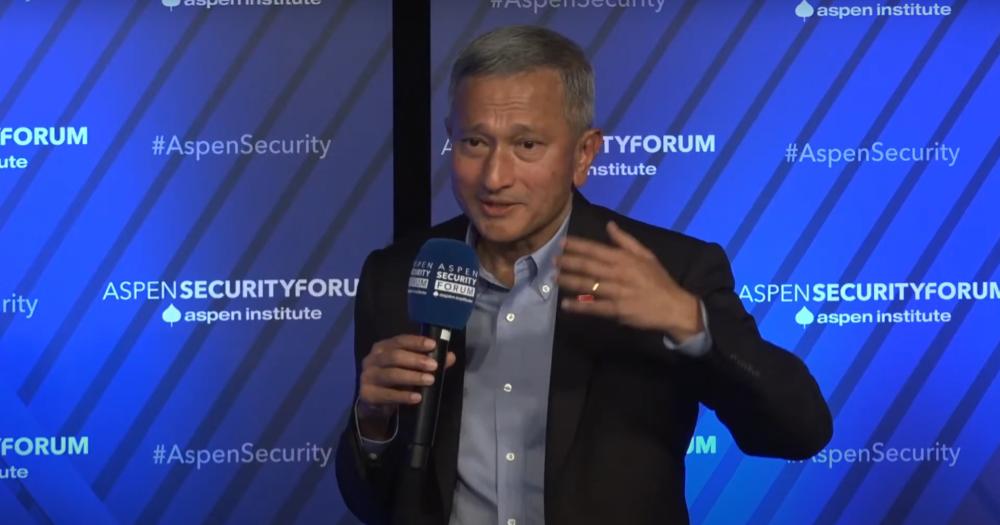

 Singapore’s foreign minister, Vivian Balakrishnan, spoke at the Aspen Security Forum where he participated in a “Fireside Chat” alongside Financial Times correspondent Demetri Sevastopulo.
The almost 40-minute discussion covered a range of concerns on the Singaporean and global foreign policy agenda, including Singapore’s reaction to tariffs and China’s impact on Southeast Asia.
Vivian also shared a clear take on the motivations behind the United States’ approach to tariffs and how it marked a moment of transition for the global economic environment.
No Safe Zone
Sevastopulo began by asking if Singapore had yet received a “Trump trade love letter”, referring to a series of letters issued by the administration of U.S. President Donald Trump clarifying the trade tariff rate that that country would be subject to.
Vivian confirmed that Singapore had yet to receive such a letter, to which he was asked if Singapore was “in the safe zone”.
Vivian initially answered by trying to put the current situation in context, attributing the favourable state of Singapore’s economy to two factors “turbocharging” it: the Pax Americana, and the reforming and opening up of China.
Magnanimous hegemon of the past
He acknowledged the unusual approach that the U.S. had taken in the aftermath of the Second World War.
Rather than collecting the spoils and imposing their will, in the manner of previous war victors, the US instead embarked on rebuilding both Japan and Germany, their former foes.
Vivian described this move as unique and historically unprecedented, envisioning and underwriting the modern rules-based multilateralism and globalisation, and doing so using its own “blood and treasure”.
This included the establishment of many of the modern world’s multilateral institutions, including the United Nations, the World Trade Organisation, the World Bank, and the International Monetary Fund.
It was in this way that the U.S. had acted as a “magnanimous hegemon”, which allowed Singapore to make itself relevant and hospitable to the expansion of multinational corporations.
Singapore’s belief in free trade stems from a trade volume three times larger than its GDP.
For Singapore, free trade is not a negotiating point: “It is our lifeblood”.
When pressed, Vivian invoked founding prime minister Lee Kuan Yew, who he said urged Singaporeans to “take the world as it is, not as how you wish it”.
“So no, a small city-state is never safe”.
Atlas shrugged
The world as it is sees that the “magnanimous hegemon has changed its posture”.
Vivian remarked that the change was due to domestic politics in the U.S.
In the post-WWII world, US GDP was 40 per cent of the world’s.
It was “entirely worth America’s while, and in its own enlightened national interest, to underwrite the global system in blood and treasure, because for every additional dollar generated in the world, 40 cents came back to America.”
“Today it is 26 per cent.”
The difference was enough that Vivian felt it was “an entirely legitimate question” for U.S. voters to ask why they were spending resources and lives to prop up the system, and if there should be a fairer distribution of the burden.
If the U.S. spends 3 per cent on defence, he mused, what about the rest of the world?
Investment, not just trade
Vivian was then asked about whether U.S. tariffs were providing an opportunity for China in Southeast Asia.
Vivian replied by saying that China’s trade with the region was double that of the U.S., at a trillion dollars and half a trillion dollars, respectively.
But in terms of the flow of foreign direct investment from the U.S. across Southeast Asia, the U.S. outpaces China four to one.
In terms of FDI already in the region, the U.S. to China ratio was ten to one.
The investment numbers were significant because “you can trade with anyone, but investment requires a certain belief, a certain optimism, a certain confidence in the future”.
Vivian then spoke about the 10 per cent baseline tariff imposed on Singapore, which was imposed even though Singapore had a trade deficit relative to the U.S. and an existing Free Trade Agreement.
Repudiation at a very fundamental level
The tariff amount was not the central issue; instead, its presence was a “repudiation at a very fundamental level” of foundational principles of the World Trade Organisation.
If the U.S., of all the superpowers, were to reject this, it would “give ideas to everyone else in the room”.
Instead of having a rules-based global system that promoted trade, the world now had a system where “every trade agreement becomes a bilateral arm-wrestling match”, something that naturally worries a country like Singapore.
There is also a worry that the imposition of tariffs might result in reciprocal tariffs, leading to an escalatory spiral, similar to the 1930s, the period of the Great Depression.
"Not a glorious period for economics, for globalisation, and for peace and stability”.
Top image via The Aspen Institute/YouTube