News

SM Lee says US tariff impact will continue beyond Trump’s term, world won't return to status quo
“Once you make a move, you cannot take it back.”
July 16, 2025, 01:10 PM
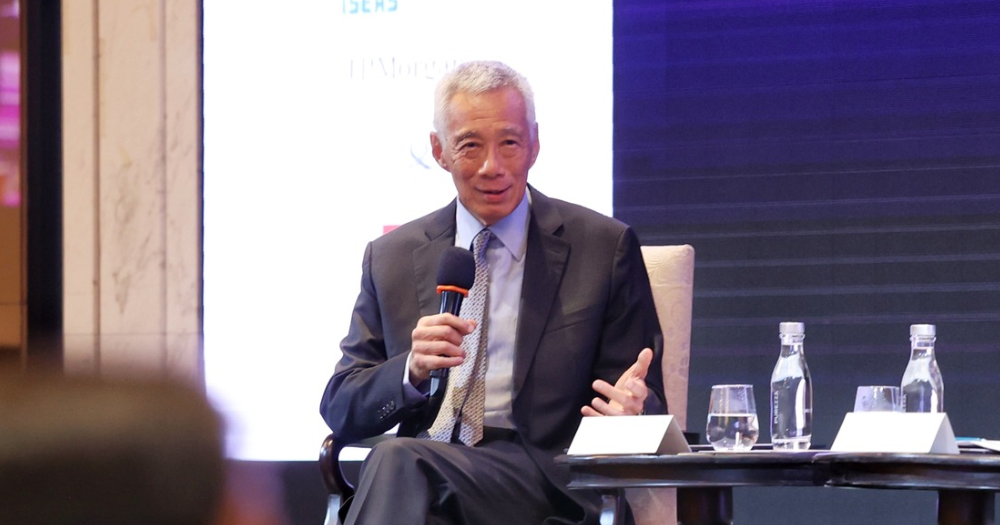


Senior Minister Lee Hsien Loong has said that the impact of U.S. tariffs will not be temporary, and it is “politically not possible” for the world to return to the status quo.
“In trade policy, in economic policy, once you make a move, you cannot take it back,” the former Prime Minister explained, speaking at a dinner held by the Economic Society of Singapore on Jul. 15, 2025.
SM Lee told ESS president Euston Quah, who moderated the dialogue, “There are consequences. When you first put in the tariffs, everybody complains.”
“But once you have put in the tariffs, and once new players come who depend on the tariffs, and need the tariff protection, and you say ‘I am taking the tariffs away, we are going back to where we were’, it is politically not possible.”
On Jul. 10, Deputy Prime Minister Gan Kim Yong said that Singapore would need to be prepared for a longer period of uncertainty after the Trump administration sent letters announcing new reciprocal tariff rates to over 20 countries.
Singapore has apparently not yet received a letter and remains subject to a baseline 10 per cent tariff.
However, pending confirmation, concessions are expected to be offered to Singapore’s pharmaceutical exports to the U.S.
Is Singapore badly affected?
In response to Quah stating that Singapore is “not so badly affected yet”, SM Lee quoted a Chinese saying: "The person who retreated 50 steps from the battle laughs at the person who retreated 100 steps, and says, ‘You are worse off than me.’”
He noted that the U.S. still levied a 10 per cent tariff on Singapore, despite Singapore imposing zero tariffs on the U.S. due to an existing Free Trade Agreement between the two countries.
“I suppose if you treat the world as the way it is and ask, ‘Could it be worse?’, it could be worse,” he said. “But is it better than we were before? I am more sceptical.”
Quah also asked SM Lee if comparative advantage is dead, amid growing protectionism in international trade, to which SM Lee stated that he did not think so.
Comparative advantage refers to a country’s ability to produce a good more cheaply and easily than its peers. It underpins how a country can benefit from international trade by exporting such goods and importing those with a greater opportunity cost.
While the U.S. has decided on a more bilateral and transactional approach to international trade, SM Lee noted that other countries maintain an extensive framework under the World Trade Organization (WTO).
He said, “One thing I have learnt in government is that you can fail to follow economic principles, but you cannot repeal an economic law.”
What can we do?
Speaking on the approach countries should take moving forward, SM Lee has underscored the need to strengthen ties with like-minded regional and international partners, adding that it is crucial to diversify within the region and in new markets, such as Latin America.
He additionally highlighted the importance of being able to “have enough of a consensus of countries to say, ‘We move ahead.’”, even as some countries decide not to follow suit.
Even if the U.S., one of the world's biggest economies has retreated from that front, the WTO still remains, with other countries still interested in lowering trade barriers instead of putting them up.
“We should try and make the multilateral framework less bad, rather than write it off,” he said.
SM Lee pointed to other agreements like RCEP (Regional Comprehensive Economic Partnership) or the CPTPP (Comprehensive and Progressive Agreement for Trans-Pacific Partnership), which Singapore is involved in.
They involve countries in the same broad region, with complementary economies.
"Not everybody comes along, and some countries are not comfortable. Well, that is alright. The rest of us, let us move ahead," SM Lee said.
Top image via Lee Hsien Loong/Facebook