
News

S'pore dog owners advised against using shock & prong collars, more 'humane' methods recommended: AVS & SPCA
Such devices can cause serious harm to dogs, and pose a safety risk if not operated properly.
July 26, 2025, 02:35 PM
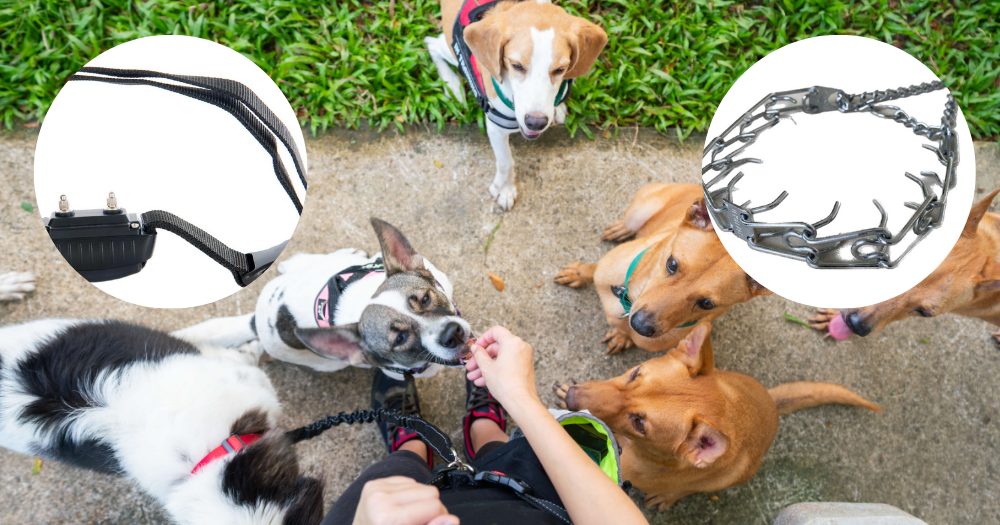


Do you own a dog?
A new advisory developed in collaboration with the Animal & Veterinary Service (AVS) and the Society for the Prevention of Cruelty to Animals (SPCA) discourages the use of aversive tools such as electronic shock collars and prong collars, in favour of more humane rewards-based training practices.
The advisory, released on Jul. 26, said such training devices have the potential to cause serious harm to dogs both physically and mentally, as well as pose a safety risk to humans and other animals if not operated properly.
Dog owners are advised not to try to use the training devices on their own.
Instead, they should consult an AVS-accredited dog trainer for advice on dog training.
A veterinary assessment is also recommended in order to rule out any underlying medical condition which might contribute to behavioural issues.
Shock and prong collars discouraged
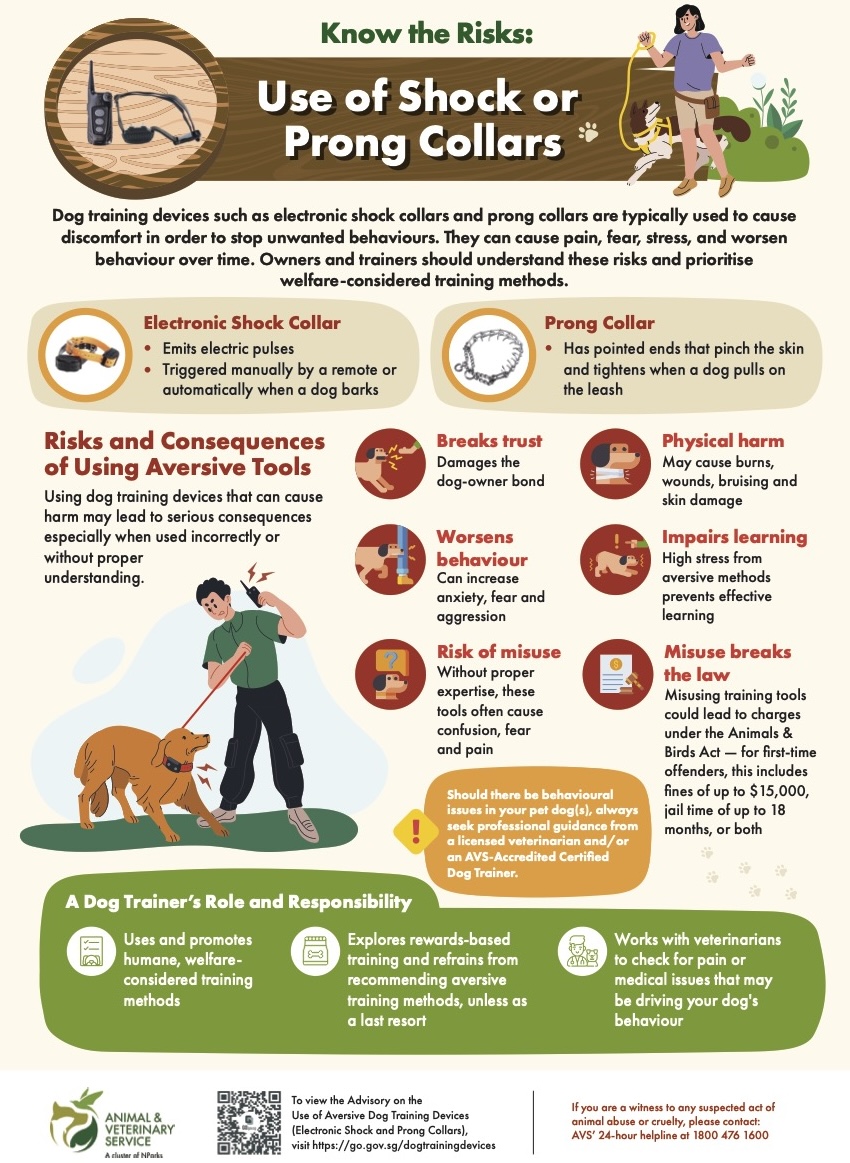 Infographic from AVS
The advisory was launched by Minister of State for National Development and Trade and Industry Alvin Tan, during the Pets' Day Out event at Tampines Boulevard Park on Jul. 26.
Tan said the advisory provides clear science-based guidance to help dog trainers and pet owners in their pet training.
Best practices in animal training should prioritise humane and minimally aversive methods, Tan noted.
"In essence, we discourage the use of electronic shock collars and prong collars. At the same time, we strongly encourage positive, rewards-based training methods. These rewards-based training methods that help build trust with our dogs, making them feel safe, making them feel confident, while training and teaching them to better adapt to life in our urban environment", said Tan.
Tan added that the use of aversive dog training devices should only be chosen "as a last resort" and only by trained professionals or under the supervision of one.
AVS said in a Jul. 26 release that the advisory is part of broader efforts to safeguard animal health and welfare and raise standards in the dog training industry.
The advisory on the use of aversive devices was developed by the Dog Training Standards Workgroup and co-chaired by AVS and SPCA.
This comes after focus group discussions were conducted on the issue in April 2023, with stakeholders including dog trainers, veterinarians, animal welfare groups, working dog units, and pet owners.
"The discussions revealed a strong consensus on the need to raise awareness about the risks associated with aversive training devices and to promote safer, more humane alternatives," said AVS.
What are the risks?
 Image from advisory
Electronic shock collars typically have different modes to adjust the intensity and duration of electrical impulses.
These can be activated manually, automatically when the dog barks or crosses a boundary line.
 Image from advisory
Prong collars are collars with pointed ends such as prongs or teeth, which will pinch the skin around the dog's neck when pulled and tightened by a handler.
They are typically used by handlers to suppress unwanted behaviours such as excessive pulling or lunging towards people.
According to the advisory, the improper use of shock and prong collars can lead to associated risks such as causing the dog to experience feelings of pain, fear and anxiety, and physical damage like skin irritation, pressure wounds and burns.
It can also increase the likelihood of aggressive behaviour being a part of a dog's regular behavioural patterns, which could endanger surrounding people and animals.
For instance, if pre-bite signals such as growling, staring or snapping are punished, a dog may be conditioned to skip these signals and go for the bite directly, the advisory indicated.
Dog owners are advised to use rewards-based training methods, which have been shown to be just as effective, if not more effective, while having fewer welfare risks, said the advisory.
Those found misusing training tools can be charged under the Animals and Birds Act.
First-time offenders can be fined up to S$15,000, jailed up to 18 months, or both.
Owners having trouble with their dog's behavioural issues are advised to seek professional help from a licensed veterinarian or an AVS-Accredited Certified Dog Trainer.
Future plans
The Dog Training Standards Workgroup will continue to explore regulatory options for training devices, taking into consideration the diverse views of the public and within the dog training sector, AVS said.
This is part of the agency's larger review of the Animal and Birds Act.
A new school outreach programme on understanding canine behaviour will also be rolled out to secondary school students this month.
Students will get to learn the various dog training techniques, and take part in a hands-on session at the Centre for Animal Rehabilitation.
Related
Top image from AVS