



News

EU strikes 15% tariff deal with US, commits to S$1.73 trillion in investments & purchases
The bloc is to invest S$768 billion in the U.S. as part of the deal.
July 28, 2025, 01:41 PM


The European Union (EU) and the United States (U.S.) have reached a trade deal imposing 15 per cent tariffs on most EU imports, which European Commission President Ursula von der Leyen has defended as “the best we could get”.
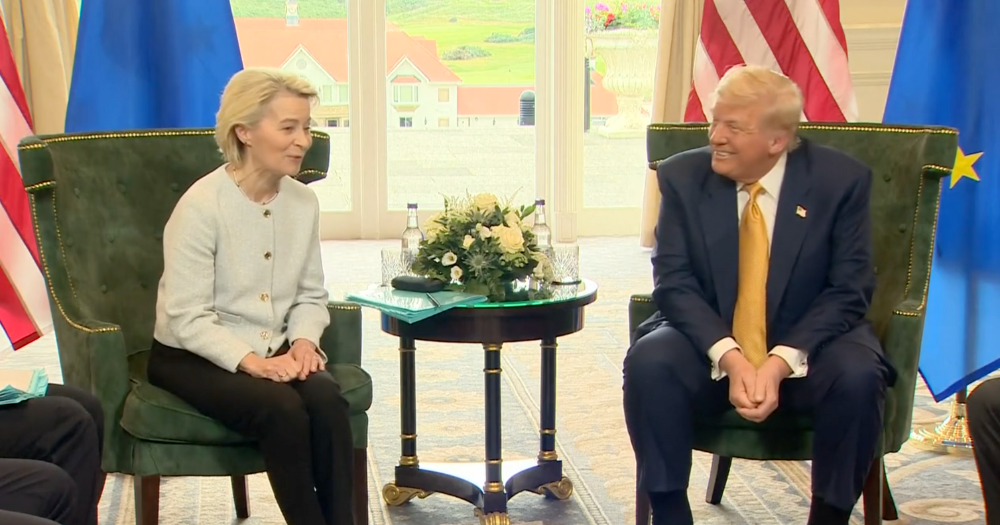
U.S. President Donald Trump and von der Leyen announced the deal on Jul. 27, after an hour-long meeting at Trump’s golf resort in Scotland, Reuters reported.
“The best we could get”
Von de Leyen said that a baseline tariff of 15 per cent would apply to most EU imports, including cars, semiconductors and pharmaceutical goods.
That is half the tariff rate Trump had threatened to impose starting Aug. 1.
“15 per cent is not to be underestimated, but it is the best we could get,” she told reporters when asked if she considered it a good deal for European carmakers.
Trump said that the deal would also involve the EU investing US$600 billion (S$768 billion) in the U.S., as well as purchasing more U.S. defence equipment and energy, which includes US$750 billion (S$961 billion) worth of U.S. Liquefied Natural Gas (LNG) and nuclear fuel over three years.
"We still have too much Russian LNG that is coming through the back door," said von der Leyen. The EU is proposing a ban on Russian gas imports by the end of 2027.
50 per cent tariffs on steel and aluminum
Meanwhile, the U.S. will maintain 50 per cent tariffs on the EU’s steel and aluminum, though von der Leyen has suggested that it could be replaced with a quota system, which would limit the quantity of imports.
Zero tariffs were agreed on for a range of sectors. This includes “all aircraft and component parts, certain chemicals, certain generics, semiconductor equipment, certain agricultural products, natural resources and critical raw materials”, von de Leyen said, as quoted by The Guardian.
The agreements come after negotiations von de Leyen described as “tough” and “very difficult”, with Trump keeping the EU delegation in suspense until the end as he reiterated that chances of a deal were only a “50-50” with “three or four sticking points” remaining.
“You saw the tension at the beginning. So we had to work hard to come to a common position,” she later told reporters at the airport.
Mixed reactions from EU leaders
Von de Leyen has said that the trade deal was “huge”, bringing about “stability” and “predictability”.
While the leaders of Germany and Italy largely welcomed the deal, EU trade commissioner Maros Sefcovic considers it a huge victory for Trump and his tactic of employing tariff threats.
Noting the intense atmosphere and that Trump was a “very tough negotiator”, Sefcovic described the 15 per cent agreed-upon rate as a setback for the EU, which had tariff rates with the U.S. averaging 4.8 per cent before Trump.
However, he added, “I think that what was most important for us was to make sure we would have this predictability and we would have stability for our businesses.
Meanwhile, Irish Deputy Prime Minister Simon Harris said he “regretted” the 15 per cent tariff deal, but acknowledged the importance of “certainty”.
The deal will present tough diplomatic discussions for Ireland, as Northern Irish exports to the U.S. are only subject to a 10 per cent tariff rate thanks to the UK's trade deal.
Crunch time
As for the U.S. president, he said that the deal would strengthen U.S.-EU relations following what he deems as years of unfair treatment towards American exporters.
"I think this is the biggest deal ever made," Trump lauded, noting the incoming US$600 billion (S$768 billion) in EU investments.
The U.S.-EU deal comes as nations scramble to finalise agreements ahead of Trump’s Aug. 1 deadline.
Besides the EU, tariff agreements have been reached with the UK, Japan, Indonesia, the Philippines and Vietnam, at rates of 10 per cent, 15 per cent, 19 per cent, 19 per cent and 20 per cent respectively – all lower than Trump originally threatened, but in some cases higher than the initial announced rate.
Trump has also indicated that the U.S. and China were “very close” to making progress in negotiations, with sources revealing that the two largest economies are expected to extend their temporary tariff suspension by another 90 days, the South China Morning Post reported.
Related stories
Top image via Ursula von der Leyen/X