News

S'pore still subject to 10% US tariffs, must be prepared for prolonged period of uncertainty: DPM Gan
Uncertainty.
July 10, 2025, 02:00 PM


Singapore must be prepared for another period of uncertainty with the tariffs the U.S. will impose on specific countries and products, Deputy Prime Minister Gan Kim Yong said.
He also said that Singapore continues to be subject to the 10 per cent baseline tariff imposed by U.S. President Donald Trump.
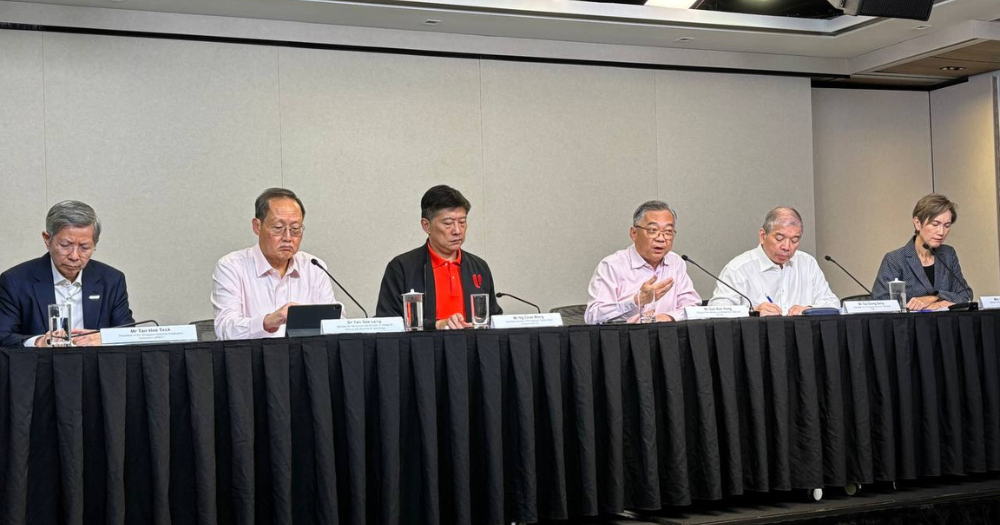
DPM Gan, who is also Minister for Trade and Industry and chairs the Singapore Economic Resilience Taskforce (SERT), was speaking at a SERT press conference on Jul. 10.
He was joined by Minister for Digital Development and Information Josephine Teo, Minister for Manpower and Minister-in-charge of Energy and Science & Technology Tan See Leng, Secretary-General of the National Trades Union Congress (NTUC) Ng Chee Meng, Chairman of SBF Teo Siong Seng, and President of the Singapore National Employers Federation (SNEF) Tan Hee Teck.
US letters on tariffs
Gan noted that letters had been sent to over 20 countries on their new reciprocal tariff rates.
Gan said he had hoped the tariffs would have settled to lower levels after the 90-day pause.
That has not come to pass for a number of countries.
He said this will likely prolong the uncertainty, volatility and challenges for economies around the world.
However, Gan said he hoped negotiations and consultations would continue to bring about lower tariffs and trade barriers.
Noting that the tariffs appear to be here to stay, he said Singapore must be prepared for a longer period of uncertainty over tariffs imposed on specific countries and products.
Baseline tariff in place, potential concession for pharmaceutical exports
Singapore continues to be subject to a baseline 10 per cent tariff.
However, Gan shared the U.S. are offering potential tariff concessions on Singapore's pharmaceutical exports to the U.S., and they are in ongoing discussions on this.
He said they "are in discussions with our counterparts from the Department of Commerce to better understand their expectations" and to explore practical and implementable approaches for companies.
Gan will be travelling to the U.S. later in the month to meet with his counterparts in the U.S. administration and business representatives.
This is to get a better understanding of the U.S. concerns, priorities, interests and to explore opportunities to work together to strengthen their bilateral relationship.
He gave examples such as AI and advanced manufacturing.
Government to work with businesses to offer support
Gan said SERT have been speaking to businesses and workers on the impact the tariffs have had on them, and how to better support them through these uncertainties.
Given the expectation of higher tariffs going forward, as well as the diminishing front loading effect, he said there will likely be slower economic growth over the next six to 12 months.
While Gan said there are a number of schemes to help businesses with the ongoing uncertainties, he said SERT is assessing how to better help businesses adapt to the changing economic landscape.
Some of the schemes being introduced include the "Business Adaptation Grant", which will be launched by Oct. 2025, to help eligible enterprises adapt to the new tariff environment for a time-bound period of two years.
This grant will be capped at S$100,000 per company and require co-funding by firms, Minister of Manpower Tan See Leng said.
The scope of the grant will cover enterprises who export to and/or have operations in overseas markets, and are impacted by tariff measures, to conduct Free Trade Agreements and trade compliance advisory, legal and contractual advisory, and supply chain optimisation and market diversification advisory.
It will also cover enterprises with manufacturing operations overseas or locally can also receive support for reconfiguration costs, such as logistics and inventory holding costs.
Top image from Daniel Seow/Mothership