News

China disagrees with Dalai Lama on successor, says his reincarnation must have govt approval
He specified that his successor would be born in the “free world” outside China.
July 03, 2025, 12:51 PM


China has rejected the Dalai Lama's succession plan, instead insisting that his reincarnation must be recognised through the “golden urn” lot-drawing process, with approval from the Chinese government.
On Jul. 2, the 14th and current Dalai Lama reaffirmed a statement he made in 2011, saying that the responsibility for selecting the next Dalai Lama belonged to members of a non-profit institution he set up – the Gaden Phodrang Trust – in consultation with leaders and spiritual figures in Tibetan Buddhism.
“I hereby reiterate that the Gaden Phodrang Trust has sole authority to recognise the future reincarnation,” said the Nobel peace laureate four days ahead of his 90th birthday.
"No one else has any such authority to interfere in this matter," he added.
China says no
However, China swiftly disagreed, its foreign ministry spokesperson Mao Ning telling a press conference the same day that the selection of the Dalai Lama’s successor must follow Chinese law.
In 2007, China passed a law incorporating the traditional ceremony into official regulations, while at the same time banning "interference" by overseas parties.
“The Dalai Lama’s reincarnation must follow the principles of domestic recognition, the ‘golden urn’ process, and approval by the central government, in line with religious traditions and laws,” she said, as quoted by the South China Morning Post (SCMP).
Need Chinese government approval
According to the SCMP, the “golden urn” system dates back to the 18th-century Qing dynasty, when the king drew lots to select reincarnations.
Since then, all successors have been recognised with approval from the Chinese government, apart from the 9th, 13th and 14th Dalai Lama.
The 14th Dalai Lama has insisted that his successor be selected “in accordance with past tradition”.
According to The Guardian, this would involve identifying a successor after the Dalai Lama's death by taking into consideration where he was looking when he died, which direction the smoke was blowing during his cremation and visions interpreted from a sacred lake in Tibet.
However, Mao said, “The 14th Dalai Lama himself was recognised after the 13th’s death following traditional rituals, but his recognition was granted directly by the then central government, exempting him from the golden urn process.”
She added that all religions "must adapt" to the "social, cultural and historical context" of the country.
Insisted on a successor born outside China
In a book published on Mar. 11, the Dalai Lama specified that his successor would be born in the “free world” outside China.
A failed uprising in Tibet against Chinese rule led him and thousands of other Tibetans to flee to India from Tibet in 1959.
Since then, the Dalai Lama has been branded a "separatist" by the Chinese government. There has also been friction between the two on issues of succession is not unprecedented.
In 1995, he recognised a 6-year-old Tibetan boy as the 11th Panchen Lama, the second-most important spiritual figure in Tibetan Buddhism.
According to NBC News, the boy “disappeared” three days later and has not made a public appearance since.
China then appointed its own Panchen Lama, who, in June, reportedly pledged loyalty to the Chinese Communist Party in a closed-door meeting with Chinese President Xi Jinping.
“We are looking at the highly likely situation that when the 14th Dalai Lama dies, there will be two Dalai Lamas named in his place,” Robert Barnett, a Tibetan expert, told The Guardian in 2021.
“One selected on the basis of instructions left behind by His Holiness the Dalai Lama and one chosen by the Chinese Communist Party.”
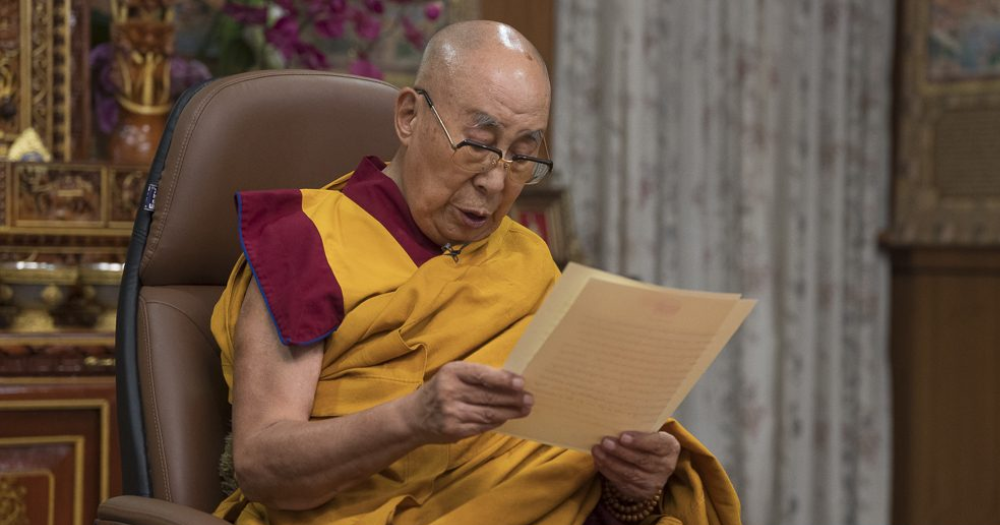
Top image via Dalai Lama