



News

Punggol to be 1st HDB estate to have self-driving vehicles in Q4 2025
Will not take any passengers in the beginning.
June 29, 2025, 06:01 PM
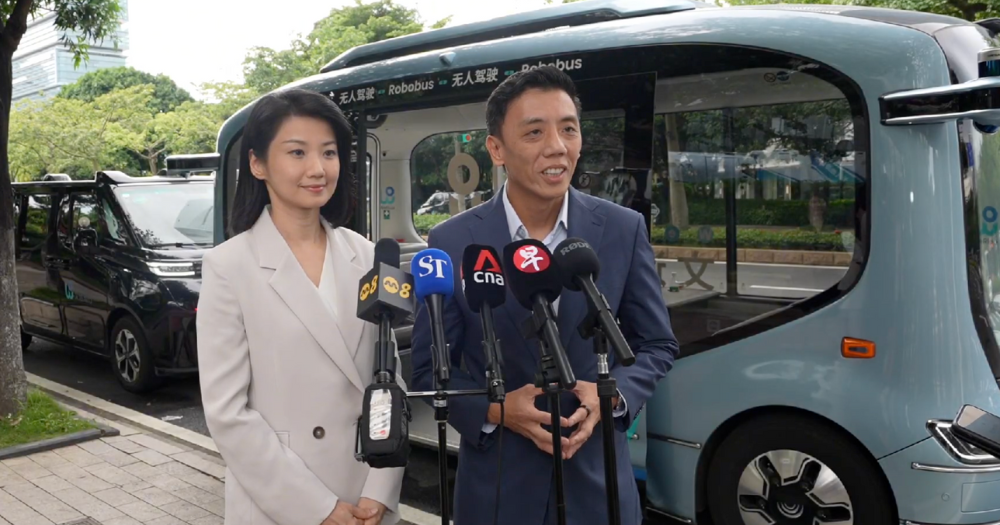


Punggol will be the first Housing and Development Board (HDB) estate to deploy autonomous vehicles (AVs) before the end of 2025.
Autonomous vehicles are also known as self-driving vehicles. Like their name suggests, they can operate without a driver in the vehicle.
At a doorstop in Guangzhou with Senior Minister of State Sun Xueling, Acting Minister for Transport Jeffrey Siow shared that they expect to be able to deploy some AVs in Punggol, where they will try out a fixed route.
Siow added that Punggol is an estate where the travel patterns and road infrastructure are mature, and they have received regular feedback from residents that helped them decide on the routes the AVs will take.
"We know where people want to go, and we know where the AVs can help them."
Siow shared that the aim is to get it on the road by the beginning of the fourth quarter of the year, and it will not take any passengers during the trial.
Safety first
Siow assured that when the AVs are deployed, they will be done so safely.
To ensure safety, AVs will have a safety officer on board, and the speed will be manageable.
The AVs will also be painted in bright colours, such as a yellow light at the top, to "socialise" drivers and residents with their existence, allowing people to see them on the roads.
"For the initial period, we'll probably run them without passengers just so that people know that they are the vehicles on the road, and they get comfortable with them before taking passengers."
"The main thing is just to get the vehicles out there and have them be part of the general landscape first, in a safe manner. And once people are used to seeing them on the roads, then they know how to deal with them, and they realise that actually, there is no real difference from dealing with any other private car."
Siow noted that there are still a few variables to work out, such as collaborating with potential operators and companies that produce AVs, as well as determining the frequency at which to run these routes.
Siow hopes to get the first vehicles on the road in the last quarter of 2025, but he admitted that he is unsure how long the socialisation period will be.
"It could be in the matter of months, and then we begin taking passengers, because we also want to socialise passengers," he said.
Fares for the AVs have also not been determined, but they could range from public transport fares to those of private hire cars or taxis.
"You are taking a short trip within the HDB town to either the MRT station or to the amenities in the estate. It’s not a long trip. It’s a trip that maybe the taxi drivers or the PHC drivers may not really want to do, especially during the peak hour."
If successful, Siow shared that in the new year, they can look to bring AVs to other estates, where Tengah could be the next HDB estate to see AVs.
"I think we want to try it in one particular place first, get really used to how the vehicles can be deployed, and understand how problems emerge and how to solve them. Do that well first before rolling it out to the other HDB estates. So one step at a time, an area we are comfortable with, then we will go with that after that," he added.
He noted that Tengah was designed as a car-lite town, a public transport-heavy town and is a place where AVs will be useful.
Game changer
Siow shared that AVs are going to be a game changer for public transportation.
In the short term, Siow said that AVs could introduce point-to-point fixed route services in HDB estates, making it more convenient for people to travel to MRT stations or places such as mosques, markets, community centres, and hawker centres.
In the long run, AVs could help alleviate manpower constraints, allowing for the introduction of services like night buses. It could also help expand the public transport network, particularly the public buses, more quickly.
Siow added that it could change the nature of driving, allowing for the hire of autonomous vehicles.
"I think over time, people will get used to travelling this way, and the jobs, the humans who are involved in this will change," he added.
Top photo via Ministry of Transport