News

Societies can advance economically, while regressing socially: President Tharman
He delivered the opening keynote address at this year's ICCS Conference.
June 25, 2025, 06:07 PM
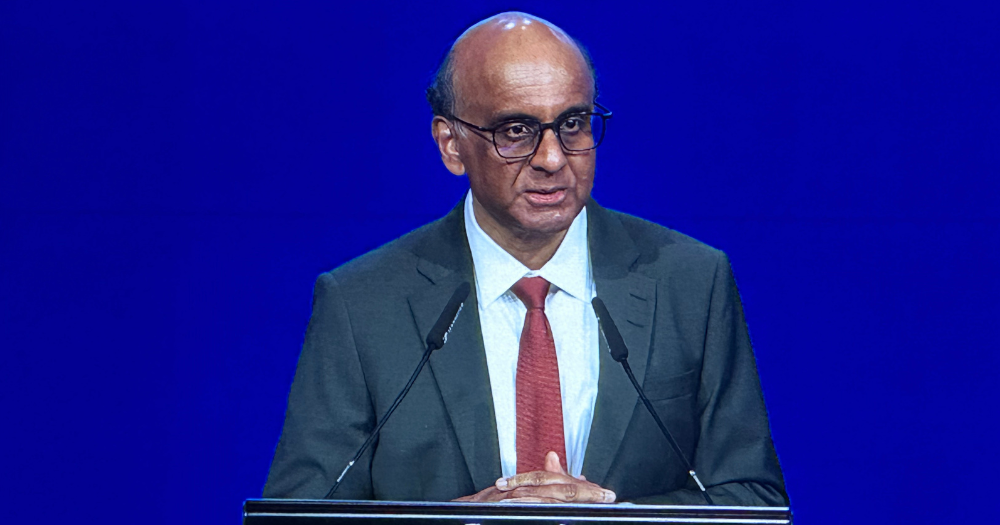


Societies can advance economically, while regressing socially.
That was one of the points President Tharman touched on during his keynote address on the first day of this year's International Conference on Cohesive Societies (ICCS) on Jun. 24.
Leading up to that point, he highlighted how culture and identity are becoming increasingly divisive forces in today's society, in particular, the injection of culture and identity "into economic debates, economic contention".
President Tharman acknowledged that "identity" and "exclusionary views" have always been lurking beneath the surface.
However, he noted that economic insecurity, or at least "the perception that I am losing and someone else is winning" converts identity and culture into a more "virulent" and "divisive political method".
The president was speaking at the ICCS, an international platform for multicultural dialogue that sees leaders and delegates from around the world gathered in Singapore over three days from Jun. 24 to Jun. 26.
This year's conference is the third of its kind, the first being held in 2019, and was organised by Nanyang Technological University's S. Rajaratnam School of International Studies (RSIS).
Delivering the keynote address on the first day of the conference, President Tharman opened by saying that cohesive societies can only be sustained "if people have shared hopes and a shared purpose and...endeavour."
It is no longer enough to have a "coexistence" or "tolerance" of difference races, religions and cultures, he added.
Cultural disparity leads to rise of populist politics
A key aspect of President Tharman's speech focused on the increasing prevalence of populist politics in recent elections, especially in western countries in Europe and the U.S.
Citing a study conducted across U.S., Britain and six other European countries, he highlighted that the belief that minorities have better access to job opportunities than white people is the "single best" predictor on whether someone is likely to vote for a right-wing nationalist party.
Another alarming trend in advanced democracies lies in the increasing social and political divide between the better educated and less, in particular between those with a college education and those without, and between those within the countryside and those in cities, he pointed out.
Culture and identity add "virulence to the feeling that the system is not fair", President Tharman said.
Even in the developing world, culture and religion have become increasingly divisive forces due to their overt presence in politics and the media, he added.
He listed three key forces leading to anti-minority sentiments:
- The failure to control immigration, and to assimilate immigrants into a country;
- The polarising effect of a fragmented media landscape and the propagating of negative messages by social media business models, accentuating partisanship, and
- Growing feelings of isolation, particularly in more advanced countries, leading to reduced exchange and acceptance of different ideas.
It was for the third point that President Tharman made the case that societies can advance economically, while regressing socially.
He pointed to how people were more likely to have meetings at home, shop from home, be entertained at home instead of at movie theatres, and even eat in at home.
It is not only the going out part that has changed, but how even architecture had evolved to match this change, President Tharman said.
Rooms are increasingly being designed for "maximum screen opportunities", which means families are increasingly not even meeting in the living room.
All this, he noted, will lead to a weakening of interactions between people.
"So people are living lives more on their own, and the weakening of interactions that this all means the weakening of interactions to people who live around you...The weakening of those interactions has consequences, because it was those interactions that enabled people to understand differences and to accept people who disagree with them."
So how do we respond to this?
Weaving a tapestry
"The truth is that no political system, democracies included, can give us assurance that moderate integrationist tendencies will prevail in government or amongst the people", President Tharman pointed out.
"We are moving away from integration. We are moving away from moderate tendencies towards more polarising behaviour, views and politics."
Likening a society to a tapestry, President Tharman added that multicultural societies must always "be actively woven" because there are always countervailing sentiments below the surface.
A society must therefore be woven like a batik, not a quilt, he explained.
A quilt is typically made with different patches and designs stitched together.
However, in times of stress, like in economic insecurities or when polarising forces invade societies, the stitches can be easily broken and the quilt forced apart, he said.
A batik, or a patterned fabric made by wax resist and dyeing techniques, on the other hand, represents "a larger motif of a nation in many strengths and many histories, but a nation at one with itself".
Weaving "threads of different colours, even different textures" is what he says will sustain the resilience of multiculturalism.
"It requires, above all, building opportunities for interaction...and that requires putting in place sensible guard rails to prevent extremism" while allowing and encouraging differences in views, he added.
Education
One such form of integration is through public school systems, when children of all backgrounds are brought together regardless of ethnicity and social class.
This is something that Singapore has "put great effort into", President Tharman pointed out.
"Education systems must be effective in uplifting every individual and every group."
Urban design
A second important factor in promoting integration is urban design, referring to Singapore's integrated housing estates, which houses more than 75 per cent of the population.
This helps "to prevent enclaves, ethnically or even socially defined models," President Tharman said, achieved through the "mix of ethnicities in every block, every precinct" and the "mix of people from different income groups, different economic locations, all the way from the poorest to the upper middle income."
Media fragmentation
The third factor President Tharman discussed, and also "the most complex of the problems", is the issue of social media fragmentation and hate speech.
Solving this "requires old thinking", he said, explaining that the government and civil society have to work together to provide a safe landscape for democracy and the removal of hate speech, as per the EU's Digital Services Act.
"It is more regulation than we are used to, but far better to have a regulated media landscape and have some sacrifice to the freedom of the market than to have society gradually unravel."
News outlets, at the same time, need to be "built on accuracy, fairness and transparency...separating news from opinion" in order to restore trust and value in their brands, President Tharman said.
A culture of respect and solidarity
The fourth and final point brought up alluded to a community of respect that "goes to the heart of social cohesion".
Similar to media fragmentation, President Tharman said that this must be achieved with the cooperation of the government and civil society educators, for example religious and community leaders.
Speaking on the Gaza War, he said that Rabbis and Imams around the world have convened prayers and dialogs for peace and faith in diversity.
President Tharman ended his speech by saying that respect is not just a source of unity.
"It is also a source of mutual upliftment."
Top image by Constance Tan/Mothership