



News

Floor tiles at Choa Chu Kang Crescent HDB block lift lobby explode & pop suddenly
Spontaneous.
March 12, 2025, 11:18 AM
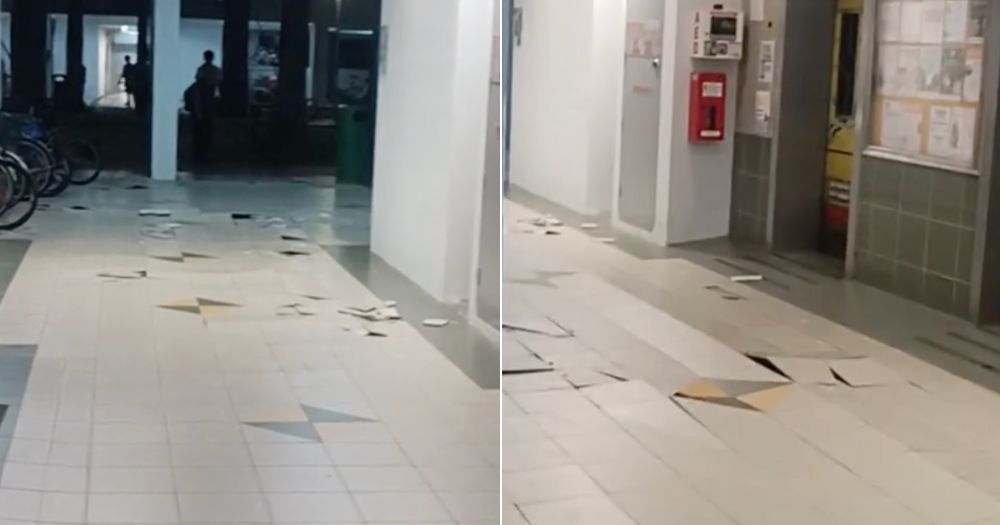


Floor tiles at the lift lobby of a Housing and Development Board (HDB) block in Choa Chu Kang Crescent were seen "exploding" and "popping", leaving a trail of cracked and shattered flooring.
A video of the incident was uploaded on TikTok.
@yunzhonh.qu♬ original sound - yunzhonh qu
Loud popping noise
In the video, loud sounds could be heard as the tiles appeared to "explode" and shatter spontaneously.
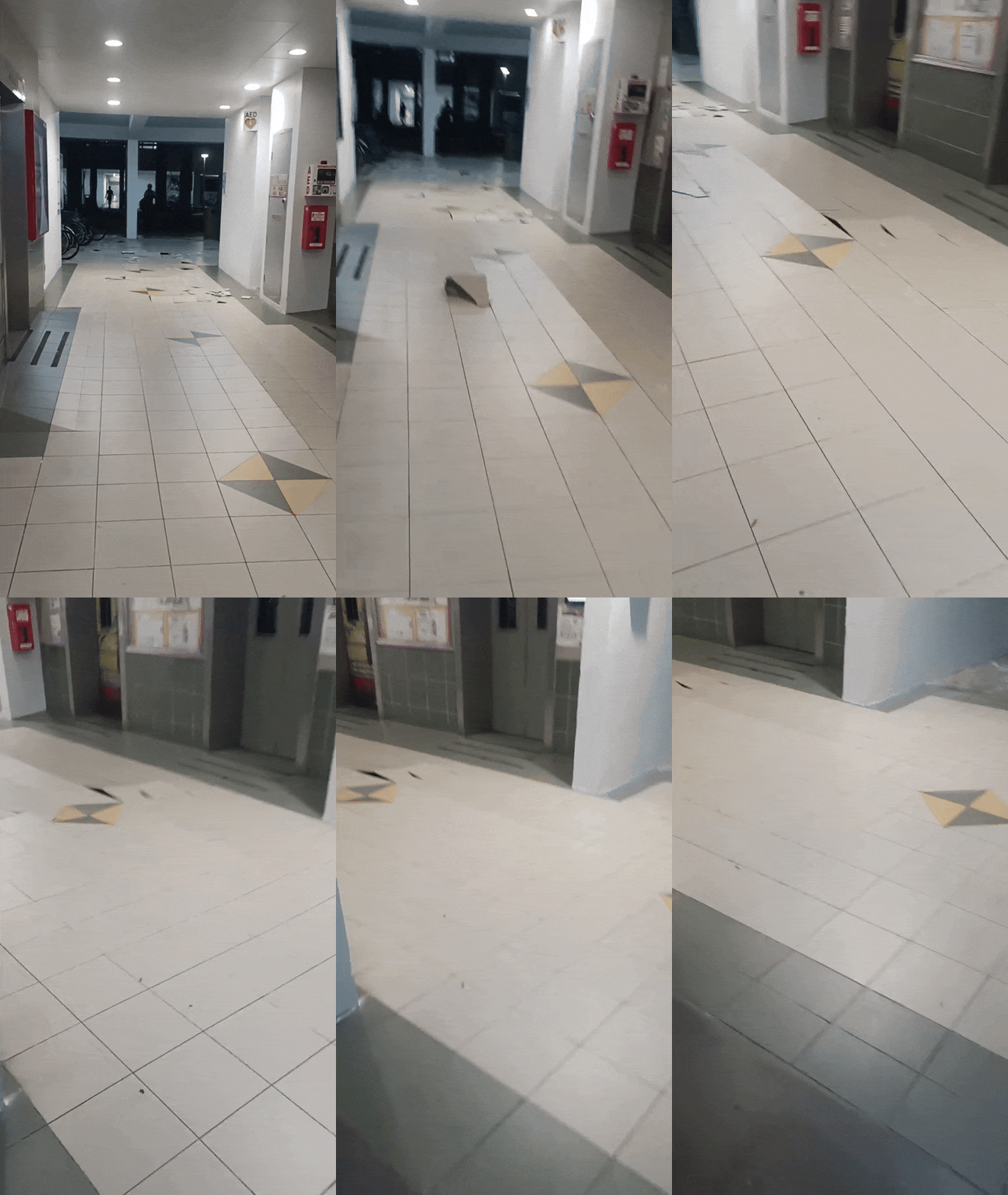 Gif via yunzhonh.qu/TikTok
Some tiles were seen cracking, while some were dislodged.
The person behind the video appeared to move back as the tiles started to pop closer to where the person stood.
A comment on the video identified the location as Block 692A Choa Chu Kang Crescent.
Checks by Mothership showed that the block was completed in 2001.
Mothership has reached out to the town council for more information.
Repairs underway
In a Facebook post, Member of Parliament (MP) Alex Yam stated that repairs for the tiles will take about two weeks to complete.
He clarified that the incident occurred at the lift lobby of Block 691A Choa Chu Kang Crescent.
"Once alerted, our Town Council workers moved in to remove the popped tiles as a safety precaution and they have placed a canvas sheet on the surface to allow residents to access the lobby," he said.
"Our term contractor has already placed an order for the replacement tiles and it will tentatively take about two weeks for repairs to be completed."
He explained that popping tiles are usually due to changes in weather temperature or due to age.
"We seek everyone's patience during this period and apologise for the inconvenience," Yam said, urging residents to be cautious while walking over the uneven surface.
Why do tiles pop?
In January 2020, then-Minister for National Development Lawrence Wong said in a written parliamentary reply that there were more instances of dislodged floor tiles in HDB flats in December 2019 likely due to the colder weather and temperature fluctuations that month.
This could have caused floor tiles and the substrate to contract and expand at different rates, which could result in the loss of adhesion between the tiles and the substrate, said Wong.
In 2017, the Ministry of National Development (MND) said in response to parliamentary questions that HDB received about 2,000 cases of dislodged floor tiles a year.
"Tiles, like all fittings, fixtures and finishes in a flat, are subject to wear and tear over time," they said.
They may dislodge due to various reasons, such as differential thermal expansion and contraction of tiles, or the natural deterioration of the bond between the tiles and the screed surface.
For cases of tiles popping in individuals' homes, MND said flat owners are responsible for the maintenance of their flats, including repairs for general wear and tear.
It has been explained as well that tiles may "pop" due to design or construction issues associated with tile, grout, movement joints, or surface preparation.
This happens when temperature or moisture changes cause stress between the tile and adhesive or between the adhesive and the concrete.
If movement joints or grout joints are too narrow, the stress builds up like a "stretched rubber band" and eventually causes the tile to pop when the bond can no longer hold.
Related story
Top photos from yunzhonh.qu/TikTok