News

More GRCs in S'pore since 1988 but they've become smaller, explained
And what are some of the criticisms against the GRC system?
March 12, 2025, 04:16 PM


The Electoral Boundaries Review Committee (EBRC) report was released on Mar. 11, 2025.
Three Group Representative Constituencies (GRCs) — West Coast, Jurong, and Pasir-Ris Punggol — were dissolved due to population growth while five new GRCs were created.
The five new GRCs are Punggol, Pasir-Ris Changi, Marine Parade-Braddell Heights, Jurong East-Bukit Batok and West Coast-Jurong West.
You might also be asking yourself at this point: what is the purpose of GRCs again?
Introduced in 1988 to ensure minority representation
GRCs were first introduced in 1988 on the basis of ensuring multiracial representation in Parliament. Each GRC has to have at least one MP from a minority community.
Under the the Constitution and in the Presidential Elections Act, GRCs can have three to six MPs each and there must be a minimum of eight Single Member Constituencies (SMCs).
According to then-Prime Minister Lee Hsien Loong in a speech in 2009, the introduction of GRCs was done to encourage political parties to appeal to all races with moderate policies, and not to one race or another with chauvinist or extreme policies.
In addition, the GRCs also put a premium on parties which can field credible teams and therefore demonstrate that they are fit not just to become MPs but to form the government, he said.
As for the requirement to have eight SMCs, it is meant to keep the entry barriers low, which means small parties and independent candidates can still participate in the elections, Lee added.
Number of GRCs has gone up while average size has decreased
At the time of the scheme's introduction, 13 GRCs were introduced, representing 39 out of the 81 seats in Parliament at that time.
The number of GRCs increased in subsequent elections and by the 2011 General Election, there were 15 GRCs representing 75 out of 87 parliamentary seats.
Of these, two GRCs had four Members of Parliament (MP), 11, including Aljunied, had five MPs, and the remaining two had 6 MPs.
The 2011 General Election was also a watershed moment as it marked the first time an opposition party — the Workers' Party — captured a GRC.
During the 2015 General Election, the number of GRCs introduced was increased to 16.
However, the average size of the GRCs, in terms of the number of MPs, went down.
There were six 4-MP GRCs, eight 5-MP GRCs, and two 6-MP GRCs.
For the 2020 General Election, the number of GRCs increased to 17.
This time, there were six 4-MP GRCs and 11 5-MP GRCs. There were no GRCs with six MPs.
And the trend of downsizing appears to be continuing for the upcoming 2025 General Election.
Of the 18 GRCs announced, 10 are 5-MP GRCs, while the remaining eight are 4-MP GRCs.
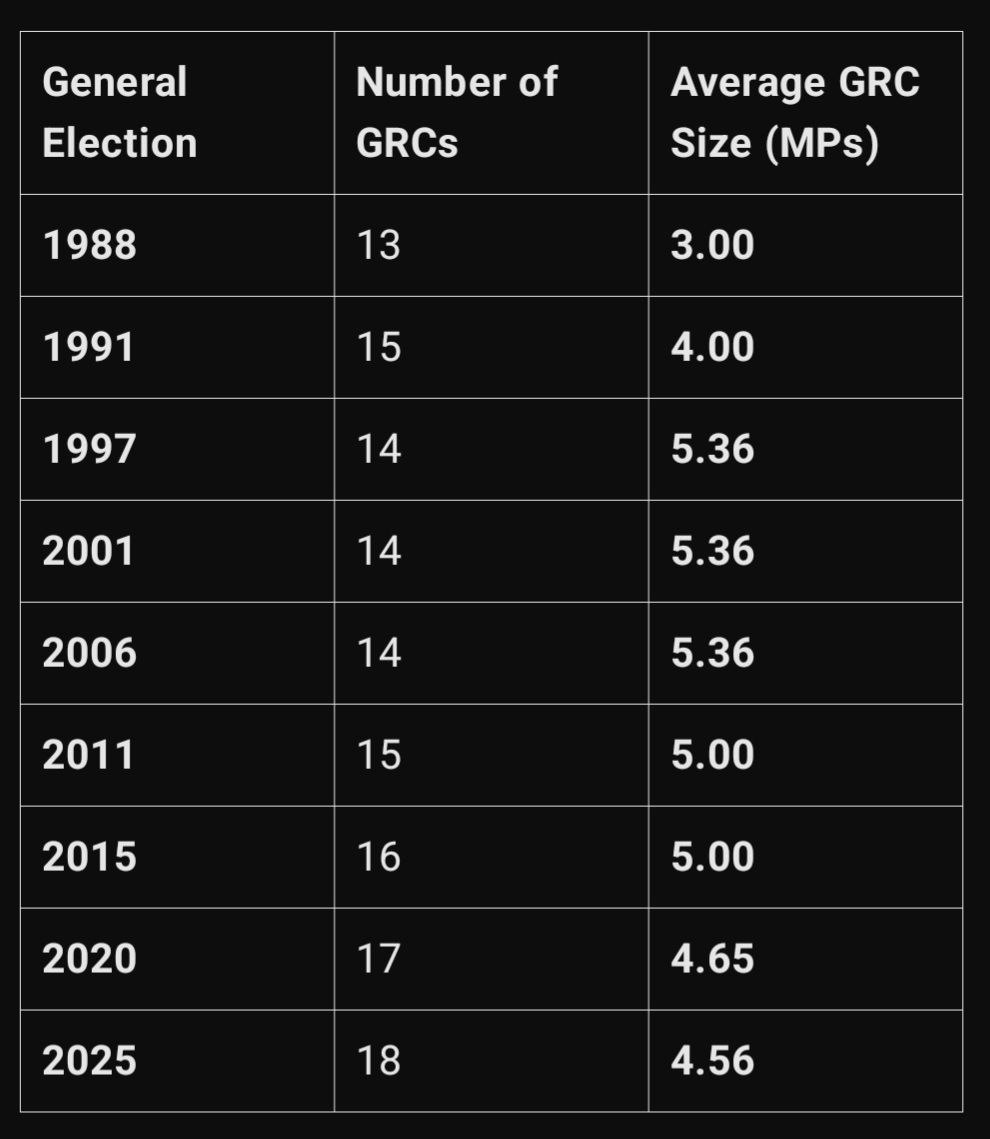 Average size of GRCs in terms of no. of MPs since 1988.
Why has the number of GRCs been going up while their sizes are shrinking?
In his 2009 speech, Lee said bigger GRCs enable stronger multiracial teams to be formed with MPs who have different backgrounds and skills,.
They also require challengers to field a "strong team" and offer a serious alternative to have a chance to win.
"Therefore, bigger GRCs encourage responsible and credible Opposition parties to emerge," he added.
However, he also acknowledged that there are some downsides to having too big a GRC as it becomes harder for voters to identify with the whole GRC or with the whole GRC team.
Lee explained:
"The members split up, so the voter knows who is looking after his area but for the other MPs, he may not have quite as close a relationship. Each MP has to look after his own ward in the GRC and, therefore, it is not easy for him or her to get to know the voters in all of the other wards."
Lee then highlighted that the government has concluded from their experience that smaller GRCs (less than six members) have the edge over larger GRCs (six-member GRCs).
He reiterated this again in January 2016, when he said a bigger GRC benefits from having an anchor Minister to take care of their affairs, as well as having better economies of scale in running GRC-wide programmes and activities, and in running the town council.
However, smaller GRCs create a closer connection between MPs and their residents while SMCs give the MP direct responsibility for everything that happens in his constituency.
He then added that when he appoints the EBRC, he will instruct it to reduce the average size of GRCs further, and to create more SMCs.
Criticism of the GRC system
The GRC system has its detractors and their most common criticism is that it allows less viable candidates to ride on the coattails of more established or popular MPs into Parliament.
In an Academia.sg piece, a lawyer at Peter & Choo LLC, Priscilla Chia, explained that under the GRC scheme, voters are forced to vote for candidates they may see as undesirable so that other candidates they like also enter Parliament.
However, Chia highlighted that voters do not want candidates to receive a "complimentary entry pass".
She cited the case of Ivan Lim, a potential candidate fielded by the People's Action Party (PAP) in Jurong GRC who attracted widespread criticism during the 2020 General Election.
Lim ended up withdrawing his candidacy before Nomination Day.
Jurong GRC included then-Senior Minister Tharman Shanmugaratnam, who would win the constituency with 74.62 per cent of the vote — the best-performing People's Action Party (PAP) team in that year's General Election.
Such an incident, said Chia, is indicative of how voters want each candidate to prove their individual worth at the ballot box..
Changes to the GRC system cannot be viewed in isolation from changes to the other schemes
It is perhaps worth remembering at this point, that when Lee shared about the purpose of the GRCs in his 2009 speech, it was done so in the context of changes that also were being made to the NCMP, SMC and Nominated Member of Parliament (NMP) schemes.
According to Lee, these changes would ensure there are at least 12 SMCs, at least nine Opposition members and nine Nominated MPs, so that there will be at least 18 members who are not from the ruling party, which is about one-fifth of the House.
Lee explained:
"These changes are not to entrench any one party, nor to deliberately result in weakened governments. They update our political system so that it reflects better the aspirations of Singaporeans. They provide adequate voice for diverse views in Parliament, including non-partisan views and those who have voted for the Opposition.
He also added:
"The changes to smaller GRCs and more SMCs may or may not result in more seats being contested or more Opposition MPs being elected. That is not their purpose."
Lee then concluded:
"Ultimately, it is up to the Opposition MPs to field candidates to contest elections and up to the voters to decide who they want to represent them in Parliament.
The purpose of these changes is to make the GRCs scheme work better and to strengthen the link between voters and their MPs.
We want voters to have a strong incentive to vote for candidates who will do the best job of looking after their interests, representing them in Parliament and forming a government to run the country."

Top photo via Jurong GRC/Facebook