Perspectives

'I was crying everyday': Syrian eatery owner in S'pore shares struggle of fleeing civil war, realising returning home is impossible
Hadi also shared about how he eventually decided to cut off from reading the news about his country to preserve his mental health.
March 22, 2025, 11:27 AM
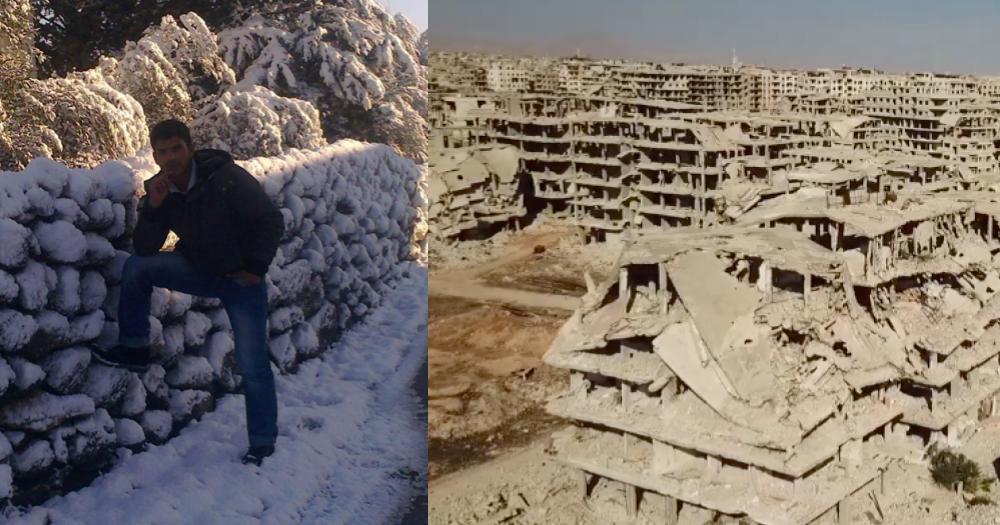


Firsthand: In April 2012, Abdulhadi Al Saadi (also known as Hadi), left his home country of Syria as the civil war in the country began to escalate.
In June 2023, he established Damascus Delights at Tampines MRT station, an eatery that serves authentic Syrian cuisine in the form of shawarma.
Previously, in the first part of our interview, he spoke about what life was like in Syria before the civil war, the brainwashing he experienced as a child in support of the country's dictator, and what he saw when the Syrian government decided to subject the city where the first protests broke out to a full-blown siege.
In the second portion of Mothership's three-part interview with Hadi, he shares with us the struggle to keep up with his education as he moved from Lebanon to Egypt to Malaysia, the emotional turmoil he experienced amidst the realisation that returning to his home and former life would no longer be possible, how it affected his mental health and his decision to eventually stop reading the news about what was happening in Syria.
From the moment he left Syria for Lebanon in 2012, things were "tough", Hadi said.
"I was crying every day," the 28-year-old told me when I asked him how he felt following the news about Syria.
"I was following (the news) heavily...because we want to know when (the conflict) stops so we can go back," he added.
"What happened? When can we come back? Did he (Syria's then-President Bashar Al-Assad) fall already? Did the president run away or something?" Hadi said.
More importantly, he wanted to know when he could resume his daily life.
In recounting the full emotional toll of being uprooted, Hadi said :
"I (wanted) to go back to my school, I missed my school so much. I was crying everyday because this is my life. This is where I was born and I have my friends, you know, my cousins, all these people...(my) neighbourhood."
Family thought the situation would calm down quickly at first
Hadi acknowledged that he is "fortunate" in the way that he left his country, as he did not have to do so as a refugee.
"We went [through the] proper channels," the 28-year-old said, regarding his entry into Lebanon.
In addition, his siblings helped to facilitate their exit from the country.
Still, the decision to leave Syria was not unanimous amongst his family at first, he added.
Following the government's siege of Daraa in April 2011, a city just five kilometres from their village, the family decided to take a vote on whether they should move.
"Some of my family members [didn't] want to move," he said.
They were still of the opinion that the situation would calm down quickly and thought there might be an event like a military coup to stabilise things.
In the end, following some convincing by one of his brothers, the family came to a decision to move to Lebanon in the hopes that they could come back after a short while.
By April 2012, all of them — his mother, eight brothers, including himself, and six sisters — had all left the country.
Hadi added that a few of his siblings who had already established their own lives in other countries also moved to those countries upon leaving Syria, including a sister who went to the UAE and a brother who went to Malaysia to start up a restaurant.
"Whatever happens in Syria will also affect Lebanon"
As for the family members who moved to Lebanon, they ended up staying at a border town for three months, before deciding to make another move to Egypt.
Hadi admitted to me that he does not recall the name of the town very clearly, as he did not ask his family where exactly they were going to in Lebanon.
"As a child, I wouldn't question which city we are in, to that extent," he said.
During this time, Hadi's brother enrolled him in a private school for Syrians living in Lebanon, to ensure he did not fall behind.
Even though the school operated on the same system as schools in Syria, Hadi said it was still a "tough" time for him.
In addition, "whatever happens in Syria, Lebanon will be affected," Hadi pointed out.
In May 2012, Foreign Policy reported that the influx of Syrians into Lebanon strained the country's own domestic security situation, with violence at one point breaking out in the Lebanese city of Tripoli between factions who opposed and supported Assad's regime.
Another incident of violence in June 2012 in Tripoli between pro- and anti-Assad regime fighters left at least 12 people dead and 50 people wounded, CNN reported.
Within Lebanon itself, support for Assad's regime in Lebanon includes the militant group Hezbollah which would eventually intervene in the Syrian civil war on the side of the Syrian government in 2013, according to The Guardian.
Moving to Egypt for two and a half years, moved back by a year during enrollment in school
At the same time, Egypt appeared to be stabilising following the deposition of its longtime ruling president, Hosni Mubarak in 2011, Hadi pointed out.
A new Egyptian president, Mohammed Morsi, had been elected in June 2012 and he pursued a policy of welcoming Syrian refugees.
Under his government, Syrians could access Egypt's public schools and healthcare facilities, at a level similar to that of Egyptians, The Guardian reported.
A best friend of Hadi's eldest brother, an Egyptian engineer who worked in Syria, also offered to help the family relocate.
The family thus decided to accept the engineer's offer in light of the developments in Lebanon and Egypt.
Initially, they lived at the friend's house — a "big house" because he was earning a comfortable amount as an engineer, Hadi recalled.
The family was then able to move into another house and Hadi was enrolled in school again.
This time however, he was moved back by a year, which he found upsetting.
He also found school much more challenging for a variety of reasons.
"I needed to study again, new system, the (Arabic) dialect is different (by) quite a little bit and I didn't understand much from the teachers in school. I had to take tuition just to get back on track," he said.
Ultimately however, he found himself thankful that he was moved back by a year during his enrollment as it gave him the time he needed to attain his high school certificate.
The situation would not last, however.
Egypt undergoes a military coup
On Jul. 3, 2013, current Egyptian President and then-army chief Abdel Fattah el-Sisi announced the overthrow of Morsi, as well as the suspension of the country's constitution and the installment of an interim government, according to Al Jazeera.
Morsi's overthrow followed massive protests that had taken place just a few days earlier on Jun. 30, 2013 by the Egyptian public across the country.
Al Jazeera reported that the Egyptian pound had lost nearly 20 per cent of its value since he assumed office and that businesses had been brought to a standstill by shortages of fuel and electricity.
Apart from the country's economic problems, many members of the public also complained that Morsi had done little to rein in abuses by Egypt's security services.
Public opposition also stemmed from how he had passed a decree in November 2012 granting himself far-reaching powers, according to the BBC.
The Jun. 30 protests saw outbreaks of violence between Morsi's supporters and protestors, along with the appearance of military vehicles on the streets of Cairo.
The army would eventually launch its own crackdown in August 2013 on Morsi's supporters, killing over 1,200 people, Al Jazeera reported.
In addition, Morsi's overthrow also saw the outbreak of hostility towards Syrians in Egypt, with Syrians being accused of supporting Morsi's political party, the Muslim Brotherhood, according to The Guardian.
For Hadi and his family however, it was the appearance of the military vehicles which they found frightening, as it brought back memories of the Syrian army being used to quell the protests in Daraa.
Hadi summed up his family's reaction as such, "Once you see the army in the street, flee, run away."
This time, the family decided to leave the region and join their brother who had opened a restaurant in Malaysia.
"I hope nobody goes through what the Syrian people have gone through"
Hadi acknowledged that he was fortunate in the sense that he had family members to help him whenever he moved to a new country.
"I did not go at any point to a country where I had nobody," he said.
Still, it was the move to Malaysia in September 2015 which he found the hardest and the point where he broke down.
"I realised that I'm not a child anymore," he said.
He also realised from the news that the situation in Syria was getting worse.
At this point, constantly following the news out of Syria began to take a toll on his health, he added.
He questioned why Assad still clung to power even though the country by this point was like "the Stone Age", he said. Assad's forces were responsible for massacres of civilians during the war, including Tadamon in 2013.
"I started falling sick hearing the news and seeing the disasters and destruction. And you have got nothing, you can't do anything (about it)," Hadi pointed out.
He was in a state of "breakdown", he admitted.
Such was the emotional toll of the news that Hadi also found himself unable to focus on studying, when his brother enrolled him in a college near the restaurant.
2014 onwards also marked a growing exodus of Syrians fleeing by boat over the Mediterranean Sea — a crisis that would eventually reach its peak in 2015.
It was a journey that would also be marked by death, with 3,600 refugees recorded to have drowned by December 2015, according to TIME.
"It's heartbreaking, you know," Hadi said, recalling the images of his fellow Syrians attempting to reach Europe in a boat, or sheltering in a tent in winter at the height of the country's civil war.
"And honestly, now I have children, now I know what their parents (felt) — how desperate they were to take the risk (of fleeing)," he said.
"The sea in front of you and death behind, you choose," Hadi added.
"I hope nobody goes through what the Syrian people have gone through," he said.
The year 2014 saw the Islamic State terrorist organisation sweep in from Iraq and seize control of multiple areas in Syria, including the city of Raqqa, according to The Guardian.
The same year also saw Assad hold an election in June in which he won 88.7 per cent of the vote, thereby giving him a third seven-year term in office despite the civil war, Al Jazeera reported.
Voting was held only in areas controlled by the Syrian government, thereby excluding huge swaths of northern and eastern Syria that were in rebel hands.
The vote was denounced as a farce by the U.S. and the European Union.
By July 2015, more than 4 million Syrians had fled the country, with then United Nations High Commissioner for Refugees (UNHCR) António Guterres describing the situation as the "biggest refugee population from a single conflict in a generation."
Cutting off from the news, focusing on working in his family's restaurant
Eventually, on the advice of his siblings, he decided to stop following the news.
If he saw news of the civil war pop up on his social media, he would force himself not to take interest in it.
Hadi summed up his siblings advice as such, "Quit this, it's none of your business, (there's) nothing you can help about, just focus on your life."
And the decision worked.
He found his mental health slowly recovering once he stopped following the reports.
Hadi also decided to help out at his family's restaurant, although this was done in a gradual manner, he added.
At first, he would just sit outside the restaurant and watch people.
He subsequently began striking up conversations with the customers and playing music out the restaurant.
Eventually, he became bored of this and decided to help out in the restaurant's kitchen, eventually clocking in working hours that started at 10am and ended at 2:30 to 3am.
Hadi found he no longer had time to think about what was happening in Syria.
It also meant he started to form new daily habits and became more focused on a new goal: earning his own money.
Earning his first paycheque was "nice", he told with me a smile.
More importantly however, the restaurant was where he would also meet his future wife, a Singaporean and a regular customer.
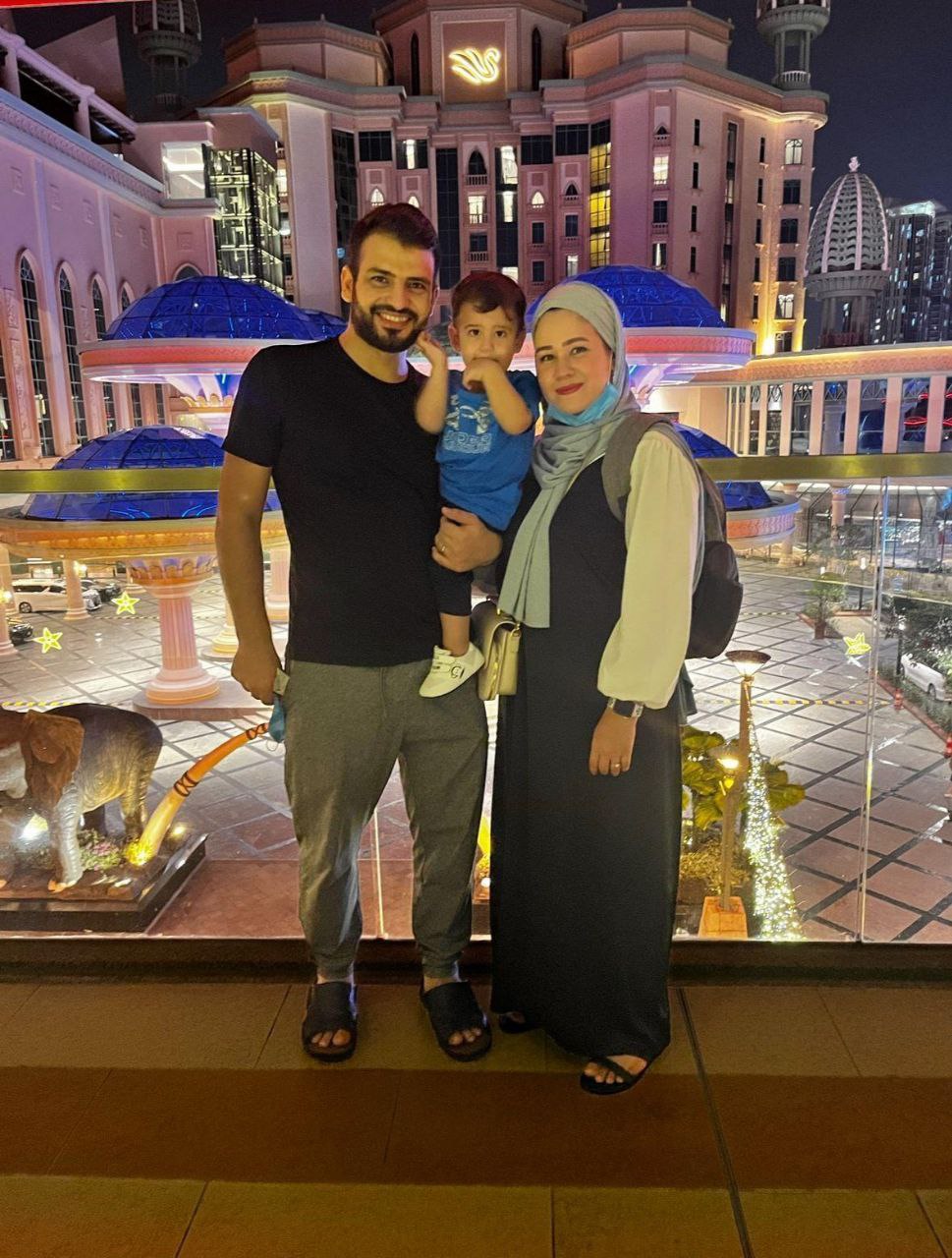 Hadi with his wife and children. Photo courtesy of Hadi.
Left image courtesy of Hadi, right image via The Guardian/YouTube