


News

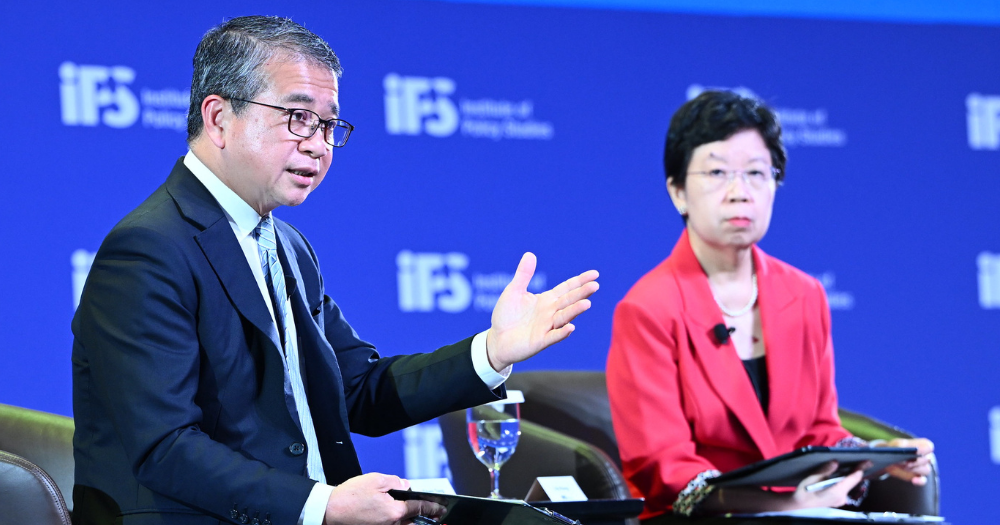
Govt seeks 'plurality of voices' & accepts contrary views as long as they are constructive: Edwin Tong
AWARE executive director Corinna Lim asked Tong about the fear of participating in advocacy in Singapore.
January 21, 2025, 11:27 AM


How do we assure people that it is okay to pursue advocacy in Singapore? Is the Ethnic Integration Policy still relevant for Singapore today? What can we do to make our community centres more engaging?
These were just some of the questions addressed to Minister for Culture, Community and Youth Edwin Tong at the Institute of Policy Studies’ (IPS) Singapore Perspectives 2025 conference on Jan. 20, 2025, by students, activists, and civil servants alike.
Before the question and answer session, Tong delivered a closing speech at the conference on the importance of maintaining social cohesion and fostering a collective "we" mindset.
On civil society and the fear of being an advocate
Before Tong's speech, speakers had earlier spoken during the conference on the status and role of civil society in Singapore.
Executive director of the Association of Women for Action and Research (AWARE) Corinna Lim, following up on those discussions, asked Tong about fears faced by those looking to participate in advocacy and the effects such fears might have on civil society in Singapore.
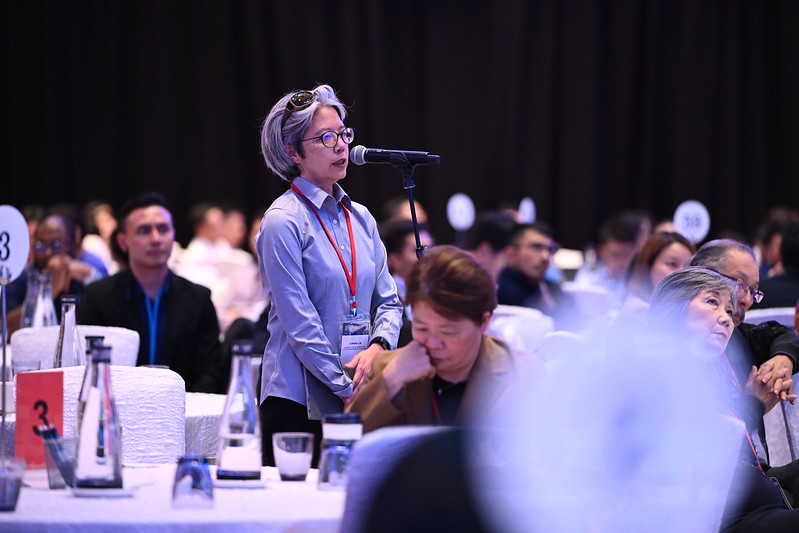 Corinna Lim asks Tong about civil society and fears of advocacy. Photo by Jacky Ho/IPS.
Lim: "So, we've heard from some of our friends who are doing advocacy that it's very difficult to register themselves, either as a society or as a company. They could be delayed for a year or not get registered at all.
And this, of course, impacts their ability to grow, because without registration, people won't fund you. Secondly, among the social service agencies who want to work with us and who have good points and this, of course, they have a lot of experience on the ground, they're scared of actually being seen to have dissenting views of participating in advocacy, and they ask us, "How come you can do it?" And I'm like, "It's okay in Singapore."
So there is a fear, even if it is okay among many groups, especially those who receive funding from the government to participate in this way. Services, they say, are welcome, but different ideas may not be, and I think that we do support it by not encouraging this. Thank you."
Tong: "...Well, Corinna, I mean, the fact is, you're here, speaking your mind in this forum.
I think the fact that you're here hopefully illustrates the point, tells other people that.
And I'm sure you are not in fear, and I've known you for so many decades, you know, it won't spook you. And I think this is the way in which we would like to progress as a society.
I mentioned in my speech earlier, we do want to see a plurality of voices, but it's also got to be seen in the context. It's not just, according to a contrarian voice for the sake of being contrarian.
It's got to, as I said earlier, fit into the entire compact. It's got to also be seen in the context of other multifaceted and interconnected features that progress.
And so I think it's really about that, and if you are able to come and offer a view that helps us to move the deal, allows us to reflect on change or what we can do better, and how we can maybe be reorganising our social service sectors, which you mentioned, so that we can encompass and serve in all the spectrum of beneficiaries, yes, of course, certainly I don't see why anyone should be afraid of speaking up..."
"So by definition, I really have no difficulty with people coming forward and expressing a contrary view, but also being constructive and offering a solution."
On the Ethnic Integration Policy and Private Housing
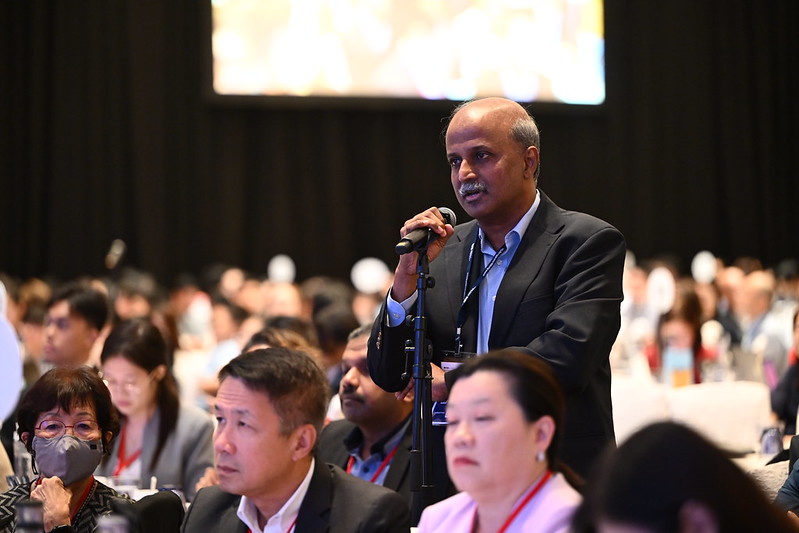 Photo by Jacky Ho/IPS.
Chairman of the Singapore Democratic Party (SDP) Paul Anantharajah Tambyah raised a question on the Ethnic Integration Policy (EIP) and housing.
The EIP stipulates the ratio of flats within neighbourhoods for different ethnic groups in HDB housing, with the quotas and ratios having changed over the years.
According to the Housing and Development Board (HDB), the policy "ensures that there is a balanced mix of the various ethnic communities in HDB towns."
The EIP, however, only covers public housing and does not apply to private housing.
Tambyah: "If the government believes that the EIP (Ethnic Integration Policy) is so important for integration, will this be rolled out to GCBs (Good Class Bungalows), landed properties and condominiums? And if not, doesn't this add fuel to the common view that there's one rule in Singapore for the rich and one for the rest?"
Tong: "...EIP is important because in the context of public estates, 85 per cent of the population live in HDB estates. There are grants that are given, different types of grants from different locations, and the way in which flats are selected through these grants, as well, is also a nudge.
So it's in a sense, for the government to control it's easier, because the grants are granted, sales are that way, and we can then look at this across the spectrum.
It's harder to do in the context of rental and tenancy in the private estates, as you might imagine.
And I'm not so sure that it is great to bump it up, and say that there are therefore different laws that apply to rich and not-so-rich. And I think we take the surrogate as on private property as a marker for income, it may not always apply, in all cases, so I would beg to differ with you on this.
You got to look at the space you interact as well. You look at the HDB estate for example, there's a coffee shop, there's a market, there's a hawker centre, there are provision shops around, there are schools around.
There is a stronger sense of that community, and it's important that that community be intermixed as much as possible. Local, foreigner, and even within Singapore…and I believe that is a very important consideration for us as we look at multiculturalism."
On how to make community centres more engaging
The theme of Singapore Perspectives 2025 was "Community".
On the topic of community, one attendee raised a question about how community centres (CCs) might be improved.
Attendee: "What is your plan in terms of transforming community centres, as today's theme is community, because I have observed over the years that the community centre is no longer a place where people really gather.
And the way it's designed, when you walk in there, they seem to put the reception as far away as possible so that people don't go to the reception.
And it's almost like transactional, and I hope that the compensation packages for People Association (PA) staff who've been measured on how many returning participants and how much engagement they do, rather than trying to stay away."
Tong: "On the CCs, I get your point. Yes, it's not as if they're trying to shy away from people, but we try as far as the previous designs wanted, to enhance the spaces that were more prominent for more common activities, rather than put the offices there.
I get your point about accessibility. Maybe we can direct all of the walk-ins to the spaces to the reception, but we wanted to keep the spaces at the forefront in the forecourt either for commercial spaces or for programs that residents can take part in more easily.
And I will certainly take into account your point about having engagement or returning engagees as one KPI (Key Performance Indicator) for our staff."
Top photo from Jacky Ho/IPS